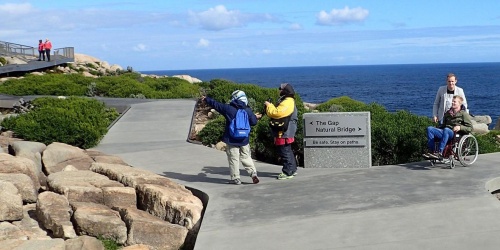
DBCA manages about 34 million hectares of national parks, marine parks and other conservation reserves across the State supporting industries such as nature-based tourism, under the Conservation and Land Management Act 1984.
DBCA also manages biodiversity across the State and regulates its protection and use under the Biodiversity Conservation Act 2016.
In performing these management responsibilities, DBCA grants licences, permits and other authorities for a range of activities, uses and development.
Stop the clock position statement
The Stop the clock position statement was developed as part of whole-of-government Approvals Reform and is being rolled out across regulatory agencies.
The position statement can be viewed on the Approvals WA website linked below, along with a list of frequently asked questions and other relevant information:
https://www.wa.gov.au/government/publications/stop-the-clock-position-statement
Parallel decision making
In accordance with the WA Government’s response to the Independent Review of WA Environmental Approvals Processes and Procedures, legislative amendments have been made to the Environmental Protection Act 1986 (EP Act) to enable parallel decision-making for proposals that are subject to Part IV EP Act assessment. Proposals that are subject to such assessment may also require approvals from DBCA.
Further information regarding the recent parallel decision-making reforms can be found on the WA Government website, including the Parallel Decision-Making Policy. Under this policy, any applications seeking approval from DBCA can be parallel approved or parallel processed.
Parallel approvals
This new process enables DBCA to approve applications while a proposal is subject to a Part IV assessment. This process is suitable if a proposal requires a secondary approval from DBCA. Relevant approvals include:
| # | Decision (Approval) | Legislative reference |
|---|---|---|
| 1 | Licence to take fauna for biological assessment | r. 27 of the Biodiversity Conservation Regulations 2018 |
| 2 | Approval on a case-by-case basis for the grant of a licence to authorise access to land or waters managed under the Conservation and Land Management Act 1984 | Part VIII of Conservation and Land Management Act 1984 |
Parallel processing
Where proposals are not eligible for parallel approvals, DBCA can assess them in parallel with the Part IV EP Act assessment. DBCA can finalise decisions once the Minister for the Environment’s decision under the EP Act has been made. Relevant approvals include:
| # | Decision (Approval) | Legislative reference |
|---|---|---|
| 1 | Authorisation to take a threatened species | s.40 of the Biodiversity Conservation Act 2016 |
| 2 | Authorisation to disturb a threatened ecological community | s.45 of the Biodiversity Conservation Act 2016 |
| 3 | Approval of development in development control areas | s. 80(2)(c) of the Swan and Canning Rivers Management Act 2006 |
| 4 | Approval of a proposed management plan | s.8 and s.54 of the Conservation and Land Management Act 1984 |
| 5 | Approval for the grant of a lease over land or waters managed under the Conservation and Land Management Act 1984 | Part VIII of the Conservation and Land Management Act 1984 |
| 6 | Approval for tenure amendments to land or waters managed under the Conservation and Land Management Act 1984 | s.9, 10A, 10, 17(6a) of the Conservation and Land Management Act 1984, s.45 and s. 46 of the Land Administration Act 1997 |
Preparing your application with DBCA
To streamline your assessment, we encourage you to provide detailed, quality information with your referral and applications as this can help reduce timeframes. Our Regulatory Documents page for licences and permits and authorisations provides information to assist you with preparing your application.
Preparing and submitting your proposal to DWER for EPA assessment (Part IV)
If you are submitting a proposal under Part IV of the EP Act for assessment, we encourage you to discuss your proposals with DWER, so they can work with you to scope your requirements, look at your assessment options, and provide guidance on processes and fees. Please refer to the EPA website and DWER’s One stop shop page for further information.
Frequently asked questions - Parallel decision-making
| Background | |
| Background | New legislative reforms to the EP Act to enable decision making authorities (DMAs) to make decisions in parallel to an environment assessment process under Part IV of the EP Act under s.41(3) by enabling DMAs to make decisions about a proposal in parallel to an environment assessment process. The parallel Decision-Making Policy will guide DMAs in appropriately processing and issuing decisions in parallel to a Part IV assessment. |
| What is parallel decision-making? | The parallel decision-making reforms enable DMAs to make decisions in parallel to an environmental assessment process undertaken by the Environmental Protection Authority (EPA) under Part IV of the EP Act (a part IV assessment). This means that decisions can be made where appropriate – meaning proposals can be processed or approved in parallel. It is important to note that the prohibition on implementing a proposal before the Part IV assessment process is complete remains in place. |
| What has changed? | These reforms amended section 41 of the EP Act to allow other Government regulators to process and issue their own approvals in relation to a proposal while a Part IV assessment is underway. |
| Why have the parallel decision-making reforms been introduced? | To respond to the Independent Review of WA Environmental Approvals Processes and Procedures, which is aligned to WA Government’s objectives to maintain Western Australia’s rich biodiversity and natural environments. The review outlined there are several areas for improvement in areas where there is duplication, lacking coordination, culture, resourcing, and communications in Western Australia’s environmental regime. |
| Implementation of proposals | |
| Can proponents implement a proposal before the Part IV assessment is complete? | No – To ensure robust protections for the environment are maintained, the reforms make clear that no decision made in parallel to a Part IV assessment will have the effect of authorising a proposal to be implemented. Proponents will also still be legally prevented from implementing a proposal under s.41A of the EP Act. |
| What are the penalties for non-compliance? | New penalties apply to reflect the seriousness of implementing a proposal before a Part IV assessment process is finalised. Penalties have doubled as follows:
|
| Benefits | |
| When can proponents expect to start having their approvals decided in parallel? | The parallel decision-making provisions are now in effect. The decision timeframe on secondary approvals will depend on the specifics of each application, the requirements of the relevant decision-making authority, and any timeframes set by other legislative frameworks. Agencies are expected to begin parallel processing and approving applications, where appropriate and in accordance with the Parallel Decision-Making Policy. |
| What are the benefits of the parallel decision-making reforms? | Faster processing: These reforms will reduce the time it takes for proposals to be considered, and if appropriate, implemented. This means important projects that respond to the needs of Western Australians can move forward more quickly, benefiting the community, businesses, and the entire State. Environmental protection: By allowing other decisions to be made, these reforms ensure that every aspect of a proposal is thoroughly reviewed by expert regulatory agencies. Where appropriate, this advice will be considered by the EPA when making recommendations, ensuring environmental and human health concerns are fully addressed. Increased efficiency: This reform aims to make the decision-making process more efficient and reduce unnecessary delays. This will help maintain the thoroughness and independence of environmental assessment while speeding up the overall process. |
| Where can I find more information? | The Parallel Decision-Making Policy, published on the WA Government Streamline WA website, details how parallel decision-making is to be implemented across government. |

Related

Contributing to action on climate change
Climate change is having an impact on Western Australia’s natural environment. DBCA is committed to actions to better understand, adapt and mitigate those impacts on lands, waters and attractions managed by the department. We are committed to playing our part in a whole-of-government response.