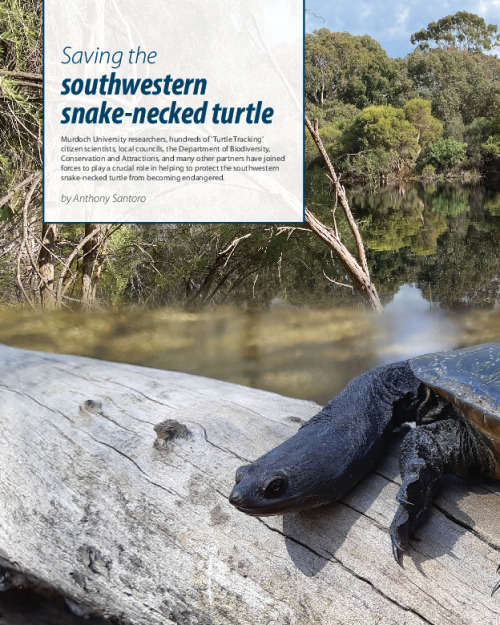
Most residents of Perth and the wider south-west of Western Australia will be familiar with the southwestern snake-necked turtle (Chelodina oblonga), so named because of its occurrence in the south-west of the State as well as its long neck, which can be almost half the total length of the turtles. The species occurs from Hill River near Jurien to the Fitzgerald River National Park and is also colloquially known as the oblong or long-necked turtle.
Rumours suggest shell lengths can reach up to 40 centimetres, however the largest captured in the last decade was just over 30 centimetres. Males are generally smaller than females but have longer tails. The species’ exact lifespan is unknown, though, like most turtles, is likely to be decades.
Southwestern snake-necked turtles are most frequently seen between September and January, when the females venture from wetlands in search of suitable nest sites. Each female can lay up to three clutches each year, with a total of between 25 to 40 eggs, so every female lost is a blow to the viability of the species.
Unfortunately, when they venture from their nests they are most vulnerable to predators such as foxes and ravens,
or to being struck by vehicles when they attempt to cross roads.
alarm bells
The southwestern snake-necked turtle is not currently listed as threatened, however, studies have shown that its populations are in decline, particularly around Perth. Of greatest concern is the decline in numbers of females and juveniles—a recent Murdoch University study found very few juvenile turtles in 35 Perth wetlands. The lack of juveniles is likely due to a combination of issues such as nests full of eggs frequently being destroyed by predators such as foxes and ravens, and loss of native vegetation around urban wetlands reducing the number of suitable nesting sites.
WA’s changing climate is also a factor in this decline, with turtles sometimes not emerging from aestivation sites at
all during dry winters and therefore not nesting or producing young. If Perth’s populations are left unmanaged, they appear to be at significant risk of local extinction.
citizen science
This is where an ambitious citizen science project comes in. Probably one of the biggest citizen science projects ever attempted to date in south- western Australia, the Saving Our Snake-Necked Turtle (SOSNT) project is a citizen science and community engagement program to help conserve the southwestern snake-necked turtle. The project aims to protect local turtle populations from further decline and potential extinction by enlisting the support of hundreds of volunteers across the metropolitan area and the south-west.
Local councils participating in the project include the Cities of Cockburn, Albany, Bayswater, Belmont, Bunbury, Canning, Joondalup, Kwinana, Melville, Rockingham, South Perth, Stirling, Subiaco, and Wanneroo, the Towns of Cambridge and Claremont, and the Shires of Denmark, Harvey, and Katanning.
These councils have hosted talks for local residents where Murdoch University turtle researcher Dr Anthony Santoro has presented research findings to date, with those attending being encouraged to use the TurtleSAT application and sign up for ‘Turtle Tracker’ training.
Turtle Tracker volunteers are shown how to use the TurtleSAT app to record and monitor the species and how to protect females and their nests from predators. The councils facilitate the formation of dedicated teams of Turtle Trackers at wetlands throughout the southwestern snake-necked turtle’s range. The Department of Biodiversity, Conservation and Attractions (DBCA) is also supporting this initiative by providing the insurance for all trained Turtle Trackers and by promoting the project throughout its network of volunteers.
Each Turtle Tracker is asked to commit to walk around their allocated wetland at least once a week during the peak turtle breeding season (mid-September to mid-November) to report any sightings, and a roster is drawn up for each group to ensure each wetland is well monitored. All observations are important, even of dead turtles and destroyed nests.
“In fact, absolutely anyone can help to collect valuable data instrumental in addressing one of the major challenges in turtle conservation—a lack of information.”
Should a volunteer spot a turtle, they are asked to follow it (staying at least 15 metres away to avoid spooking it) to see if it successfully excavates a nest and lays eggs. If it does so, they have been shown how to protect it from predators by overlaying the nest site with mesh.
one hatchling at a time
In 2021–22, Murdoch University researchers established an egg incubation program in conjunction with the City
of Cockburn. Honours student April Sturm assessed optimal conditions for successfully hatching the eggs in an artificial environment by incubating eggs under different temperature and humidity levels. The 61 hatchlings that were successfully raised were released into Bibra Lake, with 40 having miniature tracking devices attached to their shells (which will eventually fall off as the hatchlings grow).
This phase of the project, led by another Honours student, Liz Whatmore, involved tracking the hatchlings to understand their movements, habitat use and post-release mortality and survival. Thanks to this work, if relatively intact dead females are found by the Turtle Trackers, they are asked to take their remains to the WA Wildlife Hospital in Bibra Lake to see if the eggs can be saved and incubated for release back into the wetland. With local turtle populations in such a dire situation, every embryo is important.
mass nesting
Two or three days every year during the main spring nesting season have proved to be mass nesting events, usually following rain-bearing low pressure systems, falling barometric pressure and air temperatures above 17°C. On such occasions, turtles emerge en masse to lay their eggs.
They tend to choose open nest sites with minimal vegetation, at sites anywhere from one to 800 metres from the water’s edge, but generally within 500 metres.
They may spend up to an hour out of the water searching for a suitable site and can take another 25 to 45 minutes to dig the nest, lay the eggs and cover the nest.
During the 2022 nesting season, Turtle Trackers protected almost 280 turtle nests, improving the chances of hatchlings successfully emerging from these nests and helping boost the population of turtles in 12 wetlands. In 2023, the program has been expanded to more councils and more wetlands and more volunteers have signed up to help, offering significant hope for improving the outlook for the species.
In fact, absolutely anyone can help to collect valuable data instrumental in addressing one of the major challenges in turtle conservation—a lack of information. Any member of the public can download the TurtleSAT app and help scientists keep tabs on southwestern snake-necked turtle sightings, nesting and mortality by uploading data should they see a live or dead turtle or intact or destroyed nest.
Data generated through this project will help scientists to determine the conservation status of the species, inform management of the species’ wetland habitats and raise awareness in the community about the threats to turtles. Ultimately, it is hoped the data can be used to create management plans for
the species, both generally and at select wetlands.