Well before European settlement in Australia, the tall forests, coastal heathlands, rivers, inlets and ocean in the Walpole-Nornalup National Park were home to the Murrum Nyoongar Aboriginal people. The area provided all the natural resources they needed to live.
The Murrum people hunted and collected an extensive variety of plants and animals to be used as food or medicine and to make tools, clothes and shelter. Nyoongar people have long referred to the Walpole and districts area as Nor- Nor-Nup, the place of the norne, or black snake, which explains how the Nornalup settlement and Nornalup Inlet got their names.
Natural Beauty
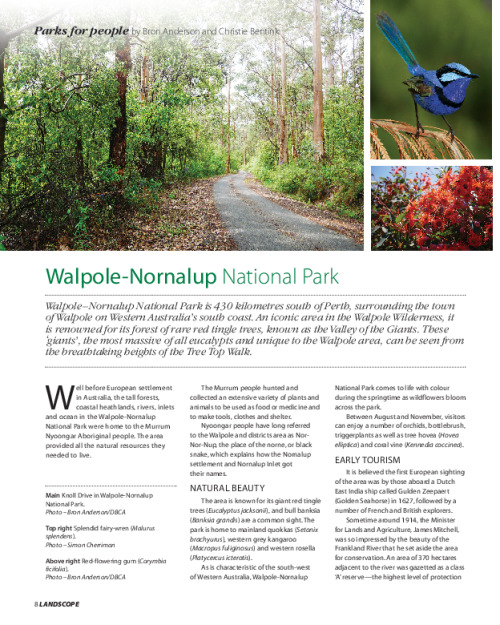
The area is known for its giant red tingle trees (Eucalyptus jacksonii), and bull banksia (Banksia grandis) are a common sight. The park is home to mainland quokkas (Setonix brachyurus), western grey kangaroo (Macropus fuliginosus) and western rosella (Platycercus icterotis). As is characteristic of the south-west of Western Australia, Walpole-Nornalup
National Park comes to life with colour during the springtime as wildflowers bloom across the park. Between August and November, visitors can enjoy a number of orchids, bottlebrush, triggerplants as well as tree hovea (Hovea elliptica) and coral vine (Kennedia coccinea).
Early Tourism
It is believed the first European sighting of the area was by those aboard a Dutch East India ship called Gulden Zeepaert (Golden Seahorse) in 1627, followed by a number of French and British explorers.
Sometime around 1914, the Minister for Lands and Agriculture, James Mitchell, was so impressed by the beauty of the Frankland River that he set aside the area for conservation. An area of 370 hectares adjacent to the river was gazetted as a class ‘A’ reserve—the highest level of protection land could be given. The area was named Nornalup National Park and would later grow to become what is known today as Walpole-Nornalup National Park.
Tourism really took off in the area in the late 1920s, with more and more people coming to experience the magnificent forests and the beautiful scenery of the inlet and coastline.
The large karri (Eucalyptus diversicolor) and tingle trees found within the region were a major drawcard, as well as the equally beautiful red-flowering gum with its spectacular red blossoms.
Old majestic jarrah (Eucalyptus marginata), tingle and karri forests surround imposing granite peaks, peaceful rivers, wetlands and tranquil inlets, and overlook picturesque sandy beaches, sheer coastal cliffs and the Southern Ocean.
Tourism took over as Walpole’s main source of income in 1995 with the closure of the timber mill and the downturn of the logging industry in the area. The lure of the big trees was strong and more and more tourists visiting the area came to see the majesty of the karris and tingles.
Walpole-Nornalup National Park is home to three types of tingle tree—red tingle (Eucalyptus jacksonii), yellow tingle (Eucalyptus guilfoylei) and rate’s tingle (Eucalyptus brevistylis).
Walpole was thrust into the international limelight with the construction of the Tree Top Walk at the Valley of the Giants in 1996. This popular attraction provides visitors with the opportunity to immerse themselves in the forest canopy and get a completely different perspective of these giant trees.
Ancient Empire Walk Trail
Located within the Valley of the Giants, the Ancient Empire Walk meanders across the forest floor between the tingle trees. The walk trail takes visitors around and through some of the giant trees including the popular 400-year-old Grandma Tingle.
In July 2023, significant works were initiated in consultation with Traditional Owners to extend the Ancient Empire, creating over 400 metres of new accessible trail. Alongside this expansion, existing timber decking structures were revitalised and levelled, removing stairs and ensuring a safe and comfortable journey for visitors.
The redesigned trail has resulted in a fully accessible loop, giving visitors a unique nature experience from ground level. The trail is now also accessible to individuals using wheelchairs or strollers.
The magnificent beauty and tranquility of Walpole-Nornalup National Park has inspired many people over the years and will continue to do so into the future.
Park Highlights
Conspicuous Cliff
The spectacular limestone cliffs are a photographer’s delight, as is the large surf that pounds the shore at this pristine beach. Easily accessible by two-wheel drive, the walk trails and lookouts provide remarkable views and a chance to witness the antics of migrating whales in season.
Monastery Landing
Enjoy a picnic in the serene surroundings of the historic Monastery Landing, the birthplace of the Walpole- Nornalup National Park. Access it by car in the drier months of the year and via the Frankland River all year round in a small boat or canoe launched at Nornalup.
John Rate Lookout
Named after the first forester in the Walpole district, this is one of the most scenic places in the area for picnics and views over the pristine Walpole and Nornalup Inlets Marine Park. In recognition of John Rate’s dedication to the preservation of the forests, the Rate’s tingle was named after him.
Valley of the Giants Tree Top Walk
The Valley of the Giants is home to the famous Tree Top Walk, which reaches a height of 40 metres above the forest floor. This 600-metre walk has a gentle gradient which is suitable for children and wheelchairs. You can also enjoy the forest at ground level along the Ancient Empire Walk through some of the giant tingle trees. Activity programs are run during school holidays for a deeper insight into the forest and surrounds.
Bushwalking in Walpole-Nornalup National Park
Mount Clare Summit Trail
Class 3, 2.4km return. Allow 40 minutes.
A gradual uphill walk takes you through magnificent tingle and karri forest to the summit of Mount Clare. You will be rewarded with views to the coast and across the Walpole Wilderness.
A good level of fitness is recommended.
Deep River Loop Walk
Class 4, 4.2km return. Allow 1.5 hours.
Follow the Bibbulmun Track down a steep valley to the Deep River. Stand on the suspension bridge and take in the river’s intense reflections. This trail skirts around to the east of Mount Clare along Tinglewood Drive back to the start point. This walk has limited directional signage and a good level of fitness
is recommended.
Knolls Walk Trail
Class 2, 2km loop. Allow 45 minutes.
This pretty walk trail gives you a snapshot of the best the Walpole Wilderness has to offer. Karri, jarrah, tingle, marri, peppermint and sheoak all grow in this small area surrounded by the Walpole and Nornalup inlets. This easy trail can be walked in shorter sections.
Rest Point to Sandy Beach
Class 4, 1.2km one way. Allow 1 hour.
This path guides you around the edge of the western knoll and provides glimpses of the Nornalup Inlet through the undergrowth of the karri forest. This is a narrow trail with steep drops to the side and it can be slippery.
Horseyard Hill
Class 2, 2.5km loop. Allow 45 minutes.
This delightful interpretive trail, illustrated by two local artists, takes you through karri, yellow tingle and marri forest. It has a medium gradient and is wheelchair accessible (with assistance) for the first 120 metres.
Do it yourself
Where is it?
430 kilometres south of Perth
Total area 15,865 hectares
What to do
Bushwalking, mountain biking,
fishing, surfing, canoeing, paddling
Must see sights
Conspicuous Cliff,
Monastery Landing, John Rate Lookout,
Valley of the Giants Tree Top Walk
Nearest Parks and Wildlife Service office
Frankland District Office, South Coast
Highway, Walpole WA 6398 (08) 9840 0400