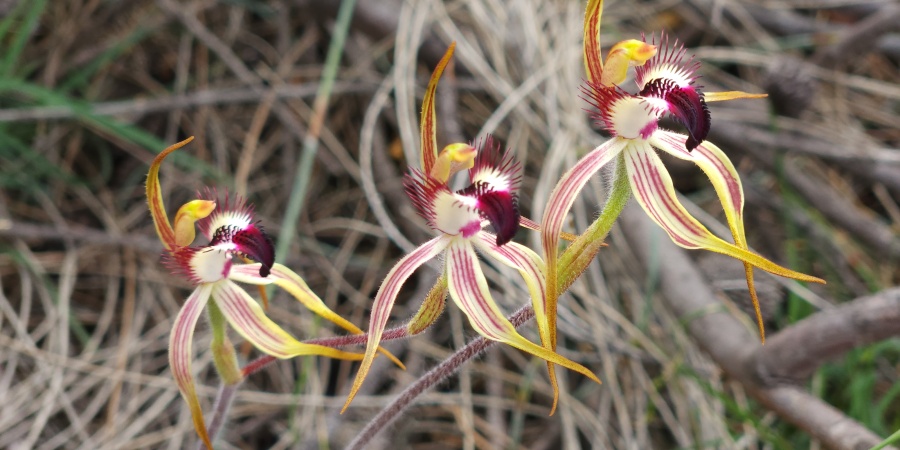
Pingaring spider orchids
DBCA’s nine regions have responsibility for on-ground delivery of biodiversity conservation with a focus on department-managed land. The department also liaises, provides advice and undertakes some management activities on other lands, particularly where these relate to Ramsar wetlands, and threatened and Priority species and ecological communities.
Regional conservation plans for each of the nine regions were developed using transparent and repeatable structured decision-support processes to identify and prioritise conservation actions for:
- landscape-scale threat mitigation in priority reserves and landscapes
- addressing specific threats to threatened and Priority species and ecological communities
- addressing information requirements to support the management of threatened and Priority species and ecological communities.
Key components of regional conservation plans
Regional conservation plans are structured to demonstrate how regional conservation actions contribute to achieving delivery of the department’s overarching conservation strategies as outlined in the Biodiversity Conservation Framework.
Regional conservation plans are comprised of the Regional Conservation Planning Approach document that outlines the approach taken to develop the regional conservation plans, as well as the outputs from the prioritisation processes in each of the nine regional conservation plans.
A suite of detailed outputs from the regional conservation planning process have informed the priorities outlined in this plan and include elicitation outputs, benefit-cost analyses, risk assessment and value of information analyses.
These outputs and supporting documentation may be updated over time as new information becomes available to inform the priority of actions delivered through regional works programs.
A recording of a presentation about the regional conservation plans is available on the Parks and Wildlife Service WA’s YouTube channel. You can also read about the evolution of the plans in DBCA's LANDSCOPE magazine.
Downloads
Map of DBCA regions
Use the map to find your region of interest and download the overarching Regional Conservation Planning Approach and regional conservation plans.
Conservation in action
See how DBCA teams across Western Australia are turning regional conservation priorities into on-ground outcomes in the videos below.
Browse Island mouse eradication in the Kimberley Region
Protecting mainland quokkas in the Swan Region
Saving rare flora in the South Coast region
Post-fire surveys in the South Coast region