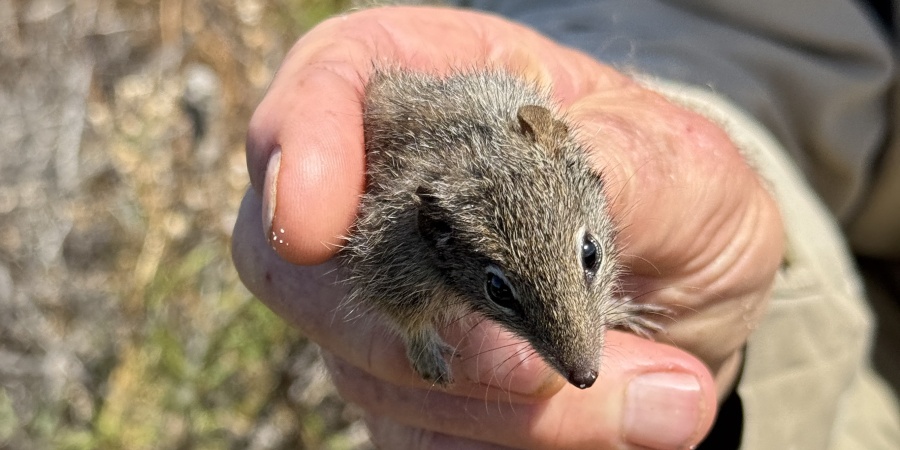
The dibbler is a small, endangered marsupial, native to a limited area of Western Australia. Photo - DBCA
In late October, staff from the Department of Biodiversity, Conservation and Attractions (DBCA) conducted a targeted trapping program to monitor dibbler populations on Jurien Bay’s offshore islands.
The dibbler (Parantechinus apicalis) is a small, endangered marsupial, native to a limited area of Western Australia, including Boullanger, Whitlock, and Escape islands.
Slightly larger than a house mouse, dibblers are easily identified by the distinctive white ring around their eyes.
Dibblers rely on the native plants on the islands for habitat, so ensuring that you stay clear of the vegetation when accessing the islands is essential for ensuring their survival.
DBCA Research Scientist Dr Saul Cowen said the monitoring program on the islands had been running for several decades, forming a critical part of DBCA’s conservation strategy.
“These regular surveys allow scientists to track population health and identify emerging threats such disease or climate change, which helps to inform recovery efforts for the species,” Dr Cowen said.
During the four-day trapping effort, the team encountered numerous healthy dibblers – a promising sign for the species’ continued survival.
They also recorded sightings of native lizards, including King’s skinks (Egernia kingii), Jurien Bay skinks (Liopholis pulchra), and West Coast laterite ctenotus (Ctenotus fallens).
Many of these lizards had been tagged in previous monitoring programs, making some of them more than seven years old!
Ongoing monitoring of the islands is essential as, without it, these vulnerable populations could decline unnoticed, making recovery efforts significantly more challenging.
Public support helps to ensure the program can continue, so if you are interested in finding out more information, contact the DBCA Turquoise Coast District office in Jurien Bay.