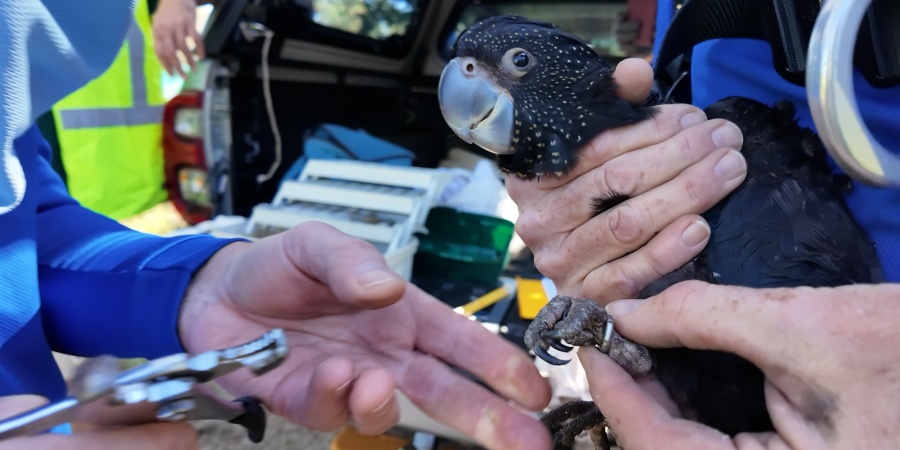
A leg band was attached to the fledgling cockatoo to help with future identification. Photo - DBCA.
The discovery this breeding season of three forest red-tailed black cockatoo (Calyptorhynchus banksii naso) nestlings in artificial hollows highlights the importance of placing artificial hollows in the right landscape.
Last month, two nestlings were discovered in plastic artificial hollows in a bushland reserve in the City of Armadale through Landcare SJ's ongoing monitoring program. A third nestling was discovered about five kilometres away during follow-up monitoring.
Department of Biodiversity, Conservation and Attractions (DBCA) Research Associate and volunteer Rick Dawson PSM inspected the nestlings using a pole-mounted camera to check their age and health.
The first two nestlings discovered were estimated to be three to four weeks old, and between five and seven weeks old, while the third nestling is 10 to 11 weeks old and when leg banded weighed a healthy 630g.
All three nestlings appeared healthy and are expected to fledge from about 12 weeks of age.
Forest red-tailed black cockatoos are listed as Vulnerable under State and Commonwealth legislation, with the loss of suitable nesting hollows a major threat to the species.
Mr Dawson said that for many years, plastic artificial hollows were considered to have limited success with forest red-tailed black cockatoos as they had only rarely been recorded breeding in them, despite numerous installations across their range.
“This discovery of three nestlings in one season suggests successful breeding is less about the material of an artificial hollow and more about where it is placed, particularly within established breeding areas with reliable food and habitat nearby,” Mr Dawson said.
"Artificial hollows don't create breeding populations; they support existing ones. Installing artificial hollows within, or close to, established breeding areas where birds already forage and nest, greatly increases the likelihood they will eventually be used.”
Mr Dawson said the findings also showed why artificial hollows should be treated as long-term conservation infrastructure.
"These artificial hollows are designed to last about 75 years, and with regular maintenance they will provide nesting opportunities for generations of black cockatoos when conditions are right," he said.
"The success of an artificial hollow isn't measured by how quickly it is occupied, but by whether it is available when the birds need it most."
The discoveries also highlight the value of Landcare SJ's long-term monitoring program, which is improving understanding of forest red-tailed black cockatoo breeding ecology and the role artificial hollows can play.
Protecting existing hollow-bearing trees remains the top priority for conserving the species. However, these breeding records show that strategically placed, well-maintained artificial hollows can successfully supplement natural nesting habitat and provide breeding opportunities for decades.