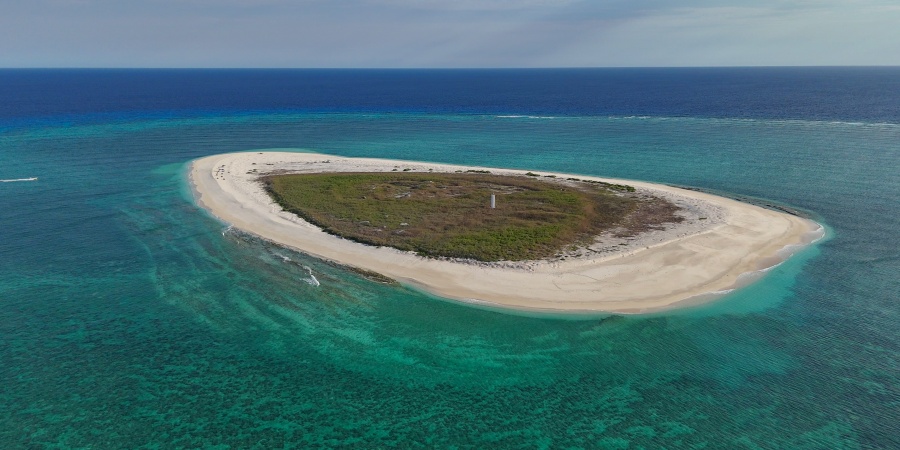
The world-first project used drones to drop bait across Browse Island in a bid to eradicate mice and welcome back seabirds. Photo - DBCA
An innovative project in Western Australia’s most remote nature reserve is hoping to help seabirds flourish by eradicating thousands of invasive mice that have run wild for more than 100 years.
The world-first conservation scheme is taking place on Browse Island, 450km off the coast of Broome, where a drone was used to try and eradicate the rodent pest problem.
The island’s dense vegetation makes it extremely difficult for traditional baiting methods to be used, so a total of more than 266,500 pellets, weighing some 700kg, were loaded into a custom-built drone and scattered throughout in October 2025.
“Rodents generally on islands are recognised as one of the most significant threats to biodiversity globally,” says Professor Rohan Clarke from Monash University.
“So, this is the first time that an eradication has been attempted for house mice anywhere in the world that's using drones. So, it's a pretty ambitious project, especially when you think how remote we are.
“I'd call this conservation in action.”
Browse Island was once a thriving seabird haven but guano mining in the late 19th and early 20th centuries and the introduction of house mice by foreign fishers turned it into a wilderness.
“Unfortunately, there's been no breeding seabirds here for hundreds of years,” says Bruce Greatwich, Kimberley District Conservation Coordinator for the Parks and Wildlife Service. “It was once described as the jewel of the crown of the Kimberley islands for seabird breeding population.
“In the late 1800s it was mined for guano extensively. So that was an extremely disruptive and damaging process which forced the all the seabirds essentially to vacate Browse Island.”
In recent years, the birds have attempted to recolonise, but the mice, which also pose a biosecurity threat to the Australian mainland, have scuppered breeding attempts by preying on unguarded eggs.
“These birds, while they spend the majority of their time out at ocean, they have to come to land, to breed. And in the north-west, there are so few of these islands that every single one is extremely important for that species because that's where they breed. So, without these islands, then their population is just going to suffer significantly,” Mr Greatwich says.
It is hoped this drone drop will help restore the island to its former ecological character and strengthen resilience of biodiversity in the region.
“We know that Browse Island was once thriving with seabirds. We know it was probably an incredible place,” says Dr Donal Smith from Monash University.
“What we'd love to see here is the island to return to that incredibly beautiful state. We're confident that can happen. There's precedent for these kinds of incredible recoveries happening.”
There have been 70 bird species recorded at Browse Island, although many do not live there. Before 2018 there was no evidence of birds breeding or roosting there, but since then there has been a remarkable turnaround with some 20,000 seabirds now visiting the island.
“They're very important sites and if we can't protect them during their breeding, then that's a real problem for their seabird populations,” says Karina Sorrell from Monash University.
The use of drone technology has previously focused on rat species, but have never been used before in an island setting on house mice.
Envico Technologies’ custom-built hexacopter was developed to carry 10kg of bait per trip and over the course of three days systematically covered the 17ha island.
“It’s similar to a lawn mower pattern, like mowing your lawn, going back and forth, back and forth. And then we’ll go all the way around the coastline as well, making sure we’ve covered any gaps,” says Mike Jensen from Envico Technologies.
“We’ve got to be real precise and cover every square inch.”
The team will return in April to see if any mice can be detected, with the hope the mice can officially be declared eradicated.
“It's hard work, especially up in these hot, humid climes, but it's just totally worth it at the end of the day. It's such a fantastic group of people and a team just working together. We all need each other to do our part,” says Nathan Waugh from Shell Australia.
“My dream would be to come back to Browse Island in say a decade's time and just see that cloud of birds over it and the nesting turtles in numbers which are growing over time. That would be amazing.”
To watch the full story visit Browse Island Mouse Eradication