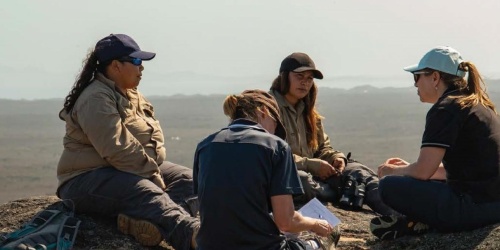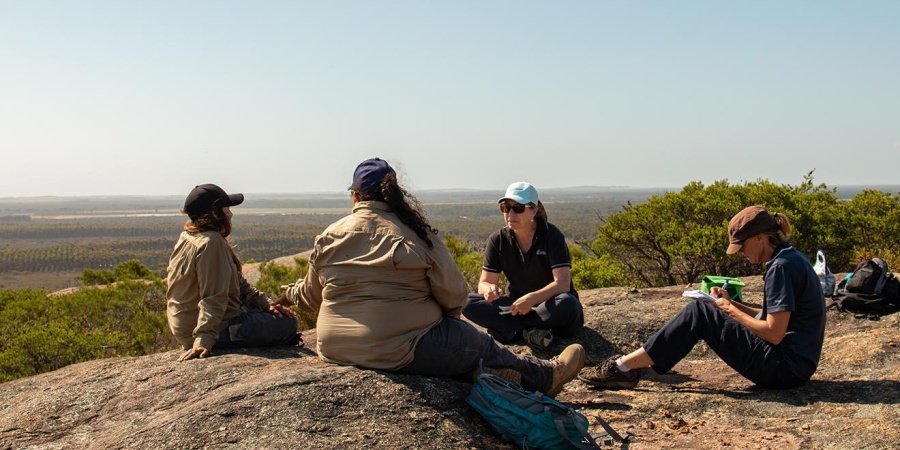
DBCA social scientists on Country listening and learning with Esperance Tjaltjraak Aboriginal Rangers.
Social research helps us better understand issues related to DBCA’s programs, enhance decision making and improve the effective and timely delivery of services.
Key activities and projects include:
- visitation monitoring, visitor statistics and targeted social research
- State-wide visitor satisfaction monitoring
- marine human use monitoring
- Aboriginal Ranger Program evaluation
- coordinating DBCA’s involvement with external social research providers.
Proposed social and visitor research to be conducted on Parks and Wildlife Service-managed lands and waters requires prior approval before research begins.
Social and economic value of protected areas in Western Australia report:
Protected areas managed by Parks and Wildlife Service under the Conservation and Land Management Act 1984 (CALM Act) provide significant environmental, social, cultural and economic benefits to Western Australia. To better understand these contributions, DBCA engaged Deloitte Access Economics to assess the value of the State’s conservation estate.
Recognising that many benefits extend beyond direct economic activity, the study used a range of valuation approaches to examine the role of protected areas in supporting biodiversity conservation, tourism, community wellbeing, cultural values and ecosystem services.
The findings provide a holistic assessment of the importance of protected areas to Western Australia and its communities.
What is social science?
Social research in this context is defined as research that improves our understanding of how people respond to and engage with the environment and protected areas.
Social science contributes to an understanding of people’s attitudes and behaviours towards the environment. It allows us to understand how people respond to the environment, wildlife and protected areas. It also allows us to maintain and enhance the values that contribute to people’s appreciation and enjoyment of protected areas.
Social science is transdisciplinary in nature. It incorporates visitor data and use, and understanding the impact of visitor activities on the environment and surrounding communities. It also includes research into park/community relations and how we work together with our Aboriginal partners to care for Country.
Park visitor statistics
Annual visitor satisfaction and total visits to Parks and Wildlife-managed lands and waters can be found in the DBCA Annual Report
Conducting social research in parks
Proposed social and visitor research to be conducted on Parks and Wildlife Service-managed lands and waters, including interviews with DBCA employees, requires approval before research begins.
DBCA’s Visitor and Social Research Unit is responsible for coordinating the department's involvement and works in partnership with various external research providers, such as universities and consultants, relevant to social science and visitor research including research collaborations, research approvals and student support.
External research providers, including students, are required to:
- provide advice of intent to conduct social research on land/water administered by Parks and Wildlife, which includes interviews with Parks and Wildlife employees, and
- apply for a fee waiver (where applicable) for the purpose of research.
How to apply
To submit your advice of intent to conduct social research on land/water administered by Parks and Wildlife, please apply by completing the online request form.
As part of the application ensure you have:
- research contact details
- supervisor contact details (where applicable),
- project details including description, aims, methods, outcomes and outputs
- an electronic copy of any questionnaire or other survey instrument to be used in the study, and
- an electronic copy of human ethics approval.
If not in an institution where there is a human ethics committee, researchers will be asked to complete a statement to agree to conduct research in line with the National Statement on Ethical Conduct in Human Research 2025 | NHMRC
Allow at least four weeks for processing of applications. You will be notified of the outcome by email. If park entry fees are applicable for the park/s you are proposing to conduct your research in, you will be advised on the process to apply for a fee waiver once the application has been approved.
Any queries should be directed to:
Parks and Visitor Services, Visitor and Social Research
Attn: Social Science Coordinator
Department of Biodiversity, Conservation and Attractions
Parks and Wildlife Service
email: amanda.smith@dbca.wa.gov.au
Contact us
For more information about social research, please email Social Science Coordinator Amanda.smith@dbca.wa.gov.au
Downloads