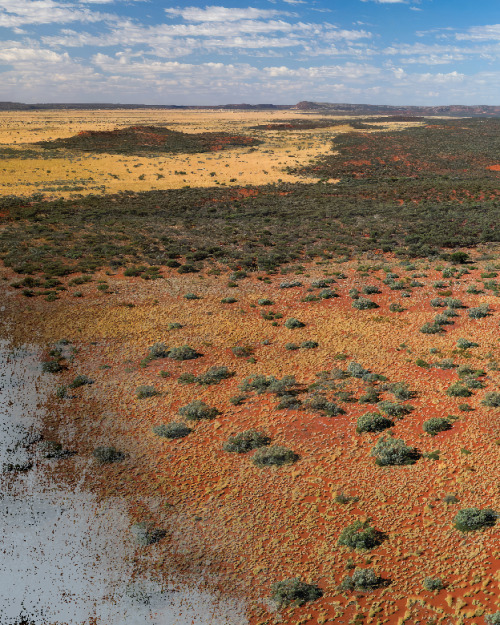
Nharnuwangga Wajarri Ngarlawangga man Stuart Robinson’s boots crunch across the red dirt as he wanders across the land of his ancestors.
He knows this semi-arid countryside nurtured his people for millennia. But in more recent times, much of his people’s Country has been under pastoral lease, and his people had not found it easy to visit.
Now, thanks to a new joint management agreement between the Jidi Jidi Aboriginal Corporation and the State Government, Mr Robinson and other Nharnuwangga Wajarri Ngarlawangga people are back on Country working as rangers.
Mr Robinson’s footsteps slow as he notices a large slab of rock in the dirt. Squatting beside it, he runs his hand over the smooth indentation. A rounded rock lies nearby.
“A grinding stone,” he announces. He grasps the stone with reverence, and wonders who last used this stone, how long ago they were here?
The artefacts are just several of dozens Mr Robinson has found scattered across the area.
Much of the park remains inaccessible, but Mr Robinson is here with staff from the Department of Biodiversity, Conservation and Attractions (DBCA) on an exploratory journey to visit sites of cultural significance.
They stumble upon tree-lined waterholes hidden among red dirt and scrubby bush. These waterholes once sustained Nharnuwangga Wajarri Ngarlawangga people and served as meeting and camping sites. Arrow heads and grinding stones bear testimony to their former presence.
Today, the waterholes also delight DBCA scientists who observe frogs, shrimp and turtles in this otherwise arid landscape.
Just outside the park boundaries, another waterhole contains rock art and has long been treasured as a family camping spot. Here, Mr Robinson instructs the DBCA team on how to throw sand into the water to announce our presence and show respect to The Dreaming serpent that resides here.
Who knows what other cultural sites and biological treasures lie, long-forgotten or undiscovered, within the park’s furthest reaches?
New beginnings
Collier Range National Park was declared in 1978, covering 240,000 hectares of hills, ridges and sand dunes, cloaked in mulga and spinifex growth.
The park offered natural protection amid great swathes of pastoral country, about 170 kilometres from Newman in WA’s Pilbara.
The Collier Range snakes through the park’s interior featuring cliffs and ridges that stand sentinel across the surrounding plains.
While the Great Northern Highway transects the far east of the park, most of the park’s interior is inaccessible.
Now, as part of the State Government’s Plan for our Parks initiative to add five million hectares to the conservation estate and jointly manage lands with Traditional Owners, there are aspirations for the park to be renamed Gulali National Park.
As part of the agreement with the Jidi Jidi Aboriginal Corporation, a portion of the ex-Waldburg pastoral station will also become national park.
Like Gulali National Park, Jilgu National Park is also dotted with cultural sites, rock art and traces of rare animals.
Jobs on country
The joint management agreement has paved the way for DBCA to employ five new Jidi Jidi positions, including a clerical officer, ranger and three ranger assistants.
These staff will help establish a works centre from which to base themselves as they return to Country to manage the jointly-managed national parks.
Mr Robinson and his partner Lylia Flowers are among the new employees. They couldn’t be happier.
“It makes me feel happy, it makes me feel proud to do this kind of work,” Mr Robinson said.
“It’s good to come up into the Country that we have never been into and exploring it, to see what’s there and find sites there that we didn’t know about before.”
Ms Flowers believes the old people would approve.
“You get like that in the bush, you know you’ve got the old people looking after you, and the ancestors,” she said.
“They’re probably looking after us doing this work, they’d be happy.”
The younger generation at Yulga Jinna Aboriginal community also relishes the prospect of work opportunities.
“[There will be] a lot more opportunities for work and stuff and might be a bit of a brighter future for us and the DBCA guys as well,” 25-year old Jack McPhee said.
“The work is a pretty important thing to do—keeping it clean and make sure all the animals and plants are alright.”
Protecting country
While the parks have been largely inaccessible, they have succumbed to the same threats as the rest of the rangelands—weeds and feral animals.
Cats have been sighted, as well as donkeys and cattle.
As part of their work, the new rangers will work to minimise these threats, work out what native animals remain and establish plans to further their protection.
The exploratory journey has already found indications that this area may once have sustained the western pebble-mound mouse (Pseudomys chapmani), which Nharnuwangga Wajarri Ngarlawangga people call windalya.
These tiny critters construct mounds of pebbles of up to 10 square metres atop their burrows—the mounds remaining in place long after the mice have become extinct from a landscape.
It’s thought the pebbles may better protect the mice from predators.
Though the IUCN lists the mice as of ‘least concern’ they are known to have disappeared from some areas in the rangelands due to feral cat predation.
In addition to offering conservation activities, the Jidi Jidi rangers will also be in a position to protect the cultural sites and places of importance to their ancestors.
Mr Robinson believes his ancestors would support their work.
“I always feel good when I’m in the bush, with the old people,” he said.
“When you’re out here you feel that they’re still around.”
As Mr Robinson replaces the grinding stone where he found it, the sun peeks through the clouds and a gentle breeze stirs the treetops. The pleasant conditions in this harsh land make it seem as if the ancestors are indeed blessing the return of the Nharnuwangga Wajarri Ngarlawangga people and their work to restore this Country.