There are more than 200 fish species that utilise the Swan-Canning Estuary and many are well-known,
but others are more cryptic and often evade observation from scientists. This was the case for the southern eagle ray (Myliobatis tenuicaudatus), a well-camouflaged, bottom-dwelling, cartilaginous fish, that is olive green with pale grey-blue markings, and occurs in coastal waters and estuaries across southern Australia to south-east Queensland, Norfolk Island and New Zealand.
First recorded in the Swan-Canning Estuary in the 1970s, the southern eagle ray is one of many species that may be responding to the increasing marinisation of the estuary, steadily driven by increasing tidal height and reduced riverine flows.
These rays are now one of the most abundant larger species recorded in the deeper waters of the lower estuary as part of the Department of Biodiversity, Conservation and Attractions’ (DBCA) annual fish community monitoring conducted with Murdoch University.
In the decade from 2012 (to 2022) since this regular monitoring began, the annual number of southern eagle rays recorded has increased tenfold, from 15 to 153.
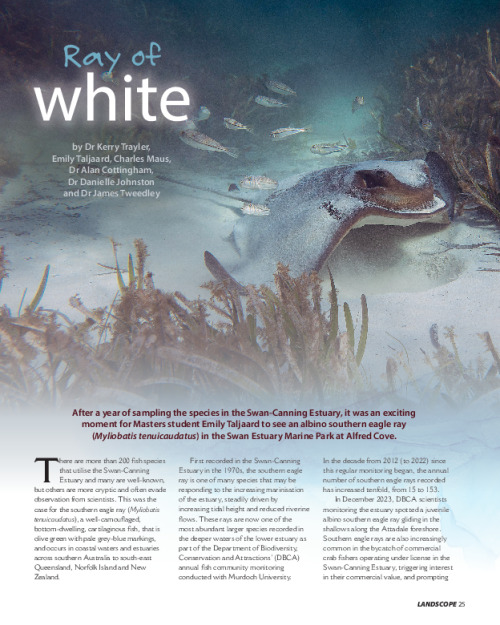
In December 2023, DBCA scientists monitoring the estuary spotted a juvenile albino southern eagle ray gliding in the shallows along the Attadale foreshore.
Southern eagle rays are also increasingly common in the bycatch of commercial crab fishers operating under license in the Swan-Canning Estuary, triggering interest in their commercial value, and prompting questions over sustainability.
With limited information available on this species, a collaboration was established between the Department of Primary Industries and Regional Development (DPIRD), who conducted the sampling, Murdoch University and DBCA to investigate the biology and ecology of this little-known species in the estuary.
Potential Estuarine Nursery
In the broader metropolitan region of Western Australia, southern eagle rays are not limited to the Swan-Canning Estuary, with local populations in Cockburn Sound, and the Peel-Harvey Estuary and marine waters. There is also some evidence that these nearshore areas may be local nursery areas for this species.
In the Swan-Canning Estuary, Emily found pups and pregnant females in most months of the year. The gestation period is not known but females have two functional uteri and give birth to live young. In keeping with other eagle ray species, it may be between nine and 12 months but it is unclear whether this includes a diapause (suspended development) period.
Emily’s work showed that the females produced a comparatively small litter for an eagle ray species with just one to three young, and were not sexually mature until they were around nine years of age.
At this time, females were approximately 83 centimetres wide (across the wings). The males were almost six years old and approximately 60 centimetres when they reached maturity. Peak birthing periods were in summer and there was evidence that the males and females would mate at around the same age. Southern eagle rays live to at least 16 years of age and, outside of the Swan-Canning Estuary, are known to reach 1.6 metres in width and up to
38 kilograms.
Generalist feeder
Rather than pointy teeth, the jaws of eagle rays contain tooth plates helping them to crush their prey. Southern eagle rays are generalist bottom feeders and adapt their diet to the environment in which they occur. Broadly, these rays are known to consume polychaete worms, bivalve and gastropod molluscs, crustaceans (e.g. crabs and prawns), echinoderms (e.g. sea urchins) and bony fishes (teleosts).
In the less marine environment of the Swan-Canning Estuary, Emily’s research showed their diet was more tailored, with prawns, polychaete worms, gastropods and crabs being the main prey consumed. Prawns were the most common prey species eaten by 50 per cent of the rays, but their proportional contribution to their diet increased in summer as prawn abundance in the system changed over time.
Southern eagle rays are less than 30 centimetres wide when born and increase markedly in size during their lifetime. Increased jaw size (gape and width) gives their tooth plates more crushing power, allowing them to eat hard- bodied prey. As such, their diet shifts over their lifetime, with small juveniles limited to a diet of softer-bodied prey (for example, polychaete worms), whereas very large individuals, wider than one metre, were found to include crabs in their diet.
Sustainable fishing
Emily’s study showed that only very large southern eagle rays consumed crabs and given the relatively small number of individuals of this size in the estuary, it is unlikely that commercial or recreational crab fisheries in the estuary would be affecting their food resources. Information on their reproduction, seasonality and distribution will contribute to the knowledge base of DPIRD’s ecosystem-based fisheries management program.