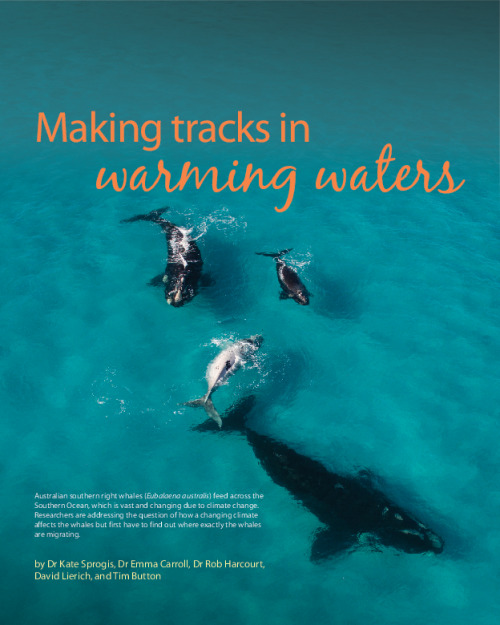
In the 1800s, there were a number of whaling stations located across Australia, and southern right whales (Eubalaena australis) were hunted to near extinction. The species was protected in 1935, and but was not until 1955 that a sighting of southern right whales was confirmed—a mother-calf pair off Albany—and since then, the number of sightings has slowly increased.
The first evidence that southern right whales breed in Western Australian waters and migrate to Antarctica was by a photo-identification match of two right whales sighted by a Japanese vessel in 1996, but little else is known about their migratory destinations. There are changes in the Southern Ocean due to the warming of the waters.
“It is predicted that the prey of right whales (krill/copepods) will be altered due to ocean warming,” Dr Kate Sprogis, from The University of Western Australia based at the Albany campus, said. “The migration paths of right whales therefore need to be understood, to predict how their foraging may be affected in the future.
“If the whales cannot find enough high-quality food, then their reproductive output can decrease. For example, if a mother whale is unhealthy, she will not be able to go through pregnancy and give birth.”
joining forces
An international research team has joined forces to uncover some of the mysteries of southern right whale migrations across the Southern Ocean (see ‘Migration mysteries’, LANDSCOPE summer 2022–23). The team includes Macquarie University, The University of Western Australia, the University of Auckland (Waipapa Taumata Rau), and the Western Australian Department of Biodiversity, Conservation and Attractions (DBCA; Blackwood District, South Coast Region and Marine Science Program), and members of the Large Whale Disentanglement Team.
Honorary Professor Rob Harcourt from Macquarie University concedes there is much to learn.
“For example, we want to find out whether all Australian southern right whales are using the same foraging areas, or are they migrating in different directions?” Dr Harcourt said.
“Are the whales migrating to the subtropical front and feeding with the whales from the New Zealand right whale population?”
To answer these questions, the team needed to obtain data on the whales migration path to across vast areas of the Southern Ocean over a long period of time.
Satellite tags are the only technology that allow the researchers to follow the whales on these journeys and have provided data to start to piece the puzzle together.
“Based on preliminary data from our first field season, whales from south-west Australia migrated to different foraging grounds spanning 6500 kilometres of the Southern Ocean,” Dr Harcourt said.
“Whales migrated to Antarctica, to the Kerguelen Islands and to the Crozet Islands. These are new insights.”
connection among populations
Satellite tracks show that southern right whales from Australia and New Zealand use foraging grounds south of Australia. Unexpectedly for the team, both Australian and South African southern right whales also visit shared foraging grounds in the Indian Ocean.
But what about the genetic connectivity? During the field season, skin samples were obtained for genetic analyses at the University of Auckland by Dr Emma Carroll and her team.
“Previously, the only genetic data we had were from 17 biopsy samples from southern right whales in Western Australia from the early 1990s,” Dr Carroll said.
“Now, more than a decade later, we are working to increase the sample size. This means we can have a better
understanding of how Western Australian southern right whales are connected to those from the east coast of Australia, New Zealand and South Africa.
“We are particularly interested in investigating if there are any close relatives between New Zealand and Australia.
“Samples will also be analysed in the future for microchemical markers called stable isotopes. These markers tell us broadly where-and-on-what the whales are feeding. This is complementary to the high- resolution foraging locations we get from the satellite track data, with the advantage that we can analyse the microchemical markers from dozens of whales.
“Analysis of the samples from the 1990s suggests a strong link between WA and Antarctica, so it will be interesting to see if this has changed.
“Future biopsy samples will also be used to determine the age of whales in the population through genetic analysis.”
“The project not only provides valuable data on the movement of the whales along the coast of southern WA, but also provides invaluable capacity building for the Large Whale Disentanglement Team.”
whale journeys
Tohorã Voyages is the New Zealand- based southern right whale project, where tohorã is Mãori for ‘whale.’ The project has so far included tagging of 25 whales with satellite transmitters in the Auckland Islands from 2020–22.
Mirnong Maat is the Australian-based southern right whale project, where Mirnong Maat is Menang/Merningar Noongar language for ‘whale travel path’ and is akin to ‘whale journey’. Mirnong means ‘whale’ and maat means ‘travel path’. As the whales are migrating to and from their feeding grounds they undertake a journey along a path, here we liken their migration to ‘maat’. So far, fieldwork has been conducted in September 2022 and August 2023, and is also being planned for winter 2024.
coastal movements
The coastal movements of tagged southern right whales provide relevant information for the proposed south coast marine protected areas in WA. Before migrating into the Southern Ocean, the whales traverse the coast showing spatial variation in use over time.
“The movements of whales along the coast are important to know so that we can ensure these habitats are protected into the future,” Tim Button, DBCA’s Operations Officer Fauna based on the WA south coast said.
Interestingly, a tagged southern right whale from the Auckland Islands (Maungahuka) south of New Zealand, actually migrated to the south coast of Western Australia. This movement of New Zealand whales to shallow,
coastal Australian waters was previously unknown. The whale named ‘Whitu’ traversed west along the coast from Esperance to Bremer Bay through the Archipelago of the Recherche and the proposed Fitzgerald Biosphere Reserve.
“Whitu’s movements into Australian coastal waters shows that we are not just managing Australian whales, but also New Zealand whales,” Tim said.
“From the 2023 Mirnong Maat field season, a whale tagged off Cheynes Beach traversed from Cheynes Beach east to Twilight Cove and back, before heading west towards Augusta at the southwest tip, and then migrated south into the Southern Ocean.”
“It was found that whales tagged off Augusta traversed the coastline to near Windy Harbour, before heading south past the shipping lane into the Southern Ocean,” David Lierich, DBCA’s Marine Park Coordinator for the Ngari Capes Marine Park said.
“When these areas overlap areas of high human usage, we can target our patrols in those areas to make sure people are keeping their distance.”
“The project not only provides valuable data on the movement of the whales along the coast of southern WA, but also provides invaluable capacity building for the Large Whale Disentanglement Team.”
“The opportunity to operate our vessels close to these animals gives team members insight into how the whales behave in a relaxed manner. This is important as it provides a better understanding of body position and behavioural cues when dealing with an entangled whale.”
With the support of DBCA, the research team hopes to piece the puzzle together further through this international, collaborative project.