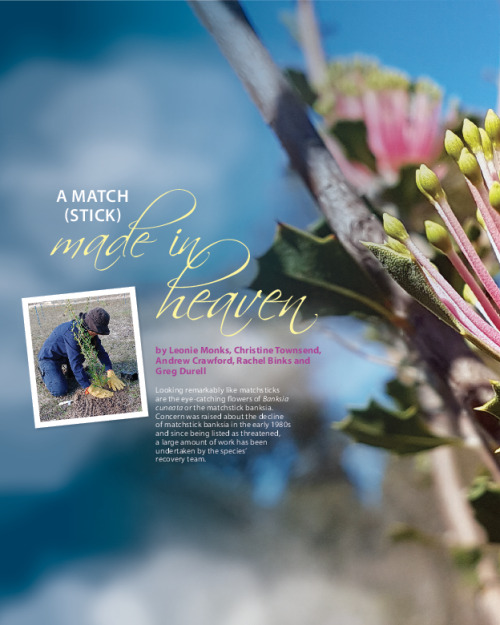
Confined to the central wheatbelt of Western Australia around the localities of Quairading, Brookton
and Popanyinning, matchstick banksia grows as a shrub or small tree, to about four metres in height with small prickly cuneate (wedge-shaped) dark green leaves. When the spectacular pink and green flowers open in spring they attract birds, such as honeyeaters, which pollinate the flowers in exchange for a nectar reward.
Like many Australian plant species, fire plays an important role (see ‘Live fast, die young’, LANDSCOPE spring 2023) in the life cycle of the matchstick banksia. The seeds are held in woody follicles in the canopy of the plant and can remain there for many years.
A small proportion of this seed may be released without a trigger, but the likelihood of those going on to produce new plants is slim as they compete with other more mature plants for space, nutrients and water.
In contrast, after fire, which kills the parent plant, seed is released en masse from the follicles, and the post-fire environment, where other competing species are of similar young age or small size, is highly suitable for seedling establishment. As such, the interval between fires is critical to the ongoing survival of the matchstick banksia.
If fire occurs too frequently, the adult plants will die but there may not be enough seed built up in the canopy for the species to successfully regenerate. However, if fire occurs too infrequently, aging adult plants will eventually die and as few seedlings are likely to survive in unburnt vegetation, overall plant numbers decline.
Stabilising populations
The species had first been collected east of Quairading in 1971 and named in 1981, but by 1982 was one of the first plant species listed as threatened in Western Australia. The species was assigned a ranking of endangered because of a continued decrease in plant numbers caused by a lack of available habitat.
Habitat loss was due to past land clearing and a range of threatening processes such as altered fire regimes, poor seedling recruitment, drought, damage during maintenance of road verges, small population size and deteriorating habitat quality because of weed invasion, grazing by rabbits, increasing soil salinity, and herbicide and fertiliser drift from adjoining farms.
In the two decades after being listed as being threatened, a large amount of work has been undertaken by the species’ recovery team and the Department of Biodiversity, Conservation and Attractions (DBCA).
This work saw the reservation of land where one of the matchstick banksia populations occurred; surveys undertaken for new populations; seed collections made and banked at the Western Australian Seed Centre; and augmentation (the growing and planting of seedlings to boost plant numbers at known locations of matchstick banksia) also known as reinforcement.
It was planned to use prescribed fire in these augmented populations in future years, when sufficient seed set had occurred, to renew the population again. As a result of this 20-year effort, 12 populations with around 780 plants of matchstick banksia were located, from which seed collections were made from ten.
Whilst some of this seed was used to produce seedlings that were planted at four of the smallest populations, the bulk of the seed was dried and frozen for safekeeping in the seed centre. This early effort made significant progress towards stabilising populations.
firing up growth
The matchstick banksia was recently listed as one of 30 plant species identified for targeted recovery action as part of the Australian Government’s Threatened Species Strategy 2015–2020. This renewed focus, with significant investment of funds from a variety of sources, has led to an increase in efforts to conserve matchstick banksia.
In 2017, a new translocation (planting) strategy was developed for the species with the goal of augmenting some of the existing populations with seedlings. The first planting involved re-establishing
a population south-east of Quairading where plants no longer existed, likely due to the natural death of all mature plants, and the lack of fire to stimulate seedlings.
Seed from populations in the Quairading area were taken out of long-term storage and germinated for this planting. Guided by knowledge of the species’ ecology, a research plan was developed to see whether seedling survival could be improved by planting after fire. This idea was tested by burning a small patch of vegetation at the site and planting seedlings into the burnt area and adjacent unburnt vegetation.
Each area was fenced to protect seedlings from grazing by animals like kangaroos and rabbits, and all the seedlings were watered over the first two summers following planting. Seedlings were tagged with a unique number so the fate of each individual could be monitored.
Four years after planting, the results were clear; 64 per cent of seedlings planted into the burnt area survived in stark contrast to the just five per cent survival in the unburnt vegetation. This encouraging result of improved translocation outcomes following fire provides valuable direction for the use of fire for future plantings.
improving numbers
Additional actions that have been implemented to safeguard the future of the matchstick banksia include further seed collections and a genetic study. These seed collections were necessary to bolster seed numbers and ensure that all populations have seed safely conserved at the seed centre.
As a part of seed storage protocols, the viability (whether the seed is alive) of each collection is tested before the seed is stored and then periodically duringstorage. This periodic testing of the old collections from the seed centre showed that the viability was the same as it had been when the seed had been collected, in some cases over 30 years ago.
This confirmed that the storage conditions utilised in the centre to maintain seed viability are working for this species. It also provided seedlings that could be used in the genetic study and for planting at translocation sites.
health assessment
The genetic study was needed to assess the general health of populations and assist with management decisions about the mixing of seed from different populations in translocation efforts.
Two previous genetic studies had been undertaken earlier for this purpose, but only included a few populations and reached contrasting conclusions. As a result, a more comprehensive study that includes all existing populations and new high-resolution genomic markers is currently underway to provide much needed data to inform the species’ conservation status and future translocations.
An additional aim of this recent genetic work was to compare the genetic diversity of the seed collections held in the seed centre, some of which are more than 30 years old and come from populations that are now extinct, with the living genetic diversity remaining in the wild.
The findings will assess the utility of those early seed collections and inform best practices.
guiding the future
Analysis of the genetic study is still in progress, however preliminary findings indicate that genetically, plants from the broad localities where the matchstick banksia occurs are quite different and shouldn’t be mixed at translocation sites.
To make use of seedlings generated as part of this genetic research, a new translocation was planned in a collaboration between DBCA, the Peel-Harvey Catchment Council (PHCC) and private property owners.
After the new site was confirmed to be free from dieback disease (Phytophthora cinnamomi), the area was fenced to exclude herbivores and an irrigation system was set up to provide water over the dry summer months. In June 2023, DBCA and PHCC staff, the property owners and volunteers worked together to plant 194 seedlings.
Over the coming years the plants will continue to be monitored to check that they not only survive but flourish and produce enough seed for the next generation. The genetic work will be used to guide future seed collections and plantings of this stunning species and ensure its persistence well into the future.