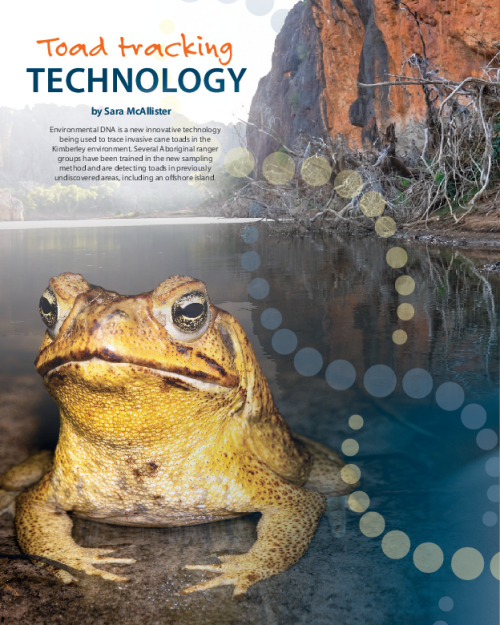
For more than a year, the cane toad team at the Department of Biodiversity, Conservation and Attractions (DBCA) has worked with DBCA’s Biodiversity and Conservation Science staff to develop a technique to use eDNA technology for early detection of cane toads (Rhinella marina) in the remote Kimberley environment.
The eDNA approach has now been rolled out in partnership with Kimberley Aboriginal ranger groups to assist with mapping the ‘cane toad frontline’ as well as surveying some Kimberley islands for toads—and so far, the results have been promising.
WHAT IS eDNA
eDNA is a sampling technique that involves analysing soil and water samples for the DNA of specific animals, such as cane toads.
Cane toads can hide really well in small cracks and crevices and can be hard to detect, particularly when they are in low numbers. This new tool is a practical and efficient way to detect cane toads in the environment without having to physically see the animals. It helps with early detection of toads, especially on isolated islands in the Kimberley, as well as helping to map the movement of toads.
The eDNA samples are collected remotely and analysed in a DBCA laboratory in Perth. It has taken some trial and error in the field and the lab to find the best method to collect eDNA samples from water in remote locations.
Transporting samples
eDNA sample kits for use in the remote and rugged northern WA environments need to be easy to use, practical and light to take out in the field. It’s important they are also cost-efficient and have a reasonable shelf life while still being accurate.
Environmental considerations formed a large part of the design process when developing the eDNA testing kits. Single use plastics and hazardous chemicals were out, and the team opted for reusable filter casings and drill pumps instead of disposable syringes.
This has culminated in the development of a 3D printed electric drill powered water pump, which pumps up to two litres of water through a portable lightweight filter. There is no use of hazardous chemicals, unlike some eDNA testing kits, and results still attain a high level of accuracy.
on country sampling
Dambimangari, Bunuba and Nyikina Mangala (Walalakoo) rangers recently sampled water bodies in the West Kimberley and surrounding islands, which detected cane toads at several locations where they were not previously found, including a newly detected population at St Andrew Island.
St Andrew Island is Dambeemangarddee Country, approximately two kilometres offshore from the mainland, in St George Basin at the mouth of Prince Regent River. Being close to the mainland means cane toads are able to raft to the island on flood debris easily during flood events.
Nyikina Mangala (Walalakoo) rangers recently worked with DBCA’s cane toad team to undertake eDNA testing to map the cane toad invasion frontline and track the movement of cane toads across their country. Mapping the invasion frontline assists in delivering effective on-ground mitigation strategies. Rangers also used traditional survey techniques to map the cane toad invasion including nighttime spotlighting and daytime searches.
From this information, and that gathered from other sources, a cane toad frontline is developed annually. The 2023 map showed that the cane toads have advanced approximately 50 kilometres in the last 12 months, maintaining their momentum as expected.
The collaboration between the DBCA cane toad team and Indigenous rangers provides training and capacity building for the rangers. Rangers also deliver important monitoring of native species for cane toad mitigation projects. The partnership fosters two-way learning, where knowledge of culture and environment assist in protecting native wildlife from the impact of cane toads.
This collaboration is an ongoing commitment included in the Cane Toad Strategy for Western Australia 2021-2026.
“The partnership fosters two-way learning, where knowledge of culture and environment assist in protecting native wildlife from the impact of cane toads.”