
Many people would argue that a snake that can grow to over four metres and as thick as a human thigh could be considered a ‘monster’.
Pilbara olive pythons (Liasis olivaceus barroni) are certainly capable of growing that large, but their shy demeanour and secretive life means that they are rarely encountered. If seen, they usually freeze and then try to slip away quietly—hardly monstrous behaviour!
These remarkable pythons are endemic to the Pilbara and despite the arid conditions of the landscapes they inhabit, Pilbara olive pythons (POPs) have been able to adapt, often by living near rivers and other waterbodies and even in small gorges on islands of the Dampier Archipelago.
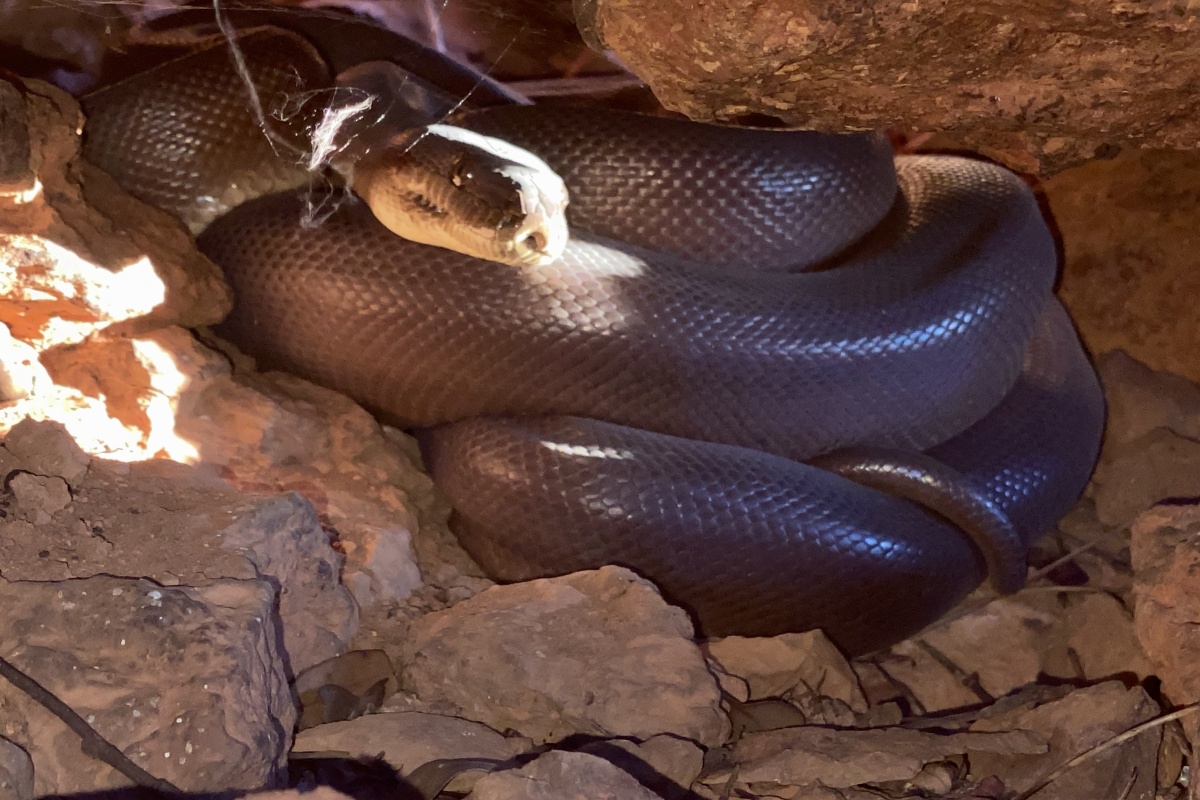
A female Pilbara olive python basks in late afternoon sunshine before continuing her examination of possible nest sites at Millstream Chichester National Park. Photo – DBCA
Learning about POPs
Studying pythons requires patience. Their life proceeds at a much slower pace than other vertebrates such as mammals, birds and even most other reptiles. It is common for POPs to sit in one place for a week, two weeks, or even two months without any need to find food or water. Which at times makes for quite uneventful field trips, particularly in winter, when even after a week or so it is entirely likely that none have moved or been visible!
Fortunately, the availability of reliable, implantable transmitters in the last 30 years has revolutionised the study of snakes. Advances in battery technology now mean that transmitters can last up to three years, which allows the collection of detailed long-term data. To implant transmitters, pythons are anaesthetised and the units with their aerials are inserted through a small incision in the flank of the snake that is then sutured, and, after a rest, the python is ready to return to the bush.
At a study site in Millstream Chichester National Park, the pythons are tracked at regular intervals on foot. It is often necessary to climb hills along the river to hear their signals. Each radio transmitter emits a signal on a unique frequency, so it is possible to track many individual pythons at the one time. If a python is submerged in water, in a steep gully or under large rocks, the signal is weakened so you need to be reasonably close to the python to detect them. This can be tricky, especially in summer, when POPs are frequently enjoying a swim in a billabong!
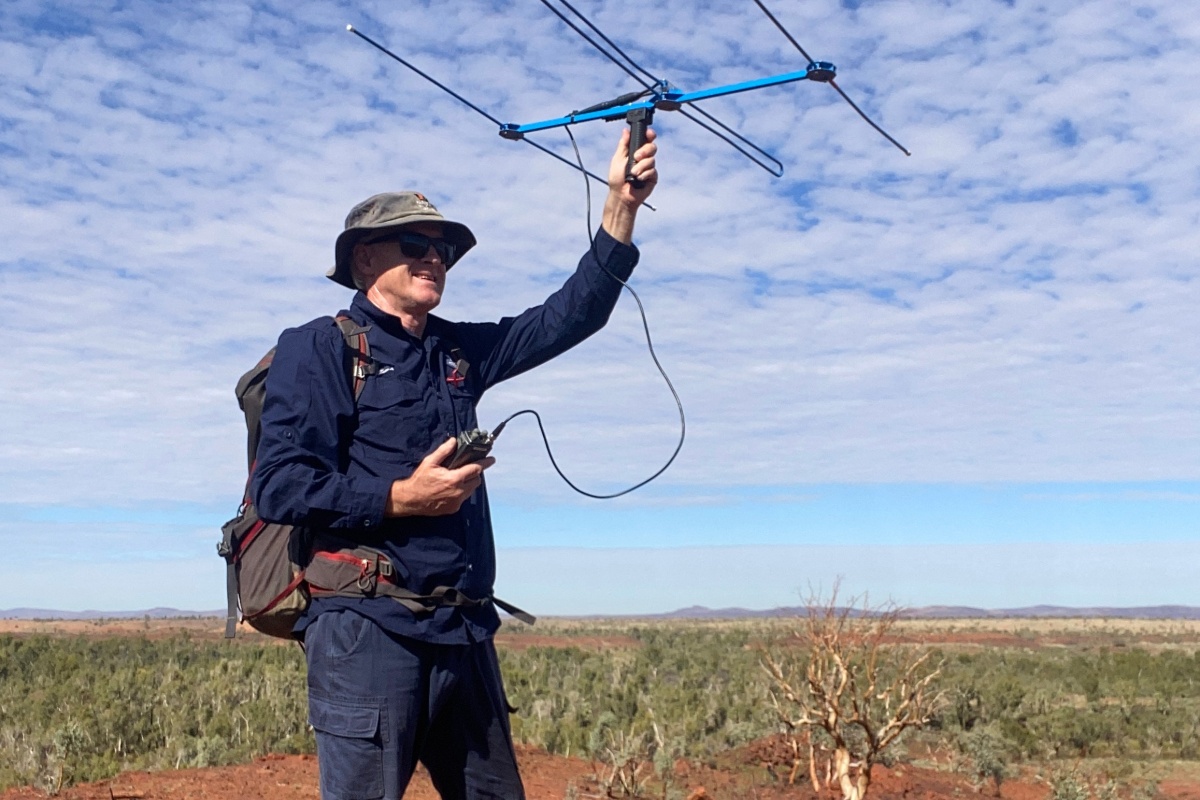
Radio-tracking pythons at Millstream. Photo - DBCA
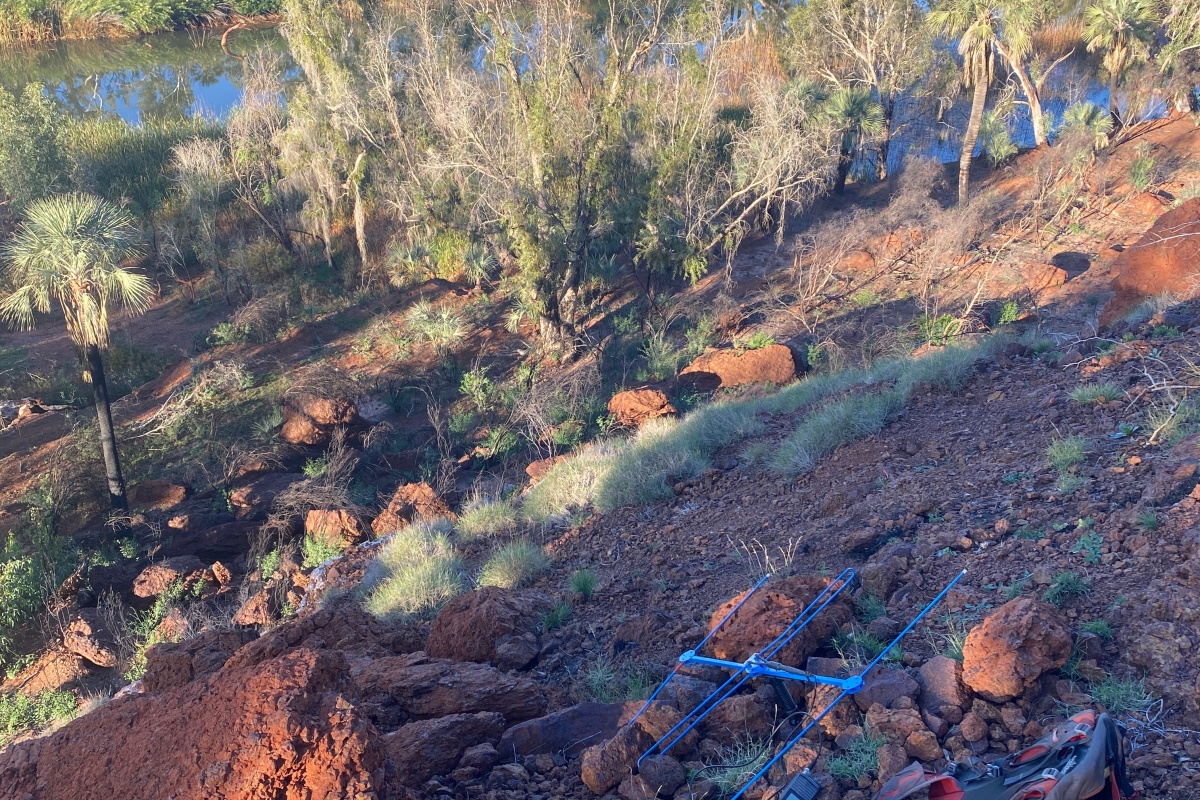
Radio-tracking near Cliff Lookout. Photo - DBCA
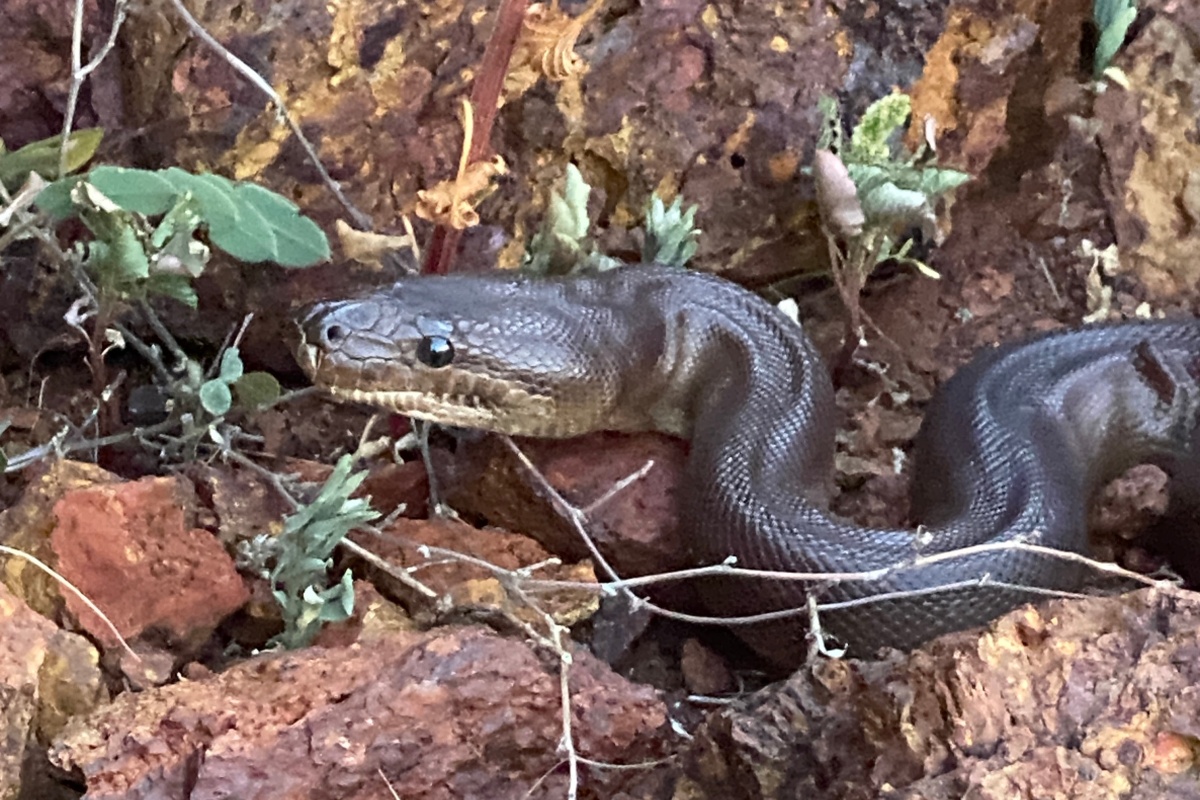
Pilbara Olive Python. Photo - DBCA
Unexpected variety
Within a snake population, we typically expect individuals to behave in a similar way for purely instinctive reasons. However, radio tracking, especially in the short Pilbara winter, reveals considerable variation in individual POP behaviour. Some smaller pythons return to the same rock crevice each year and sit for two months without moving; others choose to ascend trees and rest in hollows over the cooler months. In contrast, pythons submerged in the warm waters of the Millstream Chichester National Park springs can continue to hunt and digest prey when it is too cold elsewhere for pythons to do this.
The reproductive males and females show very different behaviours during this time, with male pythons venturing many kilometres and well away from the river to search for mates or potential nesting sites. They typically depart from daytime shelter in the late afternoon and travel during the night to a new rock shelter or tree hollow to rest during the day before continuing their journeys.
The nesting behaviour of female pythons remains largely a mystery. From limited radio telemetry data, we know that females breed infrequently; perhaps only every three or four years. Developing the body fat reserves for reproduction, then laying a clutch of eggs and coiling around them for two months to keep them protected, warm and hydrated, extracts a great toll and requires a long recovery period. Current research at Millstream Chichester National Park is attempting to improve our knowledge about the breeding behaviour of POPs, especially nesting locations and the dispersal of juveniles.

A Pilbara olive python sheltering in a coolabah log. Photo – DBCA.
Even ‘monsters’ have enemies
POPs start out as tiny pythons when they hatch, not much larger than a bootlace, and they contend with many predators such as blue-winged kookaburras and other snakes. Even larger POPs are vulnerable to native predators such as birds of prey, goannas and snake-eating snakes (mulga snakes and black-headed pythons). Their preferred habitats of thick wetland vegetation and rocky outcrops with spinifex grassland allow them to conceal themselves from many predators.
Conservation threats
The Pilbara is an ancient landscape, but some areas are undergoing rapid change due to mining operations and the development of infrastructure such as roads, pipelines and railway lines. This results in the loss of some habitat for POPs and may cause local population declines. Research is working on better ways to mitigate these impacts and to monitor populations.
Other threats include introduced predators and bushfire. These are being investigated and managed on conservation lands such as Millstream Chichester and Karijini national parks, which is beneficial not only for the POP but also its habitat and many of its preferred prey.

Python Pool in Millstream Chichester National Park. Photo – DBCA.