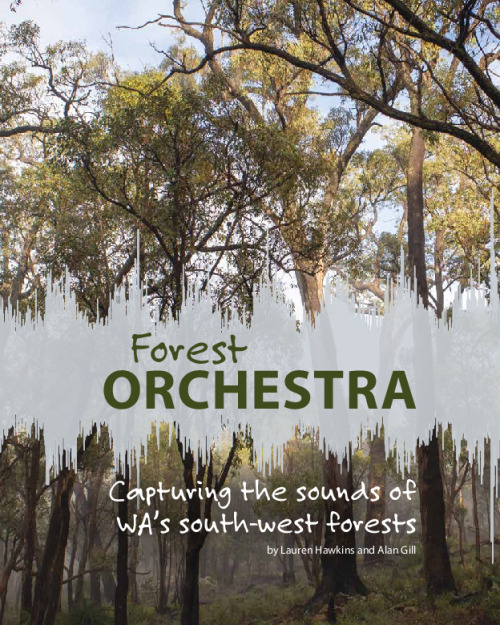
Picture, for a moment, a eucalypt forest. You see tall trees stretching skyward while dappled light casts shadows on the forest floor. You smell the distinct scent that eucalypts have, tinged with the musty, damp odour of leaf litter wet with dew. You carefully run your hand along a tree trunk, with its coarse, stringy bark confirming you’re in a jarrah forest.
But what do you hear? Perhaps it’s a bird call, or the wind rustling the leaves. Maybe you hear the soft thud as a kangaroo stirs and bounds away. And what of the insects: do you hear that all-consuming wave of sound that seems to swell and swirl around the forest?
The soundscape of an environment contains clues about the ecosystem, providing an opportunity to detect some of the most hard-to-find creatures.Technological advances mean innovative scientists can tune into the forest’s soundtrack to uncover what our eyes might struggle to see.
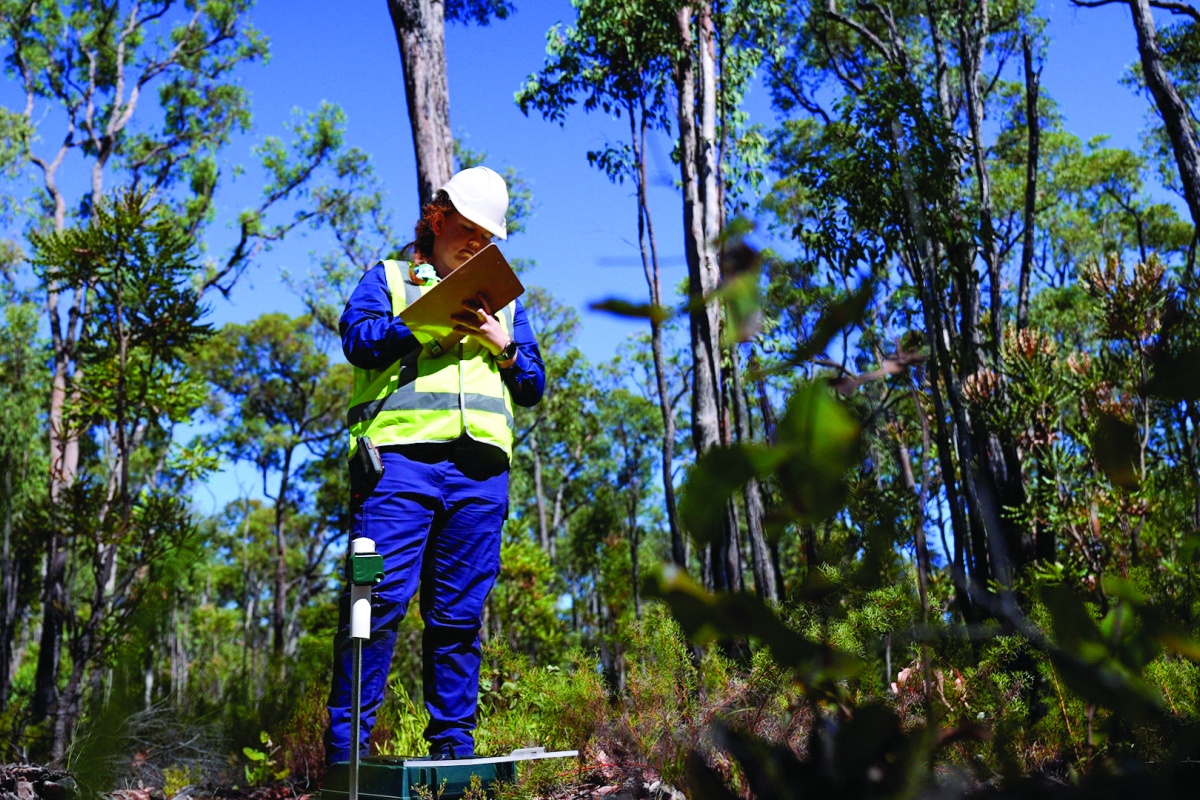
Installing acoustic recording devices. Photo – Samille Mitchell/DBCA
WIRED FOR SOUND
It is early morning, and Department of Biodiversity, Conservation and Attractions (DBCA) researcher, Lauren Hawkins, is leading a team through the Northern Jarrah Forest near Mundaring.This morning’s task is to retrieve the equipment used to record the soundscape; an emerging discipline known as ‘ecoacoustics’.
“Ecoacoustics is a way of understanding the acoustic signature of an environment and how it changes over time,” Lauren said. “We currently know very little about the soundscape of the Northern Jarrah Forest, so we are deploying a network of audio recording units to develop a baseline of what’s out here.”
Acoustic loggers such as AudioMoth units are equipped with omni-directional microphones that are highly sensitive to sounds from all directions. The loggers are programmed to record one minute of audio out of every three, and are placed in the landscape for a week to capture the cycle of sound over several day/night periods. The data they capture are then later analysed back in a laboratory using specialist software.
In addition to determining baseline soundscapes for the Northern Jarrah Forest, this research is looking at how frequently AudioMoths should be recording in order to best capture the acoustic environment.
“A one-in-three sampling frequency allows us to record the environmental soundscape without unnecessarily draining battery power or filling up memory cards,” Lauren said.
“What we need to know is what length of recording works best: is it one minute out of every three, or perhaps five minutes out of every fifteen? Some of our sites have two units deployed so we can compare detection rates between different settings.”
LISTENING AND LOOKING
While fieldwork often gets the glory, it’s back in the laboratory where these technologies start to uncover the acoustic fingerprint of a landscape. Once the team has downloaded and backed-up the data captured by the recording units, they can put on some headphones and listen to the greatest hits of the forest.
“The first listen is always exciting because you never quite know what animal sounds you might have recorded,” Lauren said.
“The data were captured during warm summer nights. When listening to the first few audio files, I could hear the rustle of animals moving over leaf litter, the high-pitched clicks of white-striped freetail bats (Austronomous australis), and the distinctive call of the boobook owl (Ninox boobook).”
This ‘first listen’ acts like an audition to ensure the AudioMoths have done their job, ready for analytical tools to help scientists see the soundscape.
The audio files are loaded into software that creates graphical representations of the soundscape, separating out sounds by frequency and time. This enables scientists to visually scan the soundscape to identify long- duration calling events like insect choruses or short, sharp sounds such as bird calls.
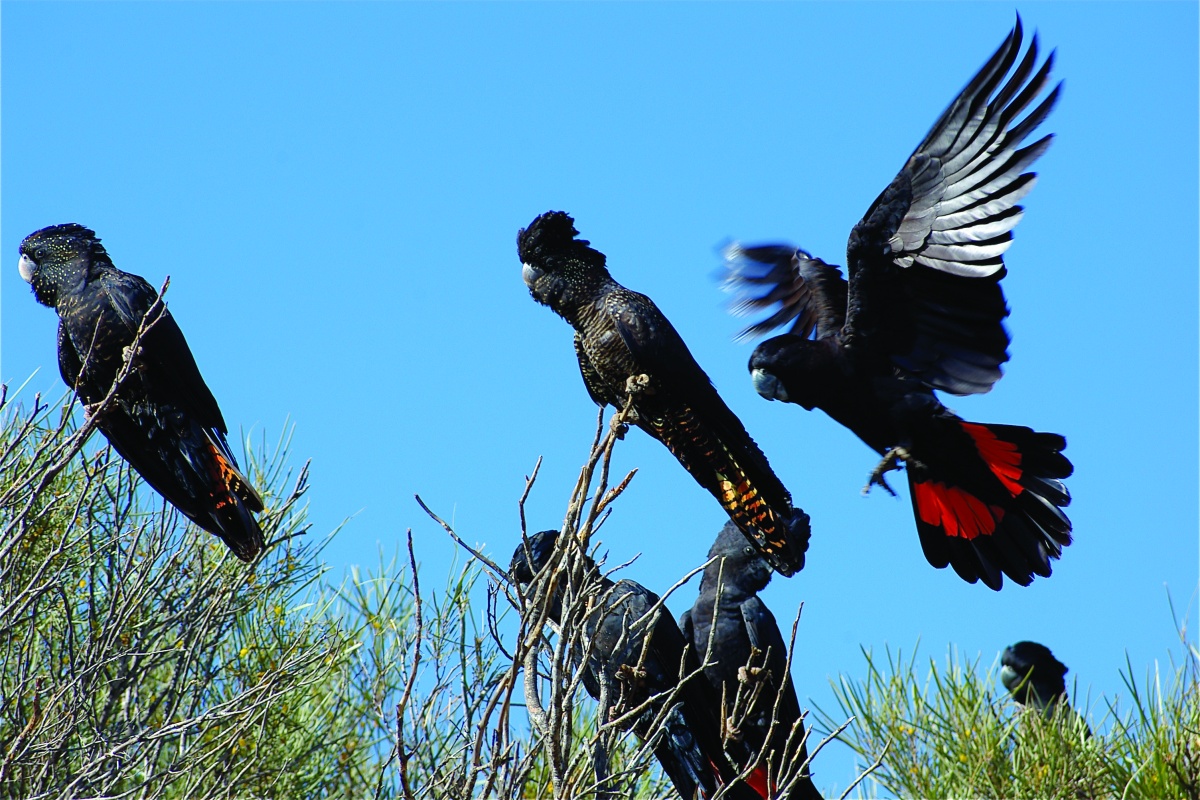
Forest red-tailed black cockatoos (Calyptorhynchus banksii). Photo – Doug Coughran/DBCA
“A range of sound-making species produce a cacophony of sound over long durations, such as birds, insects and frogs,” Lauren said.
“Identifying a chorus such as this and determining which species are singing is integral to understanding the ecosystem we’re studying.”
Visualising the audio spectrum by pitch aids researchers in narrowing down the species that may be responsible for different sounds. The concept of an ‘acoustic niche’ suggests that animals choose a frequency range, time and volume to call so that their audience—usually others of their own species—can hear them easily.
“Two different species making sounds at the same pitch and the same time will have a hard time communicating with their own kind,” Lauren said.
“Research has shown that in habitats with diverse communities of animals, most sound-producing species evolve to use a particular range of frequencies and time intervals for communication and navigation, minimising interference with other species.
“These graphical representations make it easier to spot each acoustic niche and increase our understanding not just of the landscape as a whole, but how these species interact in a noise-competitive environment.”
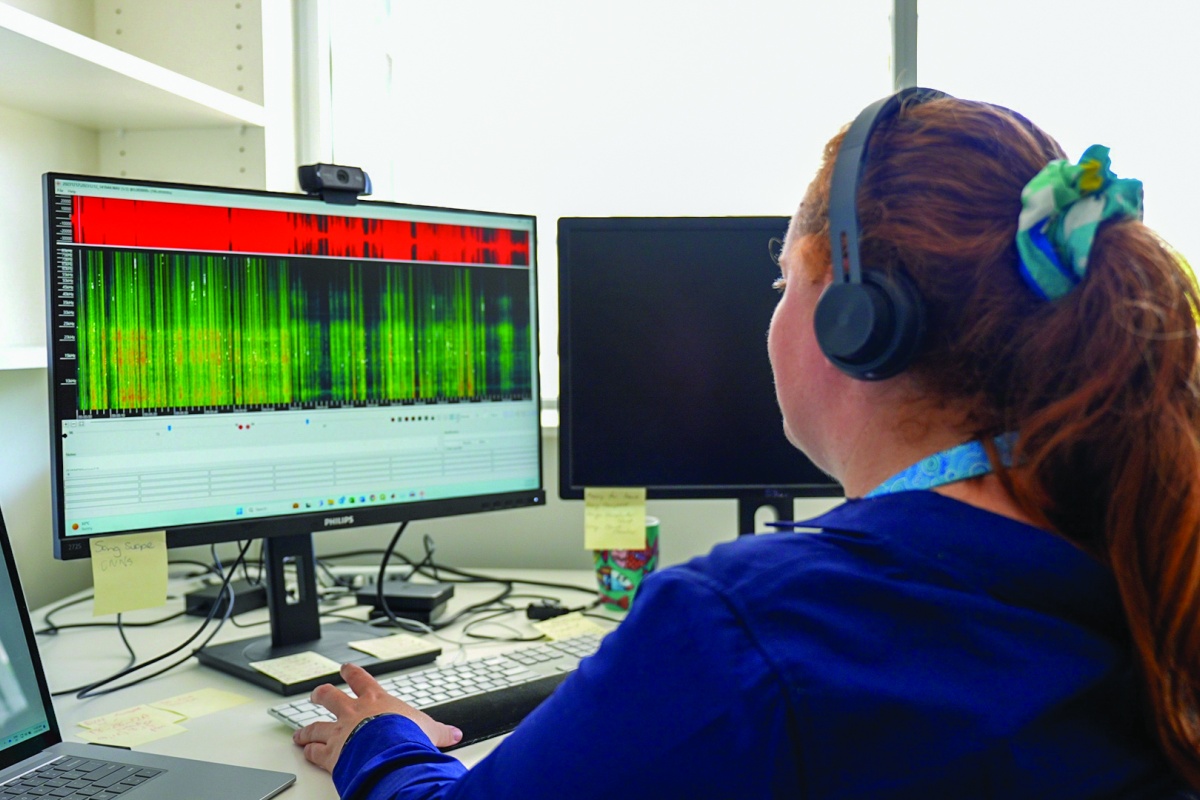
Lauren examining a picture of forest sounds. Photo – Samille Mitchell/DBCA
LOOKING FOR PATTERNS
Comparing the acoustic signatures of different sites within a habitat allows scientists to determine how much variance they should expect within a landscape. Concentrations of sounds might indicate feeding, nesting, or resting areas, or even identify movement corridors.Conversely, the relative absence of sounds may indicate a threat or disturbance in the landscape.
“We heard more bat vocalisations at one site than we recorded elsewhere in the study area,” Lauren said.
“These detections told us we needed to go back into the forest to look at this particular location to see what made it so different from the others. We could see that the site was situated close to an extended open area in the forest canopy, giving it potential as a bat flyway. Finding an acoustic anomaly like this provides valuable data on how these animals use the Northern Jarrah Forest and can inform future surveys.”
Confirming data analysis with field observations, known as ‘ground-truthing’, is an important part of an iterative process in understanding what drives the soundscape of an environment. With a variety of variables impacting local biodiversity, measurements such as tree density, canopy cover and vegetation composition are integral to understanding why some sites sound different.
“Projects such as this are critical to building a picture of what we should expect the landscape to sound like,” Lauren said.“We can then look for changes in the acoustic environment as a way of tracking changes in environmental conditions, including climate change impacts, habitat degradation and human disturbance.”
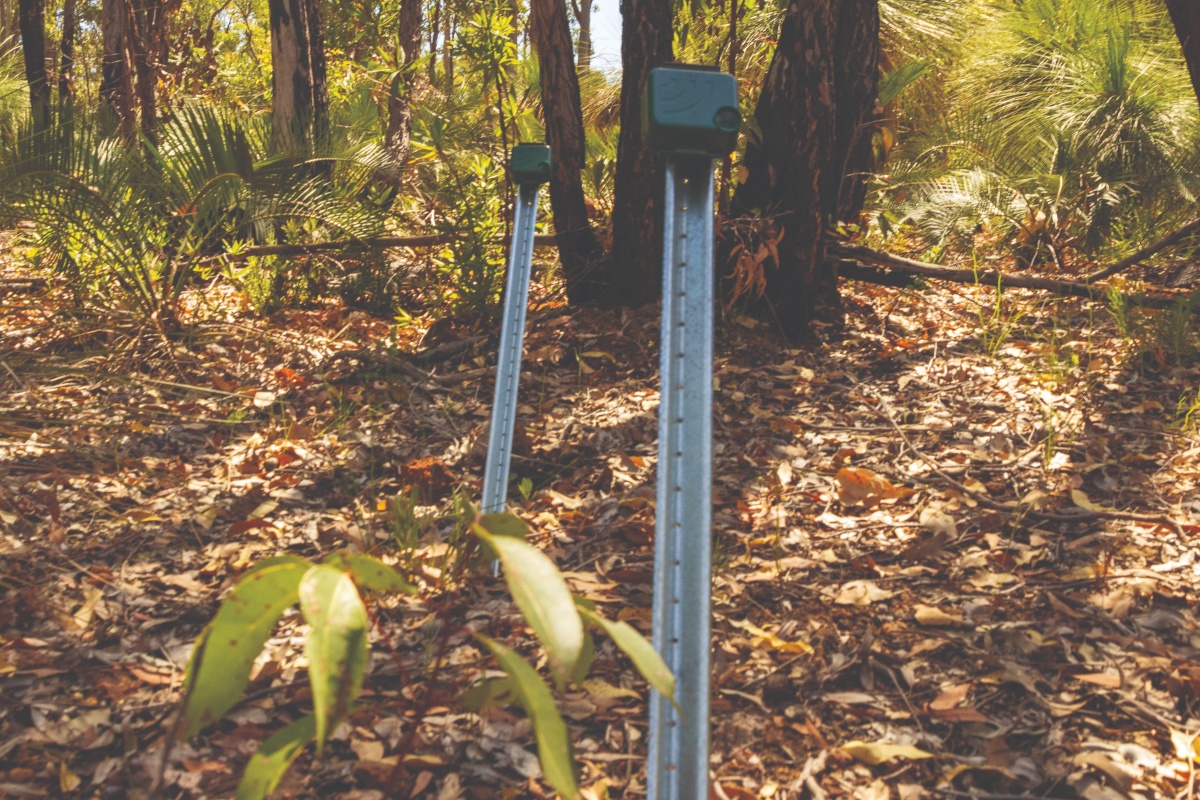
Acoustic recording devices deployed in the Northern Jarrah Forest. Photo – Alan Gill/DBCA
AI STEPS UP TO THE MIC
Soundscape recordings are not new, but advances in technology—particularly machine learning and artificial intelligence (AI)—mean scientists can now record, process and analyse vast amounts of data than would otherwise be possible.
Computers, though, don’t really know what a Carnaby’s cockatoo (Zanda latirostris) or a sunset frog (Spicospina flammocaerulea) sound like without
first being told. Machine learning allows humans to teach an AI program to distinguish different calls and the species responsible for them. Scientists label different sounds, then progressively let the program identify them, followed by validation and verification.
“The most recent field trip produced more than 1000 hours of audio recordings,” Lauren said.
“It would be impossible to listen to these files play in real-time and write down what sounds we hear and when we heard them: it would take more than six months for one research scientist to process the audio files from this single study. Graphical tools can help identify moments when the soundscape requires further investigation, but bringing machine learning into the process unlocks a level of data analysis that is otherwise impossible to attain.”
The advance of AI and machine learning may create concern for humans who might find their jobs replaced, but for scientists, these tools enable them to do their jobs better and more effectively. “Ecoacoustics can be a valuable tool for understanding our landscapes and informing future survey and conservation projects,” Lauren said.
“The field is advancing rapidly thanks to technological innovation, developing into a valuable tool for ecological monitoring and management. In a rapidly changing world, ecoacoustics may play a pivotal role in our efforts to monitor, protect, and restore the forests of south- west WA for years to come.”
“Projects such as this are critical to building a picture of what we should expect the landscape to sound like.”
Using the emerging science of eco-acoustics, DBCA researchers are monitoring forest soundscapes to better understand and benchmark ecosystem health. Eco-acoustics can also help detect rare, secretive, and invasive species in a low impact manner. While providing solid science, eco-acoustics also reminds us of the magic of stopping and listening to nature. It is part of a suite of new science informing forest management in Western Australia, under the Forest Management Plan 2024-2033. Find out more at dbca.wa.gov.au/fmp
Add podcast