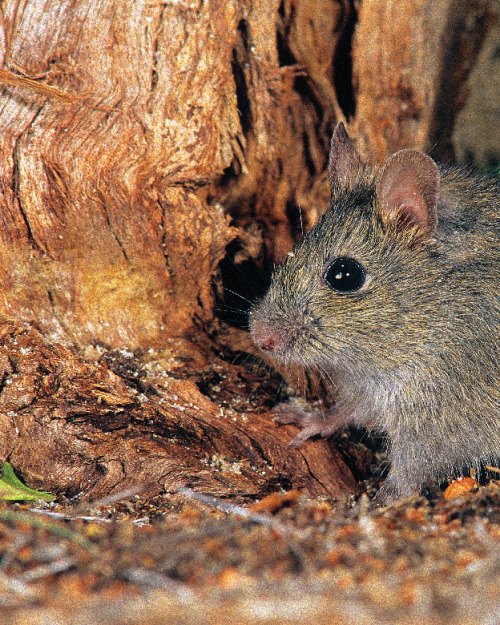
Until recently, there was limited survey effort focused on the heath mouse (Pseudomys shortridgei). Targeted surveys commenced in 2019 to better understand how well this locally rare species was faring in Western Australia. With an average weight of 70 grams, the heath mouse, or dayang, is a relatively large native mouse that is often confused with the native bush rat (Rattus fuscipes).
One telltale sign to distinguish the heath mouse is a hairy bi-coloured tail (dark above and pale beneath) minus the distinctive rings typical of rats, and their ‘roman’ nose is blunt instead of pointy. The heath mouse is listed as Endangered under the Environment Protection and Biodiversity Conservation (EPBC) Act 1999 and Vulnerable under the Western Australian Biodiversity Conservation Act 2016.
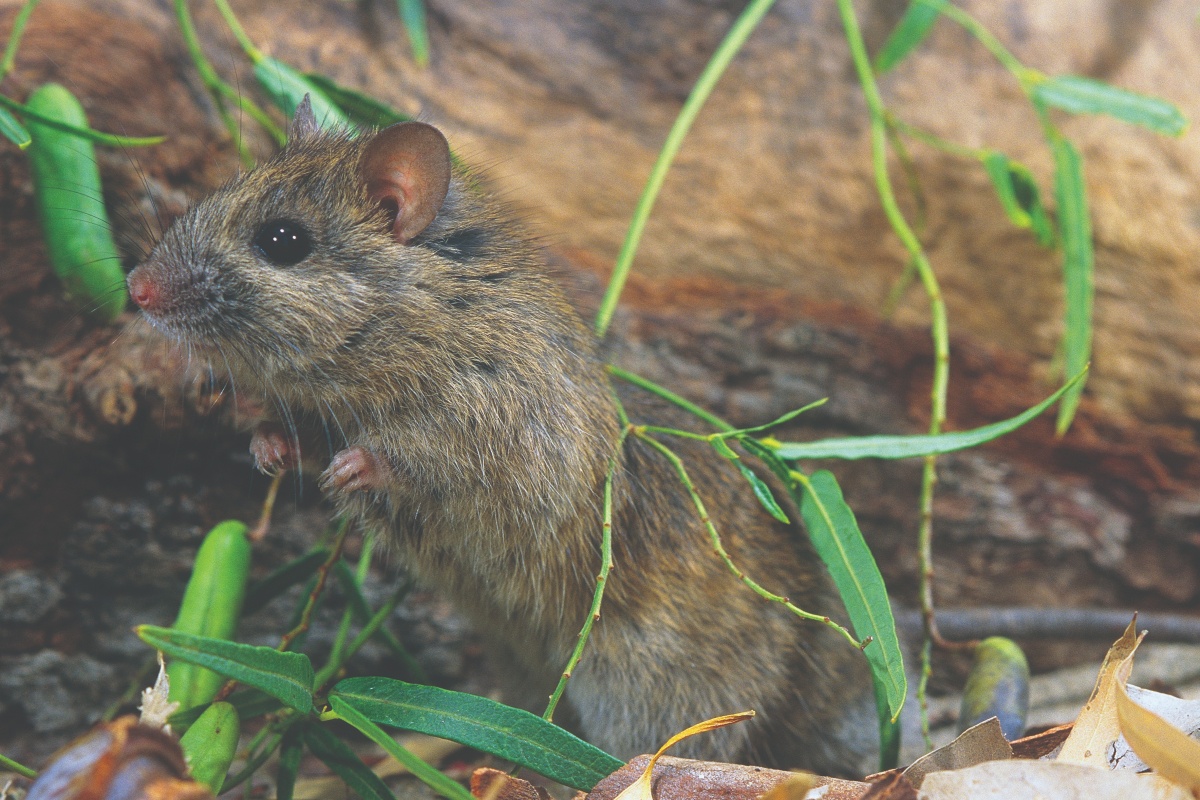
The bush rat (Rattus fuscipes) looks similar to the heath mouse. Photo – Jiri Lochman - Photo Jiri Lochman
THE GREAT DIVIDE
The heath mouse once occurred across the heathlands of Western Australia, South Australia and Victoria. But, like several other native rodents, the species has disappeared from many areas, most likely because of habitat loss and fragmentation, and predation by introduced predators such as the fox (Vulpes vulpes) and feral cat (Felis catus).
They are now found in two restricted and widely separated locations in south- western Victoria (and just across the border into South Australia) and southern Western Australia. While there is some disparity in studies investigating genetic differences across this divide, they are currently treated as a single species.
The main preferred habitat difference between these two broad locations seems to be related to the post-fire age of the vegetation. In Western Australia, the heath mouse has been found in areas of long unburnt habitat, with the highest densities recorded in vegetation 30 years post-fire.
In Victoria, the highest densities have been recorded in habitat 5–15 years after bushfire. This may be because it takes longer for the vegetation to recover following bushfire in the drier climate within the species’ Western Australian range. Favoured habitat for the species in Western Australia appears to be species- rich and structurally complex heathland, and shrub-mallee woodland. In Victoria it prefers sandy heath and heathy sclerophyll forest.
IN THE WEST
The rarely-detected heath mouse, first discovered in 1906 in Western Australia’s central wheatbelt, was believed to be extinct in WA from the early 1930s.
However, it was detected again in 1987 at Fitzgerald River National Park.Since then, it has also been found in low numbers in the Ravensthorpe area near Fitzgerald River National Park, as well as a few other spots in the wheatbelt including Lake Magenta and Dragon Rocks nature reserves. Until 2019, when survey efforts ramped up, the last confirmed sighting of the heath mouse in Western Australia was in 2009 at Lake Magenta Nature Reserve, a recognised hotspot for the species
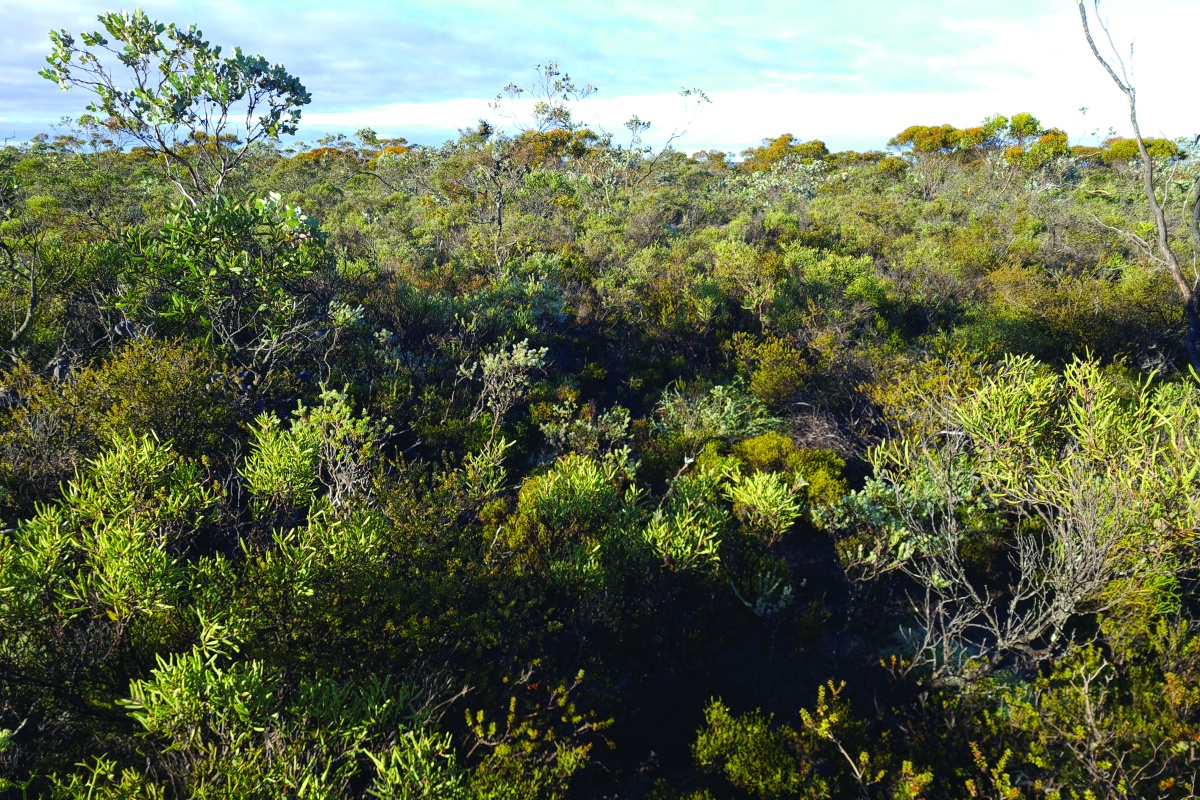
Dense habitat at Lake Magenta Nature Reserve. Photo – Saul Cowen/DBCA
THE SEARCH WAS ON
Ten years on, heath mice were captured at two locations in an area south of Ravensthorpe, and another near Digger Rocks north-west of Frank Hann National Park. While this provided hope that the species was doing okay, the Digger Rocks site was subsequently burnt in a large bushfire.
Further surveys in 2020 were undertaken in areas where it had previously been found, including the Ravensthorpe site. However, capture success across all sites for other small mammals was remarkably low, probably due to successive years of below average rainfall across the region.
Some sites were also affected by bushfire and likely to be no longer suitable. Many rodent species respond to rainfall, with rapid increases in population size following a period of high rainfall, then declining as the conditions dry out—commonly known as a boom/ bust cycle. Studies in the Grampians National Park in Victoria have shown a strong correlation between heath mouse abundance and rainfall. This is also likely to be the case in Western Australia, which is concerning given future predictions of a drying climate in the region where the heath mouse occurs. Drought conditions broke in 2021, which reinvigorated efforts and the search for the heath mouse continued. These surveys did not detect the heath mouse, and low captures generally of other native mammals may have been exacerbated by an ensuing introduced house mouse (Mus musculus) plague, and mice filling the traps. Then in May 2023, a heath mouse was captured at Lake Magenta Nature Reserve and declared (unofficially) Happy Heath Mouse Day! All those early mornings spent checking traps in scratchy, dense heath—literally blood, sweat and tears—finally paid off.
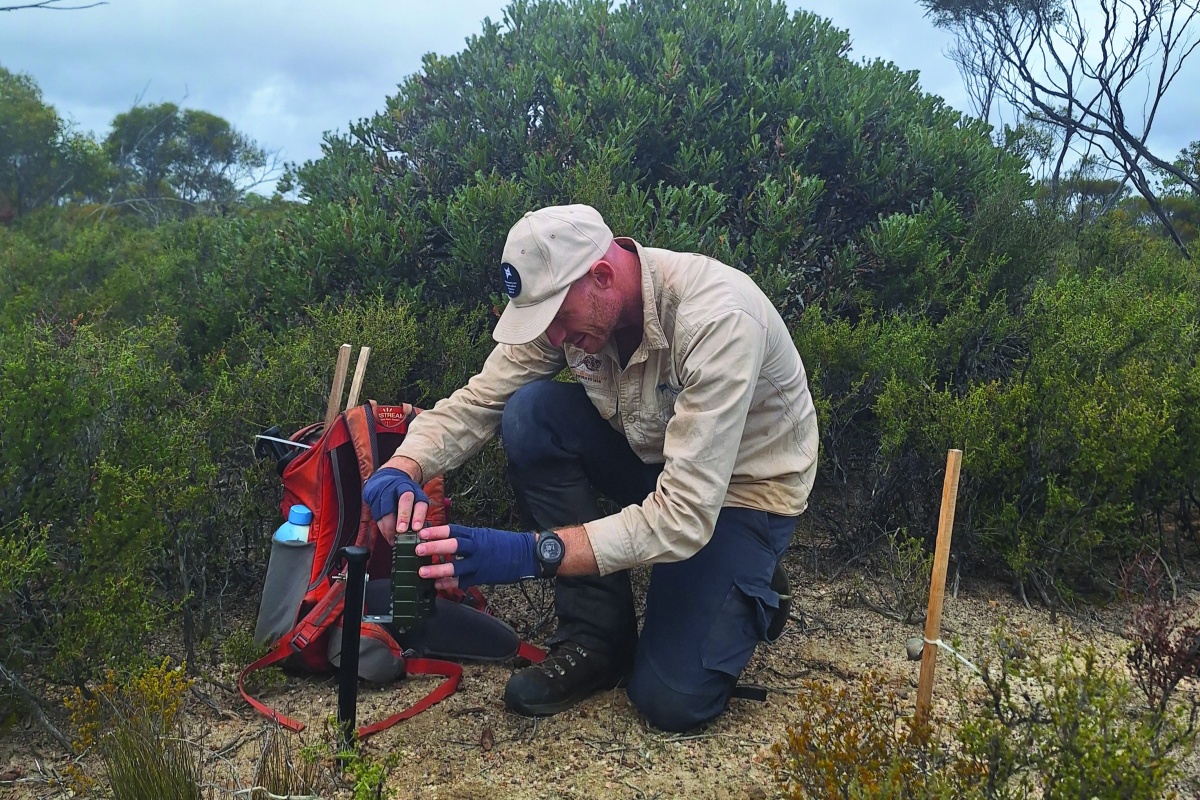
Checking traps at Lake Magenta. Photo – Saul Cowen/DBCA
YOU’RE ON CANDID CAMERA
Now we know that the species persists there, additional surveys to assess the distribution and abundance of heath mice in areas of suitable habitat throughout Lake Magenta are continuing. These surveys are taking advantage of remote sensor camera traps, which have been shown to be effective in detecting heath mice in Victoria.
Feral cat management by the Department of Biodiversity, Conservation and Attraction’s Western Shield team is also planned to be carried out in the reserve for the first time. Ongoing monitoring of both heath mice (and other fauna) and feral cat activity in the reserve will help us better understand how effective this feral cat management has been.
The rarely detected heath mouse, first discovered in 1906 in Western Australia’s central wheatbelt, was believed to be extinct in WA from the early 1930s.
A CHANGING ENVIRONMENT
Investigations are also being undertaken to identify whether there has been any significant change in the vegetation composition and structure at sites in Lake Magenta Nature Reserve where heath mice have been captured. We suspect that some areas, which were potentially suitable 20 years ago, may no longer be so, due to lack of bushfire and vegetation senescence.
While the species is believed to prefer long unburnt habitat in Western Australia, this is likely to be related to vegetation cover and structure, which eventually diminishes as vegetation ages. Introducing prescribed fire to create a mosaic of vegetation ages may improve the quality of the habitat overall and prevent bushfires destroying large areas of suitable habitat for the heath mouse
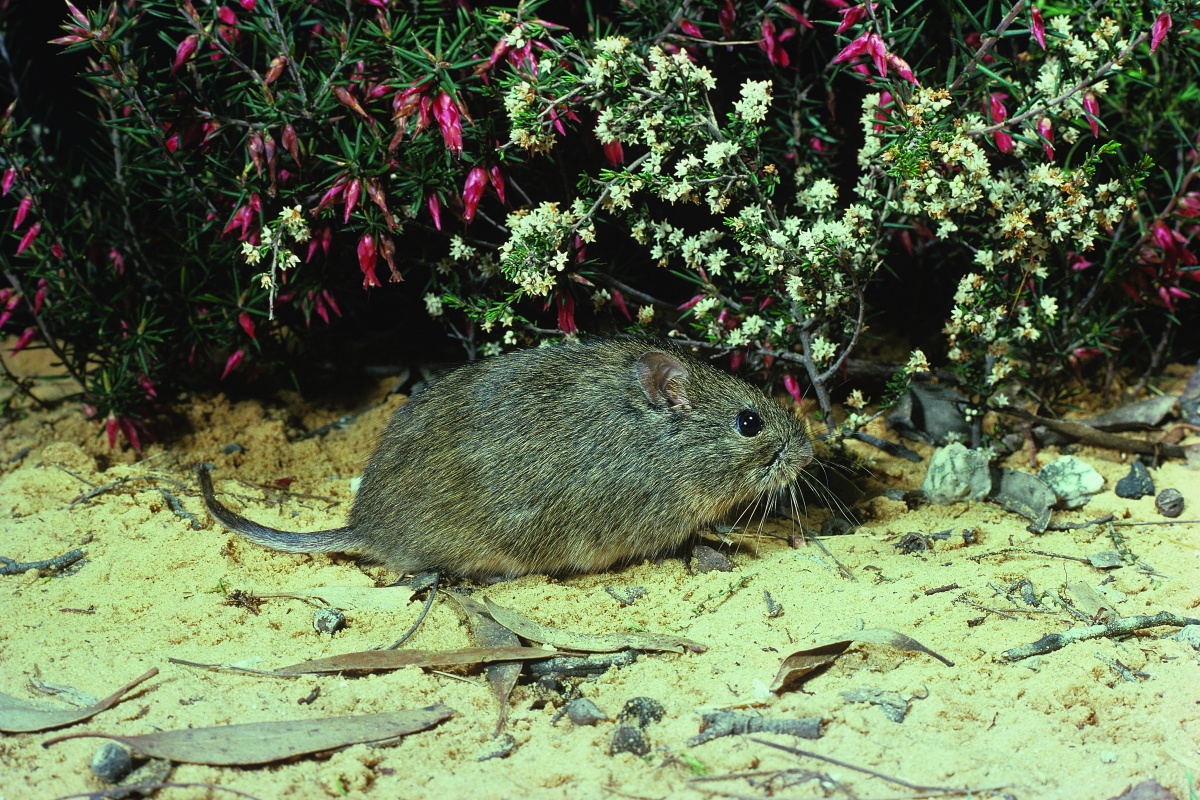
The tail length of the heath mouse (Pseudomys shortridgei) is shorter than its head-body length. Photo – Hans & Judy Beste/Lochman Transparencies - Photo
IMPROVING DETECTION
Despite the challenge of detecting a species at such low densities and with a patchy distribution, continuing to survey in other areas remains important to fully understand the conservation status of the heath mouse across its range. Habitat suitability models—based on historical records and relevant environmental data layers, that also take into consideration future climate scenarios—have been produced to help identify new areas that may be suitable
habitat for the heath mouse, and to better target survey efforts. Ongoing improvements in species detection, such as the use of camera traps and eDNA (i.e., DNA detected in the environment), may reveal the heath mouse is not as scarce as we thought— just really tricky to find.
Author box
Lesley Gibson is a Principal Research Scientist with DBCA’s Biodiversity and Conservation Science. She can be contacted at lesley.gibson@dbca.wa.gov.au or (08) 9219 9069.
Sarah Comer is a Regional Ecologist in DBCA’s Parks and Wildlife Service South Coast Region. She can be contacted at sarah.comer@dbca.wa.gov.au or (08) 9842 4517.
Saul Cowen is a Research Scientist with DBCA’s Biodiversity and Conservation Science Animal Science Program. He can be contacted at saul.cowen@dbca.wa.gov.au or (08) 9405 5119.
Peter Lacey is a District Coordinator Conservation in DBCA’s Parks and Wildlife Service Wheatbelt Region. He can be contacted at peter.lacey@dbca.wa.gov.au or (08) 9881 9210.
Carly Moir is a Technical Officer and she leads the Animal Science Program with DBCA’s Biodiversity and Conservation Science.
Deon Utber is Regional Leader Conservation in DBCA’s Parks and Wildlife Service South Coast Region. He can be contacted at deon.utber@dbca.wa.gov.au or (08) 9842 4514.