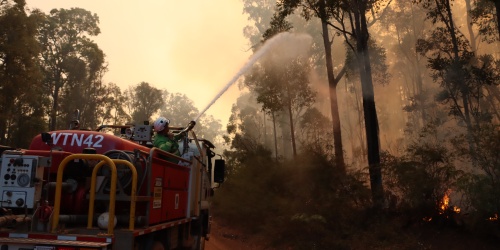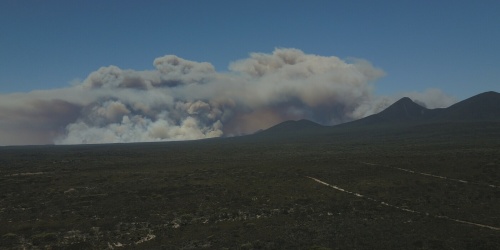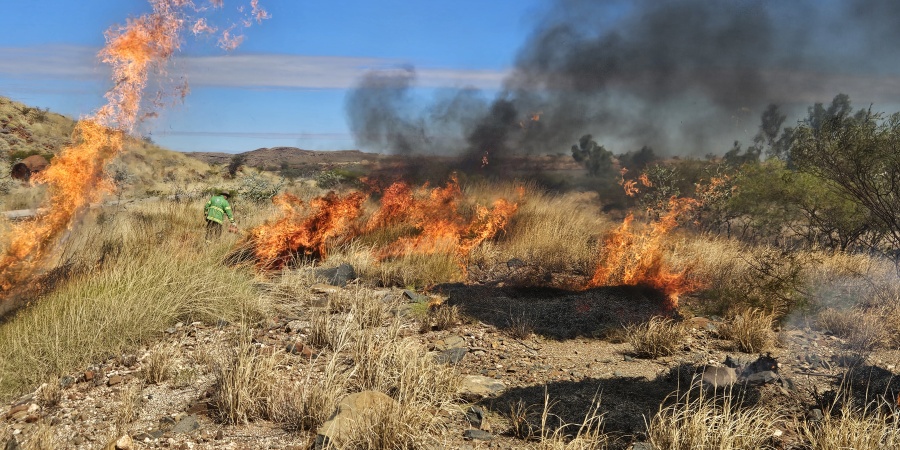
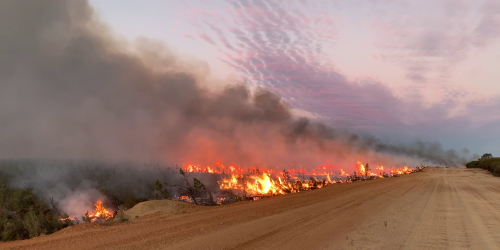
Prescribed burn, Millstream Chichester National Park, 2025. Photo - DBCA
Prescribed, controlled and planned burns are the same thing.
In Western Australia, they are referred to as prescribed burns because they follow a ‘prescription’ with several conditions that need to be met.
Why does Parks and Wildlife conduct prescribed burns?
When bushfires occur, their behaviour is driven by three factors: weather conditions, terrain, and fuel. The only factor that we can influence is fuel – fine combustible vegetation and debris like dead leaves, bark, and twigs.
Prescribed burning is the deliberate, controlled use of fire in the landscape undertaken during appropriate conditions to reduce the availability of the fuel that feeds a bushfire.
Many of our ecosystems require fire to regenerate or persist. So prescribed fire at the right frequency, season, size and intensity can enhance the resilience and diversity of our ecosystems.
The department uses prescribed burning for several purposes:
- to mitigate the severity of bushfires and to help protect lives and property by reducing the build-up of flammable fuel loads
- to maintain biodiversity
- to rehabilitate vegetation after disturbance, such as ecological thinning and mining
- to undertake research on fire and its interaction with our environment.
What is involved in prescribed burning?
Prescribed burning involves careful planning, consultation and monitoring, including:
- determining what vegetation needs to be burnt and what needs to be left unburnt (mosaic), the desired fire intensity and the season
- identifying conservation considerations, such as potential impacts on threatened species or communities and fire sensitive areas, and adopting appropriate strategies to accommodate their needs
- considering the history and variety of past fire events over the landscape, so a diversity of fire frequencies and intensities can be achieved
- studying and measuring the quantity, arrangement and moisture content of fuels
- determining, monitoring and forecasting the right weather conditions for igniting a burn using knowledge about fire behaviour
- determining the best time of day to ignite a burn in a specified pattern and sequence to achieve the desired outcomes and to prevent fire from escaping
- monitoring the results of a burn to determine how well the operation met the objectives set for the burn
- using knowledge gained and lessons learned to improve future prescribed burning operations.
All of this is underpinned by a rigorous approvals process. The section on planning for prescribed burning has more detail on what is involved.
For information on the practice of prescribed burning in south-west forests, the Pilbara and Kimberley, see Fire regions in focus (link).
When does burning occur?
In the regions in the south- west of the State with distinct seasons, prescribed burning typically takes place in spring and autumn when conditions are cooler, vegetation and fuel moisture levels are higher and weather conditions are more stable. These conditions ensure fires are controllable, while still removing enough fuel to reduce bushfire risk.
A prescribed burn may be ignited in the prohibited burning period (December to March) if conditions are suitable, in these cases, permission is granted by the Fire and Emergency Services Commissioner.
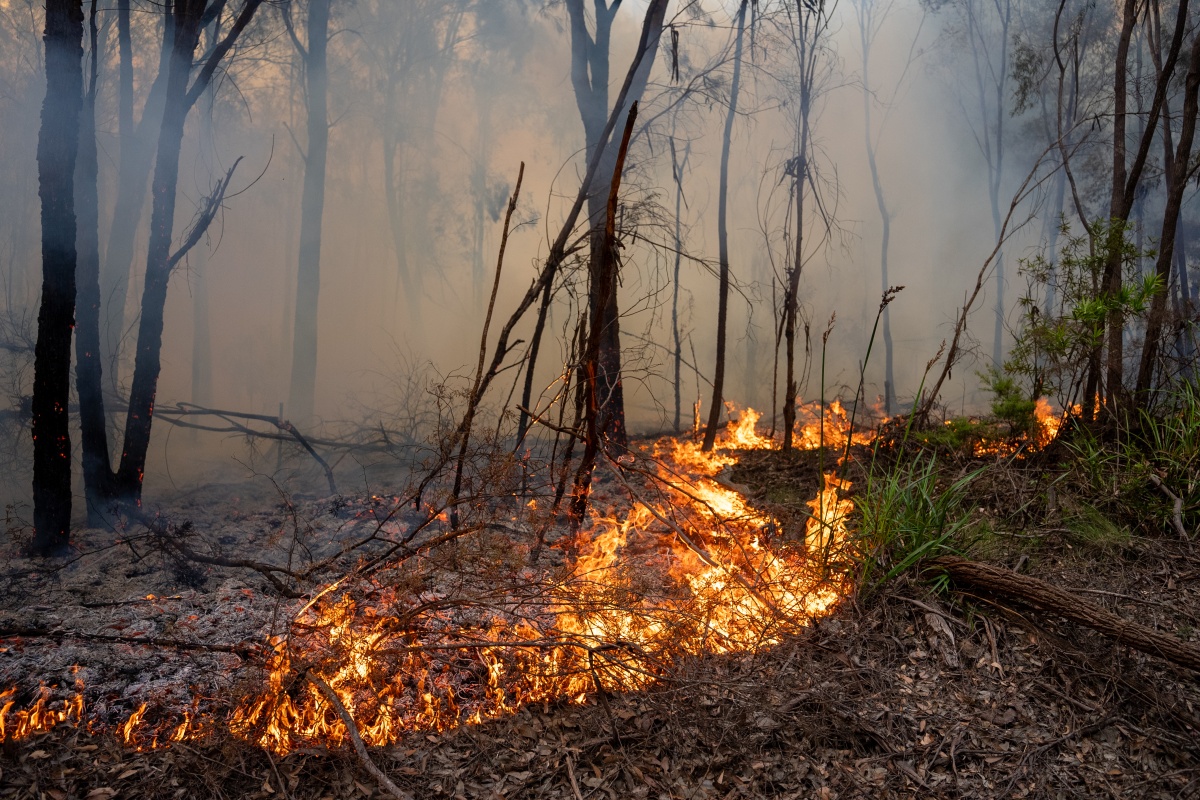
Prescribed burns may be conducted in summer in the cool wet forests near the south coast when conditions are suitable and with permission of the Fire and Emergency Services Commissioner. Photo – DBCA
In regions with wet and dry seasons, such as the Kimberley, burning is conducted from January to June (wet to early dry season), when winds are predictable and the ground vegetation is not fully cured, and fires tend to be relatively low intensity, patchy and limited in extent. Also, night conditions are conducive to fires extinguishing.
Who is involved in prescribed burning?
In Western Australia, prescribed burning involves many players as part of a shared responsibility. Parks and Wildlife Service is responsible for prescribed burning on land that it manages. The Department of Fire and Emergency Services (DFES) conducts prescribed burns on unallocated Crown land and unmanaged reserves in the metropolitan area and all town sites in WA on behalf of the Department of Planning, Lands and Heritage (DPLH). Non-government Aboriginal organisations, such as the Kimberley Land Council, oversee a network of Aboriginal land managers with responsibility for fire management. Local governments and private land holders also undertake prescribed burns on the land they manage.
DBCA works effectively alongside and consults with the community,DFES, local governments and industries such as grape growers and other landholders. Wherever feasible, Parks and Wildlife Service, DFES and local government will conduct their prescribed burning programs as a joint exercise.
Is prescribed burning safe for communities?
Community safety is our primary concern when carrying out prescribed burns. Prescribed burning is a simple concept that depends on complex factors that are not always predictable, therefore there is always an element of risk associated when burning. Each prescribed burn is carefully planned and must pass a rigorous approvals process before any burning can begin. Prescribed burning reduces the likelihood of large damaging bushfires.
Is prescribed burning effective?
Yes. Scientific research shows that prescribed burning is very effective, especially when managing bushfires. Evidence from experimental and actual fires demonstrates that higher fuel levels increases the rate of spread, flame height, fire intensity and spotting distance of a bushfire. Reducing the amount of fuel such as leaf litter and twigs through prescribed burning enables bushfires to be more readily and safely controlled.
Parks and Wildlife Service’s Blackwood District Fire Coordinator explains how two fires burning at the same time under the same conditions, had very different outcomes due to fuel levels.
“The reduced fire intensity and rate of spread observed when bushfires enter a reduced fuel area allows firefighters greater opportunity to effectively combat the fire and to limit its impact. In fact, the Special Inquiry heard evidence that the Roleystone-Kelmscott fire was extinguished on one front when it entered a section of the Banyowla Regional Park that had been the subject of a prescribed burn by DEC (now the Department of Parks and Wildlife) four years ago, as discussed later in this chapter”.
The 2011 Perth Hills bushfire caused serious damage but the destruction in this fire prone area was limited by prescribed burns undertaken in the previous four years at strategic locations.
How does Parks and Wildlife manage the risk of escapes?
Prescribed burning is not without risk. However the department, through scientific research and experience has made changes and implemented procedures to minimise the risk of potential escapes.
The department has recently undergone some major changes to ensure deliberate and pro-active risk management is applied to keep the risks associated with prescribed fire as low as reasonably practicable and aligning its risk management processes with the international standard ISO 31000 for risk management.
The Western Australian Government, through the Department of Fire and Emergency Service’s (DFES) Office of Bushfire Risk Management (OBRM), has endorsed the department’s approach to bring its prescribed burning into line with the international risk management standard ISO 31000.
OBRM is working with government and non-government organisations to align Western Australia’s bushfire business with ISO 31000. On behalf of DFES, OBRM also guides and facilitates the management of bushfire risk in Western Australia and reports on the annual management of bushfire fuel across Western Australia. For more information on DFES and OBRM visit dfes.wa.gov.au.
Daily risk monitoring and management
As part of the Department of Parks and Wildlife’s risk management approach, all burns are constantly monitored. Burns are classified each day and those determined to be active (see definition below) are scrutinised through the day to ensure the risk of escape is as low as reasonably possible.
Active prescribed burns
Parks and Wildlife carries out prescribed burns on land it manages. Burns also occur on private property or other land. For information contact your local authority.
Active burns are prescribed burns that have not been certified as completed. In the rangelands, the presence of hot spots detected by satellite surveillance over two consecutive days, means a burn is classified as active. In all other lands, a burn if still classified as active if there has been less than 30mm of rain (total) in the five days since the last ignition or that in the prior three days running fire has been observed or smoke has been reported within at least 100m of the burn boundary or within any area of unburnt fuel greater than 5ha that is within 500m of the burn.
Local fire restrictions may still be in place and must be adhered to, even if Parks and Wildlife is carrying out prescribed burns on public land. Visit the Department of Fire and Emergency Services for more information.
Related

Bushfire risk management framework and regional fuel management plans
DBCA's bushfire risk management framework and regional fuel management plans guide bushfire risk reduction on conservation lands and unallocated Crown land to reduce the risk of bushfire to people, communities, infrastructure, the economy and the natural environment. The framework and fuel management plans cover the nine Parks and Wildlife Service regions.