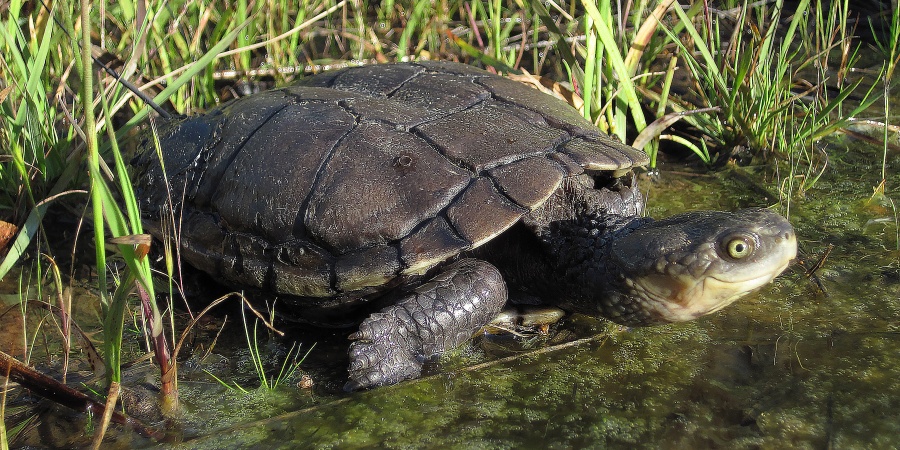
A wild female western swamp tortoise at Ellen Brook Nature Reserve in 2013. Photo - Gerald Kuchling
The Department of Biodiversity, Conservation and Attractions (DBCA) is seeking public comment on the draft western swamp tortoise (Pseudemydura umbrina) recovery plan.
The western swamp tortoise is one of Australia’s most critically endangered freshwater reptiles. This draft recovery plan outlines the actions proposed to support the long-term survival of the species in the wild, including habitat management, threat mitigation, research, monitoring and community involvement.
The draft recovery plan has been prepared under the Biodiversity Conservation Act 2016 and is now open for public comment.
Review the draft recovery plan in the downloads section below and email any feedback to fauna.recovery@dbca.wa.gov.au with the subject line 'Draft western swamp tortoise recovery plan feedback' by
1 October 2026.
To help us consider your feedback, please:
ensure comments are clear, concise and respectful
refer to relevant and specific page numbers or sections of the draft plan
be specific about which objectives or actions you support or do not support, and explain why, particularly where you disagree
include supporting information or sources where available
suggest alternatives for those aspects of the plan with which you disagree.
We may revise the draft plan in response to submissions that:
provide new information that is directly relevant to the conservation and management of the species
identify changes to, or clarify, legislation or policy that affect the plan
provide an alternative approach that better supports the plan’s objectives
indicate omissions, inaccuracies or a lack of clarity.
Changes are less likely to be made where a submission:
simply states support for the draft plan without suggesting a change
raises matters outside the scope of this plan, or seeks highly detailed operational content that does not belong in a recovery plan
repeats issues already addressed in the draft plan or considered during its development
suggests an alternative, but the current approach remains the most suitable option
proposes actions that are not practical or feasible that may be due to legislative, policy, resourcing or evidence constraints
relies on information that is unclear, inaccurate or cannot be verified
does not identify any specific change being sought.
Frequently asked questions
What is a recovery plan?
The Biodiversity Conservation Act 2016 (BC Act) provides for recovery plans to be prepared for the conservation, protection and management for one or more threatened species, or one or more threatened ecological communities, or a combination of threatened species and threatened ecological communities. A recovery plan must provide for research and management actions to stop the decline, and support the recovery, of each threatened species or threatened ecological community to which the plan relates so that its chance of long-term survival in the wild are maximised. Further information on recovery plans made or adopted under the BC Act and supporting information can be found on the DBCA Recovery Plans webpage.
Are they western swamp tortoises or western swamp turtles?
The species was first described by Siebenrock in 1901 and given the scientific name Pseudemydura umbrina and has historically been referred to as the western swamp tortoise. It is also known by several other common names, including western swamp turtle, short-necked turtle, and western short-necked turtle.
Historically, the use of tortoise and turtle have been used interchangeably and not been applied consistently on a global scale. The term tortoise is generally used for species in the family Testudinidae, which are terrestrial and typically have domed shells and sturdy, club-like feet. In contrast, freshwater turtles are adapted to life in water and usually have more streamlined shells and webbed feet. Australia does not have any tortoises in the Testudinidae family and the term tortoise has been used to describe a number of freshwater species in the Chelidae family, as it distinguished them from marine turtles. The biology and ecology of Pseudemydura umbrina are more consistent with freshwater turtles, and the species is referred to as the western swamp turtle, including on the IUCN Red List (Pseudemydura umbrina (Western Swamp Turtle)). This species is therefore known as both the western swamp tortoise and western swamp turtle. Many species have multiple common names, the scientific name provides a standardised and universally accepted identification for the species.
For the purpose of this draft recovery plan, DBCA will use the name currently listed under the BC Act: Pseudemydura umbrina (western swamp tortoise). DBCA follows advice from the Western Australian Museum (WAM) on fauna nomenclature. Unless a name change is advised by WAM and adopted by the Minister for the Environment, the recovery plan will use the name listed in the Biodiversity Conservation (Listing of Native Species) (Fauna) Order 2025.
The proposed objectives and actions in the draft recovery plan will not be impacted by the common name used for the species, which is also important to note given the recovery plan extends over a 10-year timeframe.
Why does the western swamp tortoise (WST) need a recovery plan?
The WST is one of Australia’s most threatened reptiles. It is listed as critically endangered under both Western Australian and Commonwealth legislation. The species is threatened by predation from introduced and native animals, loss and degradation of habitat, fire, and climate change. Habitat impacts are associated with factors such as groundwater extraction, urban, light industrial and semi-rural development, clay mining, and agriculture.
Under section 19(1)(a) of the BC Act, critically endangered species are those facing an extremely high risk of extinction in the wild in the immediate future, in accordance with the criteria set out in the ministerial guidelines. Further information about threatened species categories and the listing process is available on the Nominations for listing page.
The WST now occurs in a very limited and isolated area, particularly at the remaining extant subpopulations at Ellen Brook and Twin Swamps Nature Reserves. These areas are surrounded by a range of land uses and land managers. There is also an ongoing need for research to address knowledge gaps about the species and to investigate and monitor trial translocation sites in response to climate change.
Recovering the WST requires a coordinated effort across multiple stakeholders, including WA Government agencies, Traditional Owners, landowners and land managers, species experts, researchers, academic institutions, and community and natural resource management groups. The recovery plan provides a clear framework for this work by identifying the actions needed to support the protection, conservation, management and recovery of the species, with the aim of improving its conservation status over time.
How will my land be affected by the implementation of the recovery plan?
Land that will be materially affected by the implementation of this plan, including habitat that may be eligible for listing as critical habitat, are located on lands that are vested in the Conservation and Parks Commission and/or owned and managed by DBCA.
Where any recovery action is proposed on lands other than those managed by DBCA, permission is sought from the landowners and/or managers before recovery actions are undertaken on their land.
What is the difference between the recovery plan and the EPP?
The conservation and management of the WST and its habitat are to be supported by both the recovery plan and an Environmental Protection Policy.
The draft Western Swamp Tortoise Recovery Plan is prepared under the BC Act to support the conservation, protection and management of the species. It provides information on the species and sets out research and management actions to stop the decline, and support the recovery, of the western swamp tortoise so that its chance of long-term survival in the wild are maximised.
The Environmental Protection (Western Swamp Tortoise Habitat) Policy (EPP) is prepared by the Environmental Protection Authority (EPA) and approved by the Minister for the Environment under Part III of the Environmental Protection Act 1986. The EPP declares beneficial uses that are to be protected and aims to ensure management activities within the policy area do not adversely impact the habitat of the western swamp tortoise or these beneficial uses. This policy is currently being reviewed. For more information, please visit the EPA website.
Contact us
For enquiries about the draft western swamp tortoise recovery plan and to submit feedback, please email fauna.recovery@dbca.wa.gov.au
Downloads
Privacy note
Your feedback is being sought by the Western Australian Department of Biodiversity, Conservation and Attractions (DBCA) for the purpose of informing the Minister for the Environment on the making of the recovery plan under the BC Act.
Personal information that you provide will only be used for this purpose. Personal information may be shared with employees of Western Australian Government departments, the Threatened Species Scientific Committee, the Minister for the Environment and persons (including contractors) assisting the Minister for the purpose outlined above. Information that you provide on the recovery plan, and the contents of your submission may be included in subsequent publications of recovery plans.
If you choose not to provide your contact details, please understand that we may not be able to verify feedback from you and as such information you provide may not be able to be considered within the recovery plan.
DBCA will handle any personal information you provide in accordance with the Privacy and Responsible Information Sharing Act 2024 and DBCA’s Privacy Policy. If you have any questions about how your personal information will be handled, or wish to access or correct your personal information, please contact DBCA on (08) 9219 9004 or email privacy@dbca.wa.gov.au.