The chuditch was once relatively abundant right across Australia, occurring in every mainland State and Territory, until European settlement when population numbers drastically declined.
Today, the species is among the top 20 priority mammals for conservation under the National Threatened Species Strategy 2021–2031.
Apart from translocated populations, the chuditch is restricted to WA’s south- west, with the largest populations occurring in Wheatbelt reserves and the northern and southern jarrah forest.
Protection and recovery of chuditch from feral cats, foxes and bushfires across WA’s south-west has been a focus of conservation efforts by the Department of Biodiversity, Conservation and Attractions’ (DBCA) Western Shield program since 1996.
In March 2022, DBCA partnered with Taronga Western Plains Zoo in New South Wales, translocating chuditch to enable their new critical conservation breeding program to commence.
Taronga’s conservation breeding program has been designed to act as a source population capable of supplying large numbers of genetically and behaviourally robust chuditch to rewilding sites in NSW and across mainland Australia.
Six founding chuditch from Tone- Perup Nature Reserve in WA and an additional two founder chuditch from South Australia were translocated to the Taronga Sanctuary at Dubbo to form four breeding pairs.
Within the first year of the program, 17 offspring were born and 15 individuals were released into the wild at South Australia’s Vulkathunha-Gammon Ranges National Park.
After a successful first year, the capacity of the breeding program was doubled in 2023.
Officers from Taronga Western Plains Zoo recently returned to WA’s south-west to secure additional founders, this time venturing into the Batalling forest block in Muja State Forest, a 40-minute drive from the town of Collie, supported by a team of DBCA Western Shield ecologists and skilled volunteers.
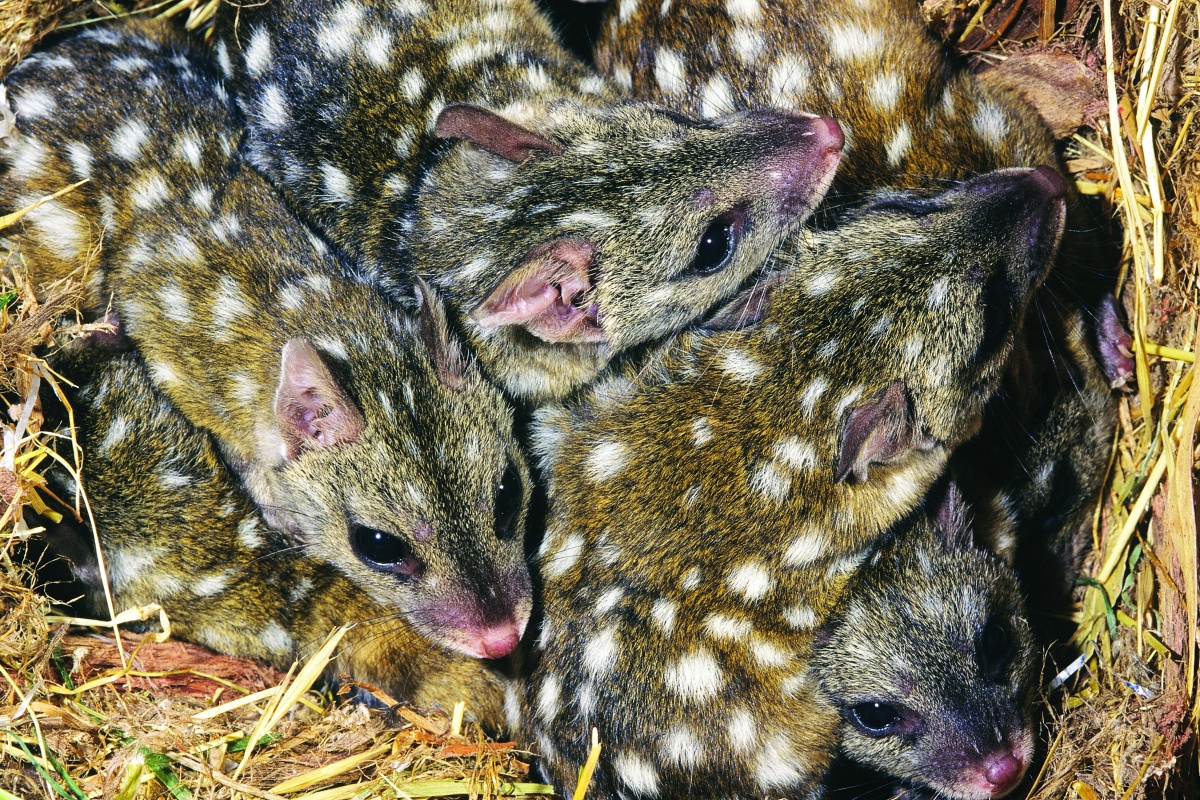
Young chuditch in the nest. Photo Jiri Lochman - Photo Jiri Lochman
The mission: catching chuditch
It’s no easy feat strategically setting up and then checking 100 traps across 50 kilometres within the Batalling forest block. The work is methodical, repetitive and cyclical.
Three young healthy females and one robust male from WA were needed to complete their 2023 breeding cohort.
The four-day mission was led by Dr Michelle Drew, Western Shield’s zoologist. She mapped out targeted areas for capture by using data collected from monitoring deployed activities throughout the landscape for more than a decade.
Stops are made every 500 metres on a given trail and the work is divided between two teams who find a suitable spot to set the trap, bait it with a piece of chicken, record the site on a GPS and tie tape around a nearby tree to serve as a marker. The hope is to return the following morning to find the trap closed with chuditch inside.
Armed with a head torch and clipboard, each team locates their traps and records whether they’re found open or shut, whether bait is present or not, and checks that ants haven’t taken over the bait.
The process of discovery is exciting and rewarding, especially when the word ‘chuditch’ is exclaimed.
Once a chuditch is caught, it’s carefully extracted from the trap and the team checks if it has been microchipped previously and its sex, weight and other measurements are recorded. A little snippet from their ear is tubed for DNA testing and their teeth are also checked.
New captures are microchipped and bring much joy to the team.
Once the most appropriate candidates are selected for the breeding program, the individuals are placed in custom-made translocation carriers to await transport to their new home. The others are released back into the forest.
MARRIED’ AT FIRST SIGHT
Migration and ‘marriage’ await WA’s chuditch cohort who first must make the long journey over east. The chuditch are driven from Collie to a ‘chuditch hotel’ run by Native Animal Rescue in Perth where they rest for a few days before commencing the journey to Taronga Western Plains Zoo.
Upon arrival, they undergo a quarantine period and health checks before being moved into specialised breeding enclosures where they are introduced to their carefully selected mating partner.
Wildlife monitoring cameras allow Taronga staff to employ a hands-off approach and let the pairs breed with minimal disturbance. Breeding season commences in May, with birthing expected between May and September.
An interesting fact—chuditch have a short gestation of only 17 to 18 days and are supernumerary breeders producing up to 50 foetuses, of which only up to six can survive.
A valuable partnership
The development of the interstate translocation strategy draws on the knowledge of a range of experts in chuditch ecology, capture, transport, ex-situ management and biosecurity, as well as veterinary expertise.
Extensive approvals and permits are required, and thorough risk analysis and planning is undertaken to ensure the success of the translocation and anticipate and overcome logistical challenges.
Taronga’s Wildlife Conservation Officer Rachael Schildkraut said the collaborative effort across State borders continues to enable the sharing of knowledge and expertise.
“The collaboration between Taronga and the DBCA Western Shield program has been integral to achieving positive conservation outcomes for chuditch. We’re looking forward to continuing to work with DBCA to build our program and its capacity to support reintroduction efforts,” Rachael said.
“The wildlife monitoring cameras we use in our conservation breeding program have increased our knowledge base by giving us an up-close and intricate look into the personal lives of the chuditch.
“We’re proud to bring that knowledge to the table and share it with experts in WA.”

Health check by Toronga Western Plains Zoo veterinarian. Photo Toronga Conservation Society Australia
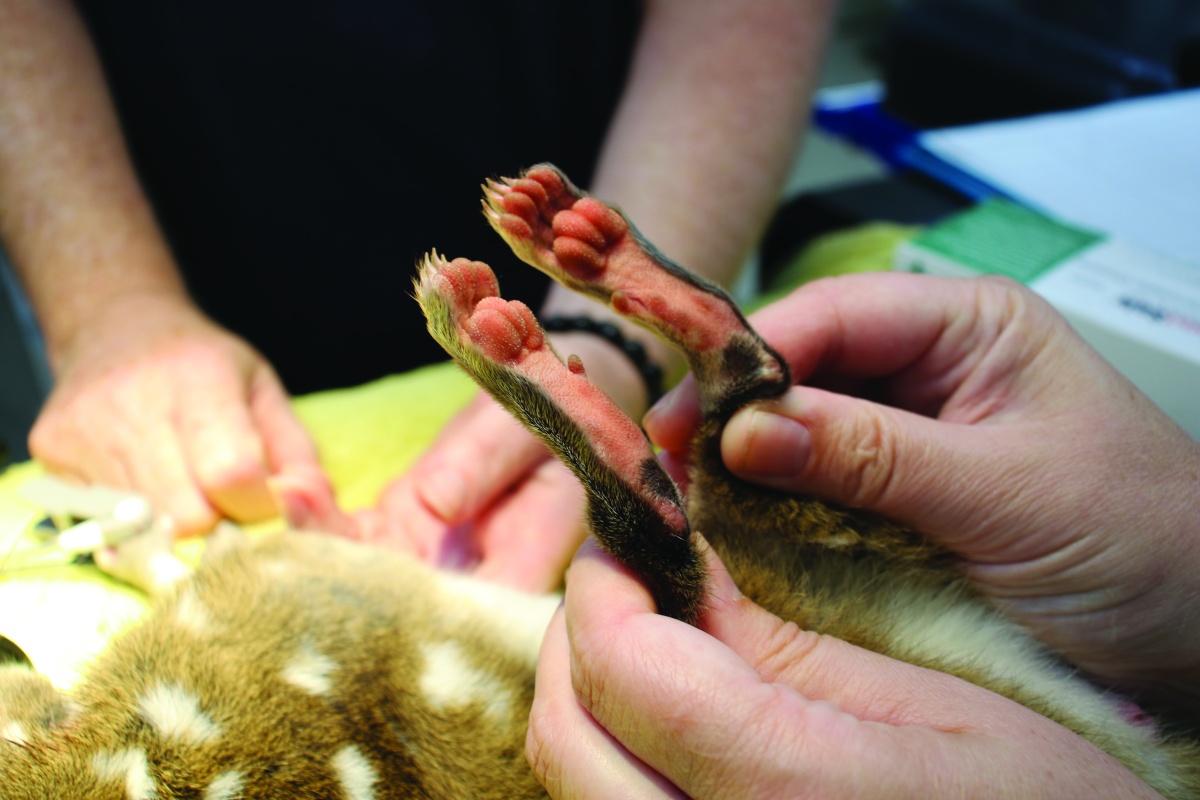
Bottom of chudith feet during a health check. Photo Taronga Conservation Society Australia
Wins all round
Monitoring conducted at Batalling forest block confirms the site is home to a healthy chuditch population and the team hopes to continue to see this upward trend.
A healthy chuditch population is symbolic of a healthy ecosystem, and improved predator management also has significant benefits for other species.
Under the Western Shield program, DBCA officers carry out baiting on a network of sites across WA to control and reduce introduced animal predation on threatened native fauna.
“The fauna trapping undertaken at Batalling forest block over four nights in March resulted in the capture of 49 chuditch, that’s 12 more than the previous year,” Dr Michelle Drew said.
“Of the 49 captured this year, 37 were new animals and 12 were recaptures from previous years.
“Most of all, we’re delighted to have a strong selection of robust male and young female chuditch to pick from, to support and expand Taronga’s conservation breeding program for the second year in a row.
“We wish the Taronga team every success as they continue their important work.”
Author box
Ivy James is a communications Office with DBCA and has previously worked as a regional journalist and media coordinator. Ivy can be contacted at (08) 9219 9924 or ivy.james@dbca.wa.gov.au