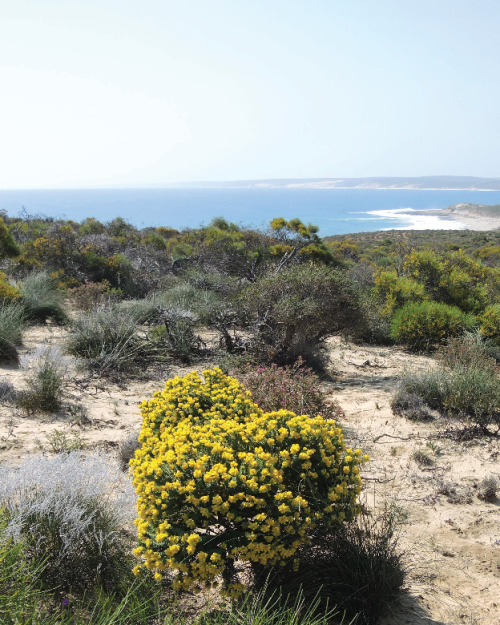
Taxonomy is the science of naming, describing, and classifying organisms. Historically, botanists relied on morphological features alone to determine relationships, assuming plants that appear more similar are more closely related.
For the most part this is correct, but not always. With the development of sophisticated methods to examine plant DNA, scientists can now test their ideas about plant relationships.
Molecular data can corroborate what we already understand, highlight unexpected relatedness between groups that appear quite distinct at first glance, or even reveal hidden diversity that was previously overlooked.
Resolving the taxonomy of a group of closely-related species is not always easy, even with newer DNA tools. The genus Geleznowia, commonly known as yellow bells, is a case in point. This genus has a long and tangled history hidden behind its name, presenting a complex taxonomic problem spanning 174 years.
BACK IN TIME
In 1849, Nicolai Turczaninow, a Ukrainian-Russian botanist, recognised Geleznowia as a new genus in the Rutaceae family. This genus was named after the Russian botanist Nikolai Zheleznov (1816–1877) using the German spelling of his name, Geleznow.
Turczaninow recognised just a single species, Geleznowia verrucosa, from a single dried herbarium specimen collected in Western Australia in 1845 by the botanist James Drummond. Drummond was among the first colonists to arrive with Captain James Stirling to establish the Swan River Colony in 1829. Over the years he supplemented his income by selling plant specimens and seeds to herbaria across Europe, some of which were eventually obtained by Turczaninow.
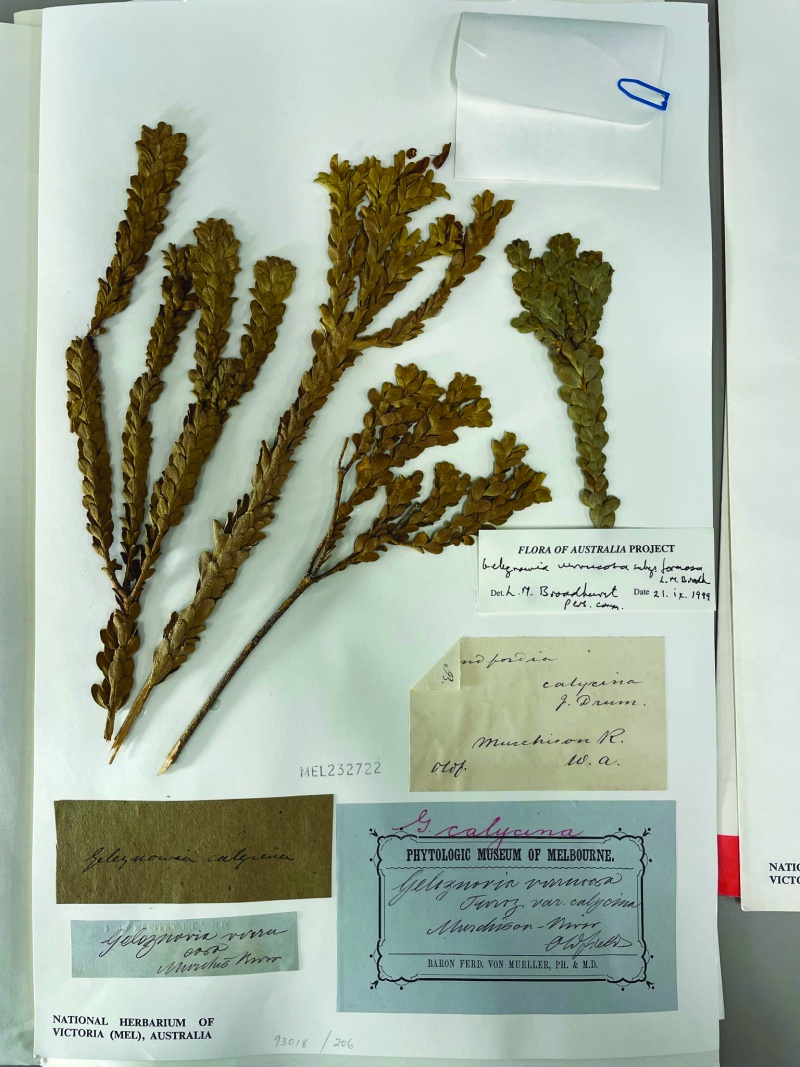
Drummond’s precious specimen is called a holotype, as it is the reference specimen for the name Geleznowia verrucosa. In modern times, the holotype resided in the National Herbarium of Ukraine in Kiev; however, due to the current war with Russia it was evacuated along with other critical specimens to another location for safe keeping.
Turczaninow’s original description of Geleznowia verrucosa was written in Latin and published in a journal based in Moscow. As was often the case, this early publication was not seen by other taxonomists. Consequently, in 1855 an Irish botanist, William Harvey, named another new genus comprising a single species Sanfordia calycina, again from material originating from James Drummond.
Sir Ferdinand von Mueller, the then- director of the Royal Botanic Gardens, Melbourne, did not agree with the taxonomy of Turczaninow and Harvey, and declared in his book Fragmenta Phytographiae Australiae published in 1859, “I do not see how Geleznowia and Sandfordia can be distinguished from the genus Eriostemon” (note that he spelled Sanfordia incorrectly when he did this, just to add to the confusion).
Eriostemon was a genus within the Rutaceae family that had first been described in 1798, prior to either Geleznowia or Sanfordia, hence this name had precedence, meaning that Geleznowia verrucosa became Eriostemon geleznowii and Sanfordia calycina became Eriostemon sanfordii.
Only four years later in 1863, George Bentham, a botanist based at the Kew Royal Botanic Gardens in London, published the first volume of his Flora Australiensis series, and he concluded that Geleznowia should be reinstated as a genus distinct from Eriostemon. Eriostemon geleznowii reverted to its original name of Geleznowia verrucosa, while Eriostemon sanfordii was given the new name Geleznowia calycina.
In addition to these two previously recognised species, Geleznowia macrocarpa was also recognised as distinct based on a fragmentary specimen, as Bentham thought it had larger flowers.
RENEWED INTEREST
For the next 90 years there were no changes to the naming of Geleznowia. Then, in 1954 Blackall and Grieve’s seminal work on the identification of the flora of south-western Australia, How to Know Western Australian Wildflowers, was published. In this book there is no reference to Geleznowia macrocarpa, and although Geleznowia calycina is listed as a species, it is noted as being “… only a small form of G. verrucosa”. By 1981, when Green’s Census of the vascular plants of Western Australia was published, only Geleznowia verrucosa was recognised as distinct.
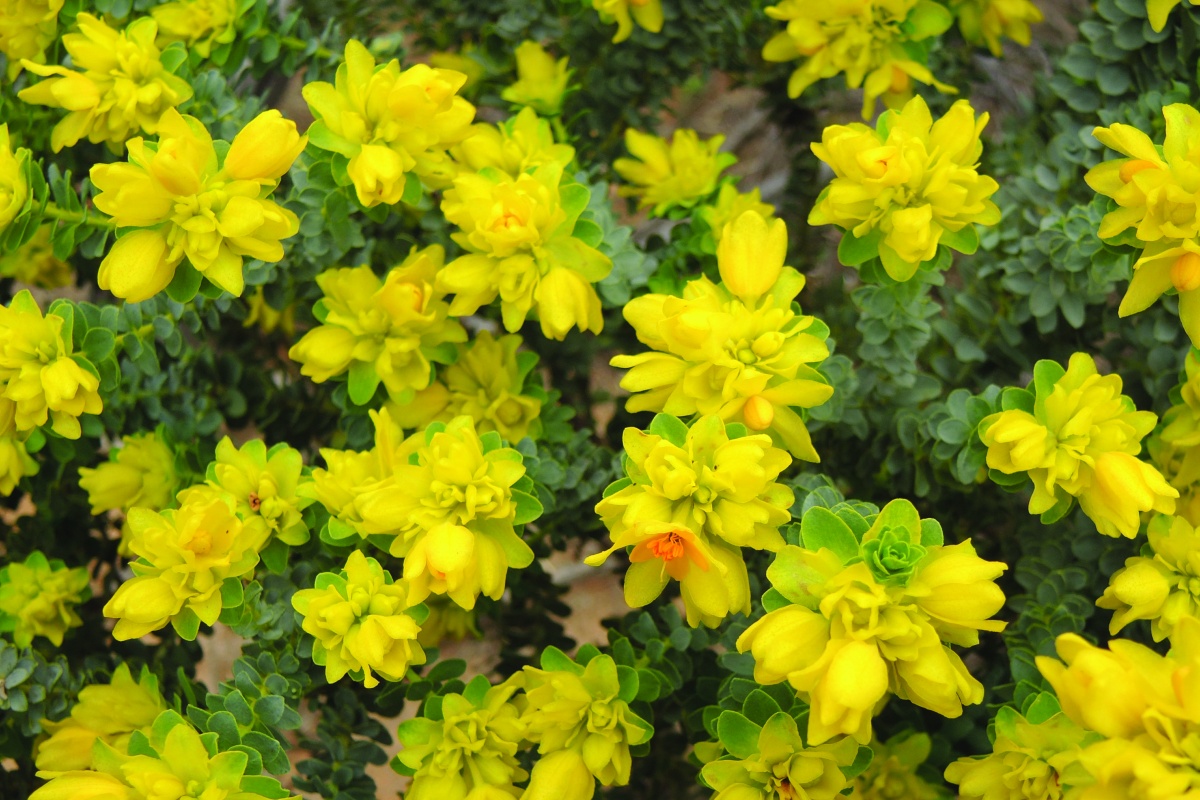
Geleznowia amabilis. Photo – Kelly Shepherd/DBCA
The late 1990s saw a renewed interest in the taxonomy of Geleznowia. Yellow bells, due to their stunning floral display, were a popular target for wildflower pickers supplying cut flowers for the floriculture industry. Despite only one species of Geleznowia being recognised at this time, the pickers and sellers of the yellow bells recognised that there were several forms of Geleznowia, known by colloquial names such as ‘daffodil’, ‘tinged’ and ‘mini’.
Identifying these forms was important to the industry, for example the form known as ‘daffodil’ was more valued due to its large showy flowers. Two scientific studies on Geleznowia started around this time.
The first was a PhD study by Linda Broadhurst at Curtin University examining the morphology and genetics of the species, and the second was a floriculture project headed by Dr Julie Plummer at the University of Western Australia (UWA) seeking to determine whether Geleznowia could be established in cultivation as a cut flower crop.
Linda Broadhurst concluded, with support from the genetic techniques of the day, that two subspecies of Geleznowia verrucosa merited taxonomic recognition, and a third form was suggested to be a hybrid. Meanwhile, the floricultural project recognised six distinctive floricultural forms.
Unfortunately, no further work was undertaken to try and resolve the complexity evident within this group and by 2013 when Paul Wilson published his treatment of the genus in Flora of Australia, only the single species Geleznowia verrucosa was recognised. Although Wilson did note that due to the variation seen in its leaves, hairs and flowers, there may be several unrecognised subspecies. After the completion of the floricultural project at UWA, one of the project participants, Andrew Crawford, moved to a job based at the Western Australian Herbarium.
He continued to collect specimens of Geleznowia and lodge them at the herbarium, adding to the knowledge about the distribution and variation of the species.
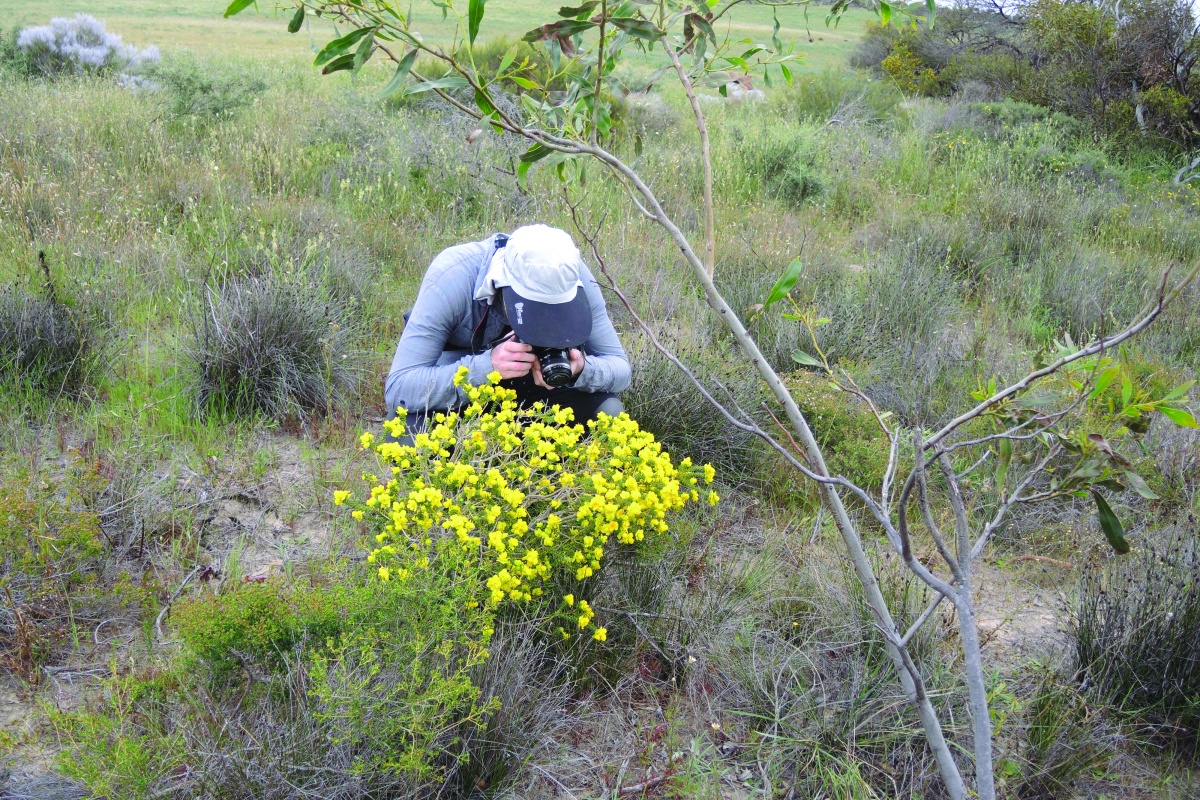
Ben Anderson photographing Geleznowia eximia. Photo DBCA
Subsequently, a thorough inspection of all the WA Herbarium collections of Geleznowia by resident taxonomist Kelly Shepherd led to three additional putative species being identified, which corresponded to some of the floricultural forms that had previously been identified. These were allocated the informal phrase names: Geleznowia sp. Binnu (K.A. Shepherd & J. Wege KS 1301), Geleznowia sp. Marchagee (A. Crawford ADC 1353) and Geleznowia sp. Red Bluff (A. Crawford ADC 597).
In 2020, Geleznowia sp. Red Bluff was formally named and described as Geleznowia amabilis. It was recognised as a species of conservation concern, as it is currently only known from a few populations around Kalbarri. The specific epithet (the second part of its binomial Latin name) means ‘worthy of love’, an appropriate choice given its striking flowers.
EMPLOYING GENOMICS
Even though some progress had been made, it was clear that further help was needed to untangle the rest of this complex. The group was investigated as part of the national Genomics for Australian Plants conservation genomics project (genomicsforaustralianplants.com/ geleznowia-verrucosa-conservation). In the spring of 2020, while the COVID-19 pandemic swept around the world and many were in lockdown, Kelly Shepherd and Carol Wilkins were able to undertake fieldwork, sampling populations across the various forms previously recognised in Geleznowia. The samples were sequenced and then analysed by Ben Anderson and Rachel Binks using modern genomic techniques.
The molecular results corroborated initial ideas but also pointed to some unexpected relationships. So, after a long and complicated journey that started with a single species, a combination of traditional taxonomy and modern genetics has now resulted in the recognition of seven species in the genus. This includes Geleznowia verrucosa, Geleznowia amabilis, and four new species, as well as the reinstatement of Geleznowia calycina, a species previously described in 1855 by Harvey (under the genus Sanfordia). Two of the new species revealed by the genetic results, Geleznowia occulta and Geleznowia eximia, are very rare in the wild, with the latter currently only known from three plants within one population.
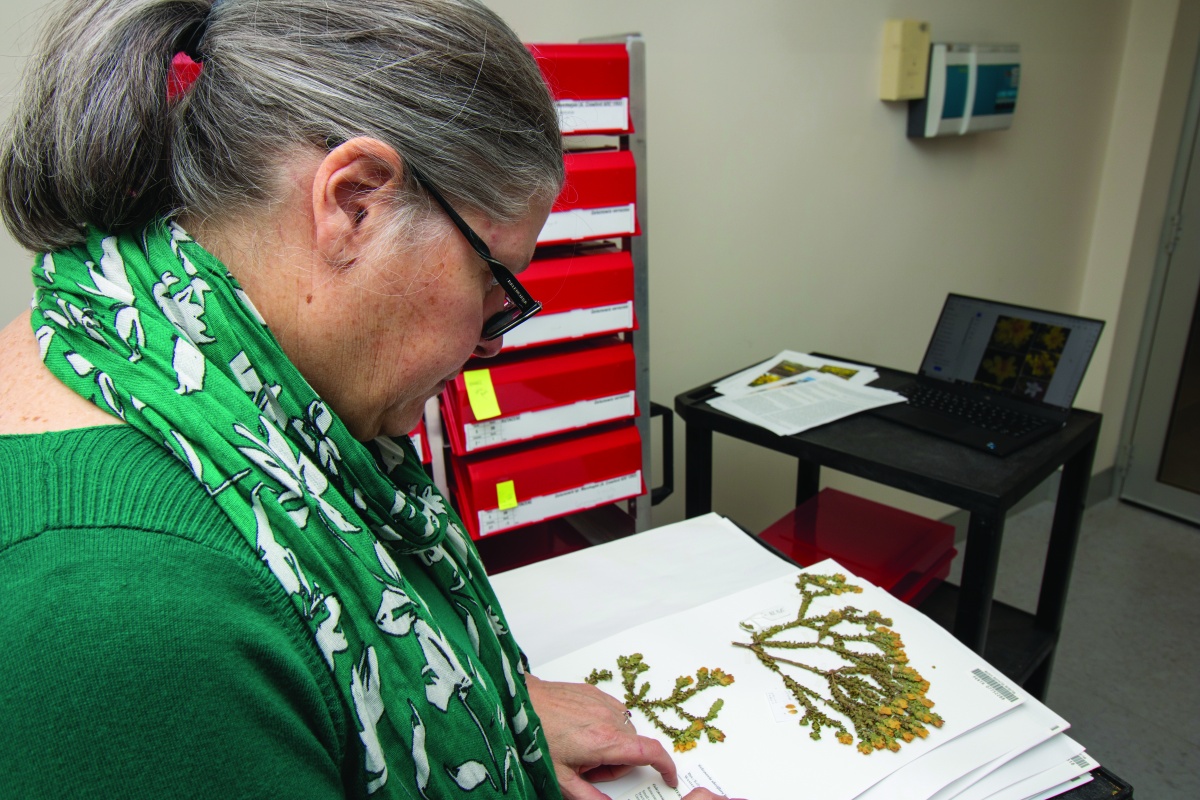
Dr Kelly Shepherd providing updated determinations to Geleznowia specimens. Photo – Andrew Crawford/DBCA
Some of these species corresponded to the horticultural forms or phrase named species that had previously been identified. For example, Geleznowia sp. Binnu (the ‘daffodil form’) was named Geleznowia narcissoides; a name based on the daffodil genus Narcissus with the addition of -oides meaning “like”, alluding to this species having showy flowers that are reminiscent of a double-headed daffodil.
To further complicate matters, when scanned images became available of the holotype of Geleznowia verrucosa held in the National Herbarium of Ukraine, it became clear that the phrase-named Geleznowia sp. Marchagee represented true Geleznowia verrucosa, while most specimens named as verrucosa were either Geleznowia calycina or the new species Geleznowia uberiflora.
Over the long and complicated history since yellow bells were first described, the number of names and concepts have varied (see timeline). This may also not be the final word, as there may yet be more diversity to be discovered.
The UWA horticultural study mentioned another unrecognised ‘form 5’ that has not been seen in the wild since then, and no specimens are available for study. While we have come a long way in clarifying what names go with which species and how they are related to each other, there may yet be another chapter to be written about these stunning plants.