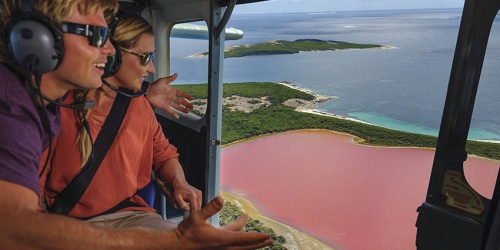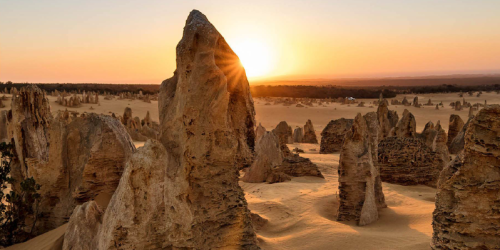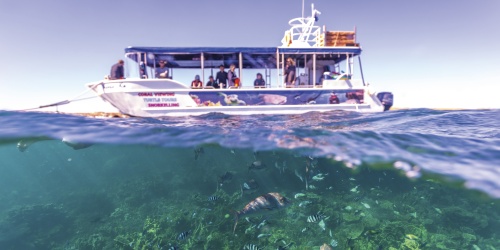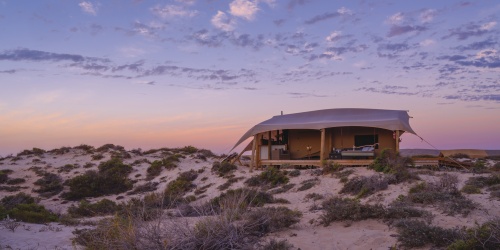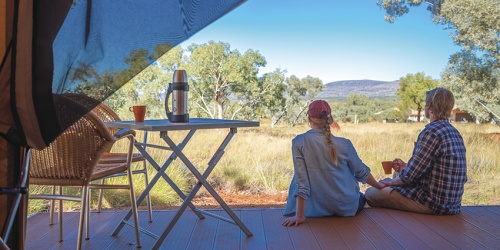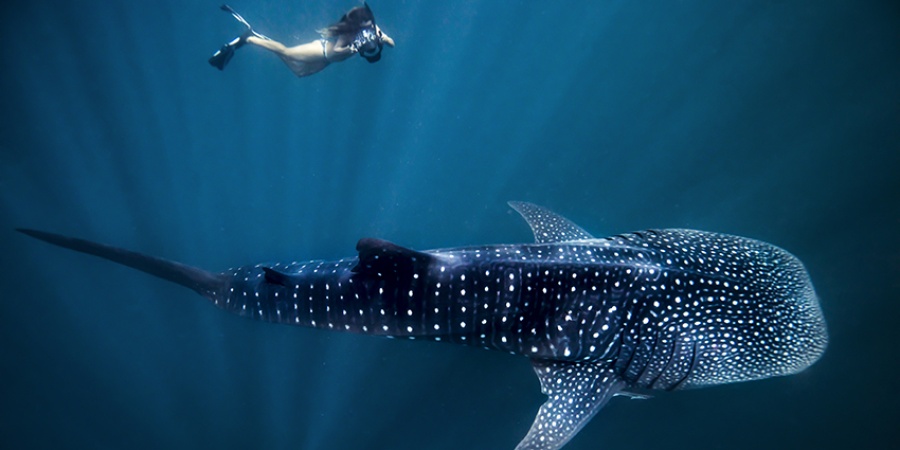
Ningaloo Marine Park. Photo: Tourism Western Australia
If a commercial filming application requires a licence, fees and charges will apply.
These are payable in addition to a non-refundable licence application fee of $50. Access charges are dependent on type of filming and the proposed amount of time to access the park.
Commercial filming licence fees and charges
| Access requirement | Stills photography | Motion filming |
| Half day access (five-hour period) | $137.50 | $550 |
| Full day access | $275.00 | $770 |
| Three plus days access | $1100 | $1100 |
Where the proposed operation includes stills photography and motion filming, only the motion filming access charges apply.
A higher charge may be negotiated by DBCA depending on the scale of production, amount of supervision required, level of staff expertise required, location of filming, and other significant factors. For example, a large-scale advertising production which uses a well-known or significant feature such as the Pinnacles Desert Discovery may attract a substantially higher charge. This charge will be negotiated with the applicant and include administrative costs of Perth-based and local staff.
Waiver or reduction of charges
DBCA may waive fees and charges for commercial filming operations on CALM Act land where:
- the filming operation will have a major benefit to WA and support the appreciation, awareness and understanding of the natural and/or cultural environment in WA, or
- the filming/photography is sponsored by Tourism Western Australia.
All decisions to waive fees will be assessed on a case-by-case basis.
If a waiver is approved, the person or organisation will be granted a lawful authority instead of a licence, and charges to access CALM Act land for commercial filming will be waived. DBCA may also waive other fees when a lawful authority is granted, for example recovery costs.
Supervision charges
Charges apply where supervision from a DBCA staff member is deemed necessary to manage access to sensitive areas and areas of environmental significance or on request from the filming authority holder.
Supervision charges are:
- $55 per hour (standard hours)
- $71.50 per hour (non-standard hours)
Supervision fees may be waived at the discretion of the relevant DBCA district or regional manager where the filming operation benefits DBCA objectives or if the operation is sponsored by Tourism Western Australia. All decisions to waive fees will be assessed on a case by case basis.
Waiver of park entry fees
Entry fees will be waived for approved filming authority holders if they are accessing parks where entry fees apply. A copy of the filming authority must be shown at the entry point, if required, to be granted the waiver.
Commercial filming authorities
Regulation 108 of the Conservation and Land Management Regulations 2002 requires any person taking images or footage for commercial purposes on CALM Act land to obtain lawful authority from DBCA. Non-commercial/private photography does not normally require lawful authority.
Please see the Commercial filming and photography handbook (available for download below) for more information on when a filming authority is required.
How to apply
Should you require a commercial filming authority, please apply online using the Commercial Operator Licensing System. A user guide on applying through the system can be downloaded at the bottom of this page.
Public liability insurance
Filming authority holders must at all times during the filming authority period maintain a policy of public liability insurance that is adequate and covers the areas and operations allowed under the filming authority for a sum of not less than AU$10 million per event.
Evidence of the insurance policy must be provided at application.
An acknowledgement of indemnity (Deed Poll) must also be signed and provided with a copy of your certificate of currency when applying for a filming authority. The indemnity specifies that the applicant must inform the nominated public liability insurer of the filming authority and its conditions. This ensures that the operator and the department is appropriately covered in the event of an accident.
Protecting Aboriginal culture and heritage
DBCA recognises that Aboriginal people have an ongoing connection to, and interest in the management of, lands, waters and the flora and fauna they contain. DBCA acknowledges the right of Aboriginal people to express and maintain their culture and partners with Aboriginal people to help protect, conserve, and enhance cultural values across the State.
Some parks are also jointly vested and/or managed with an Aboriginal corporation. In these cases, decision-making takes place through a joint management body (JMB). Increased processing time may be required for applications to commercially film in jointly managed parks to allow for consultation with the JMB. This process assists in conserving Aboriginal cultural and heritage values, as well as the environment.
Filming applicants must also ensure that any Aboriginal cultural content or material in its proposed filming operation is developed and included only with the knowledge and consent of the relevant Traditional Owners, and that their operations comply with all laws relating to the Aboriginal Heritage Act 1972 and Aboriginal Heritage Regulations 1974. This includes seeking approval from the Department of Planning, Lands and Heritage (DPLH) for commercial photography or recording on any land to which the Aboriginal Heritage Regulations 1974 apply, which includes Aboriginal sites and protected areas.
See the DPLH website for more information, including access to the public database of Aboriginal cultural heritage sites and to apply for relevant approvals.
Engaging and working respectfully with Aboriginal people
DBCA encourages filming parties to engage with Traditional Owners on opportunities to collaborate and produce culturally appropriate content on Aboriginal culture and heritage.
Tourism Western Australia and the Western Australian Indigenous Tourism Operators Council (WAITOC) have developed educational resource designed to assist non-Aboriginal businesses to engage and work respectfully with Aboriginal people and Aboriginal tourism businesses. This includes the development of four Aboriginal cultural inclusion guides which can be accessed on Tourism WA’s website here.
Protecting marine and other fauna
Interactions with marine fauna are managed under the Biodiversity Conservation Regulations 2018 (BC Regulations). The Biodiversity Conservation Act 2016 prohibits the disturbance of fauna (s153(1)) and the feeding of fauna (s155) unless the person has lawful authority, while the BC Regulations outline a set of rules for interactions with marine fauna by all people, vessels, aircraft, helicopters and aerial devices in WA State waters and lands. These rules are designed to protect marine fauna from impacts from human activities and to reduce safety risks to the public.
If the proposed filming operation involves filming of marine fauna such as whales, killer whales, dolphins, dugongs, seals and whale sharks, the filming party must comply with separation distances as prescribed by the BC Regulations.
If you intend to film animals within prescribed separation distances and/or disturb animals in order to film them, you may have the option of applying for a fauna disturbing (commercial interaction) licence. These licences are separate to a commercial filming authority and must be applied for through the DBCA Wildlife Protection Branch. Please note, these licences are only considered for certain types of operations.
Timeframe for approvals
Please submit proposals at least four weeks prior to the expected filming dates. Incomplete applications or applications submitted later than this may not be approved by the proposed filming date.
Further processing time may be required for complex applications or those that have additional consultation requirements.
Commercial filming and photography handbook
All commercial filming authority holders are issued with a Commercial Filming and Photography Handbook. This is a legal and informative document that must remain in the operator's vehicle together with a copy of the filming authority at all times when on DBCA-managed lands and waters.
The Commercial Filming and Photography Handbook also:
- ensures the protection and conservation of WA’s natural and cultural environments, including the protection and respect of Aboriginal sites
- ensures commercial filming and photography portrays DBCA, DBCA staff and CALM Act land in an appropriate manner
- clearly identifies standard conditions that apply to commercial filming operations undertaken on CALM Act land, and
- minimises risks to commercial filmmakers, visitors and DBCA staff.
The Commercial Filming and Photography Handbook can be downloaded from the bottom of this page.
Commercial filming fees
If a commercial filming application requires a licence, fees and charges will apply.
These are payable in addition to a non-refundable licence application fee of $117. Access charges are dependent on type of filming and the proposed amount of time to access the park.
| Access requirement | Stills photography | Motion filming |
|---|---|---|
| Half day access (five-hour period) | $137.50 | $550 |
| Full day access | $275.00 | $770 |
| Three plus days access | $1100 | $1100 |
Where the proposed operation includes stills photography and motion filming, only the motion filming access charges apply.
A higher charge may be negotiated by DBCA depending on the scale of production, amount of supervision required, level of staff expertise required, location of filming, and other significant factors. For example, a large-scale advertising production which uses a well-known or significant feature such as the Pinnacles Desert Discovery may attract a substantially higher charge. This charge will be negotiated with the applicant and include administrative costs of Perth-based and local staff.
Waiver or reduction of charges
DBCA may waive fees and charges for commercial filming operations on CALM Act land where:
- the filming operation will have a major benefit to WA and support the appreciation, awareness and understanding of the natural and/or cultural environment in WA, or
- the filming/photography is sponsored by Tourism Western Australia.
All decisions to waive fees will be assessed on a case-by-case basis.
If a waiver is approved, the person or organisation will be granted a lawful authority instead of a licence, and charges to access CALM Act land for commercial filming will be waived. DBCA may also waive other fees when a lawful authority is granted, for example recovery costs.
Supervision charges
Charges apply where supervision from a DBCA staff member is deemed necessary to manage access to sensitive areas and areas of environmental significance or on request from the filming authority holder.
Supervision charges are:
- $55 per hour (standard hours)
- $71.50 per hour (non-standard hours)
Supervision fees may be waived at the discretion of the relevant DBCA district or regional manager where the filming operation benefits DBCA objectives or if the operation is sponsored by Tourism Western Australia. All decisions to waive fees will be assessed on a case by case basis.
Waiver of park entry fees
Entry fees will be waived for approved filming authority holders if they are accessing parks where entry fees apply. A copy of the filming authority must be shown at the entry point, if required, to be granted the waiver.
Downloads