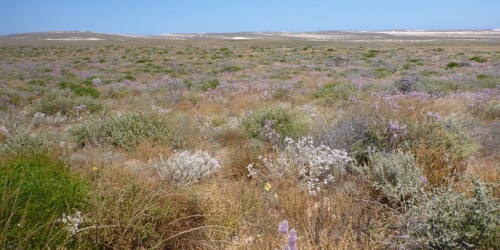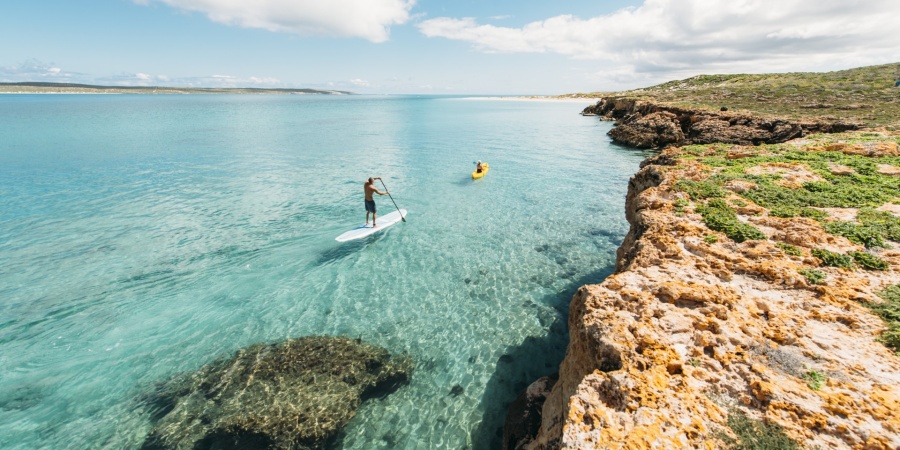
Jutting north from the most westerly part of the Australian mainland is Wirruwana or Dirk Hartog Island. The island is of great significance, both historically and for one of the world’s most important conservation projects happening right now, the Dirk Hartog Island National Park Return to 1616 Ecological Restoration Project.
The island can be visited by four-wheel drive via Steep Point, a commercial barge service from Steep Point, or light aircraft charter.
You can help protect the island by downloading and watching the island protection video before you leave home.
The island’s history as a pastoral lease ended when it became a national park in 2009, although evidence of this history remains across the island, as do the remnants of a garrison at Quoin Bluff South. The Return to 1616 Ecological Restoration Project is now breathing life back into the island.
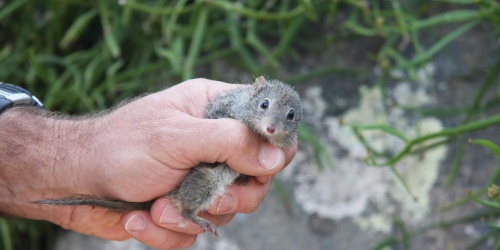
The low shrubby vegetation harbours a range of animal life including the Dirk Hartog Island black and white fairy-wren, which is found nowhere else, and the sandhill frog whose distribution is limited. Seabirds abound along the protected eastern coast of Dirk Hartog Island with species nesting on islands close to shore. Wildlife in the waters close to the island can be observed from a boat or while snorkelling or diving.
Each summer thousands of loggerhead turtles return to Turtle Bay, the area they emerged as hatchlings, to lay their eggs. Parks and Wildlife staff and volunteers have been monitoring this during annual surveys each January since 1994 and Turtle Bay is one of the most important loggerhead nesting areas in the southern hemisphere.
Visit the Explore Parks website for more information about things to do and see on Dirk Hartog Island.
Preparing your vehicle and equipment
Many of Shark Bay’s islands, like Dirk Hartog Island, are nature reserves and protect native species that have declined on the mainland. Competition with and predation by introduced plants and animals are the main reasons for mainland declines. While the isolated nature of islands prevents pests and disease from reaching them naturally, there is still a risk as visitors to the islands may inadvertently carry unwanted hitchhikers.
Please help protect native species on Dirk Hartog Island:
- Download and read the island protection brochure before leaving home.
- View the island protection video to help you plan your visit and protect the island.
- Do not take any animals (including pets) or plants on to islands.
- Make sure your footwear, clothes, packs and camping gear are free of soil, seeds, lizards, insects, spiders, etc.
- Transport food in clean, sealed plastic or metal containers rather than cardboard.
- Make sure fresh food is free of soil, ants, snails or other small animals.
- Install and regularly check rodent bait stations on board your vessel. Replace baits every six months to retain potency.
- Do not take firewood on to islands or light fires. Use gas cookers instead.
Before driving your vehicle on to the barge, please make sure its underside, radiator, tyres, sump and gearbox guard plates are free of seeds and soil. Also check seat crevices and under floor mats.
Be aware that introduced house mice and several weed species occur on Dirk Hartog Island. Please do not transport them around the island.
The introduced Asian house gecko, Hemidactylus frenatus, is common in Carnarvon and northern Australia and can now be found in Shark Bay. Please help prevent the spread of this animal—make sure you are not transporting it with your gear.
Driving on the island
A high clearance four-wheel-drive vehicle is required to drive on the island and only 20 private vehicles are permitted at any one time. The island’s single lane four-wheel drive tracks are mostly soft sand but are rocky in places.
This area is remote and inherent dangers include variable weather conditions—especially in summer when the park is hot, dry and windy—and a hazardous coastline with large surf and 200m high cliffs on the western side.
Shifting sand dunes are among the challenging four-wheel drive conditions. For your safety:
- Notify a reliable person of your trip plans so that you can be traced in an emergency.
- Be prepared for the heat. Take at least 10 litres of water for each person per day.
- Exercise extreme caution near cliff edges especially when fishing.
- Supervise children at all times.
Downloads