Fire ephemerals thrive in the post-fire environment and persist as seeds in the soil for decades to centuries between fires. These specific adaptations create unique opportunities and challenges for their conservation management.
Most terrestrial plant species in Western Australia have traits that allow them to persist through fires, either as individuals or populations. These traits have been shaped by evolution in a landscape with recurrent fires over millions of years.
Fire ephemerals are plant species whose germination is strongly driven by fire, often germinating after fires en masse, and which then rapidly grow and complete their life cycle of flowering and setting seed in one to a few years after fire. They then disappear from the above-ground vegetation for the bulk of the period between fires, existing as a long-lived soil- stored seed bank.
This fire response strategy allows fire ephemerals to take advantage of lower competition with other plants for light, water and nutrients shortly after fires.
Adaptations for the fire ephemeral strategy include a highly persistent, soil-stored seed bank that potentially retains viability over decades to centuries between fires; seed dormancy mechanisms that are broken by fire cues (usually heat and/or smoke, often in combination with in situ weathering in the soil) allowing germination to be timed to post-fire conditions; rapid growth; and early flowering and seeding.
Fire ephemerals occur in many ecosystems across WA, from deserts to woodlands, heathlands and forests. They are often most noticed in ecosystems and locations that burn infrequently, either due to natural features or anthropogenic landscape changes.

Fire ephemerals recorded after the Two Peoples Bay Nature Reserve bushfire. The vulnerable Northcliffe Kennedia (Kennedia glabrata). Photo - Megan Dilly
Fire ephemerals
Fire ephemerals range in growth form from herbs, grasses and groundcovers to shrubs and small trees, and occur across diverse plant lineages. Examples include:
| Family | Species | Common name |
|---|---|---|
Gyrostemonaceae | Codonocarpus cotinifolius | Native poplar |
Solanaceae | Anthocercis littorea | Yellow tailflower |
Macarthuriaceae | Macarthuria keigheryi | |
Araliaceae | Hydrocotyle phoenix | Fire pennywort |
Apiaceae | Actinotus leucocephalus | Flannel flower |
Poaceae | Austrostipa compressa | Speargrass |
Malvaceae | Alyogyne hakeifolia | Native hibiscus |
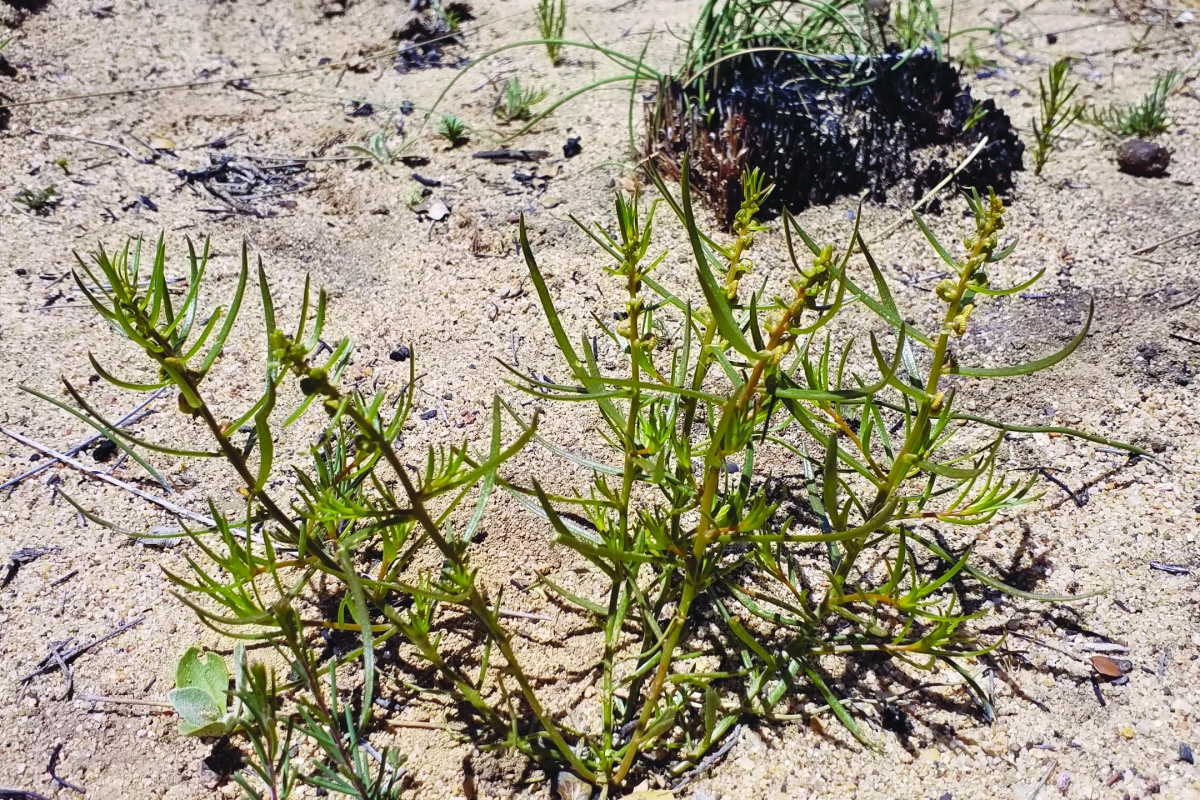
Newly-germinated Gyrostemon (Gyrostemon reticulatus) after a prescribed burn at Mollerin Nature Reserve. Photo - Bree Phillips/DBCA
Opportunities and challenges in conservation management
The unique ecology of fire ephemerals offers opportunities and challenges for their conservation management in the context of fire events, primarily through their limited lifespan as mature plants but long persistence, often undetected or unquantified, in the soil-stored seed bank.
The transient nature of adult plants presents a time-limited opportunity for conservation actions involving live plants. Monitoring of population size and extent, ecological study or observation, or conservation seed collection (such as for banking at the Western Australian Seed Centre) is only practical within a few years post-fire before the species retreats to the soil-stored seed bank.
Seed banks with putatively considerable longevity and strong responses to fire stimuli provide opportunities for the use of prescribed burns to recover live plant populations of fire ephemerals, even where mature plants have long been absent. Therefore, prescribed burns and bushfires can lead to unexpected discoveries of fire ephemerals.
Nevertheless, conservation managers face complex decisions over where, when and how frequently it may be desirable to use fire to stimulate recruitment in fire ephemerals, compounded by gaps in knowledge of the seed bank ecology of many species.
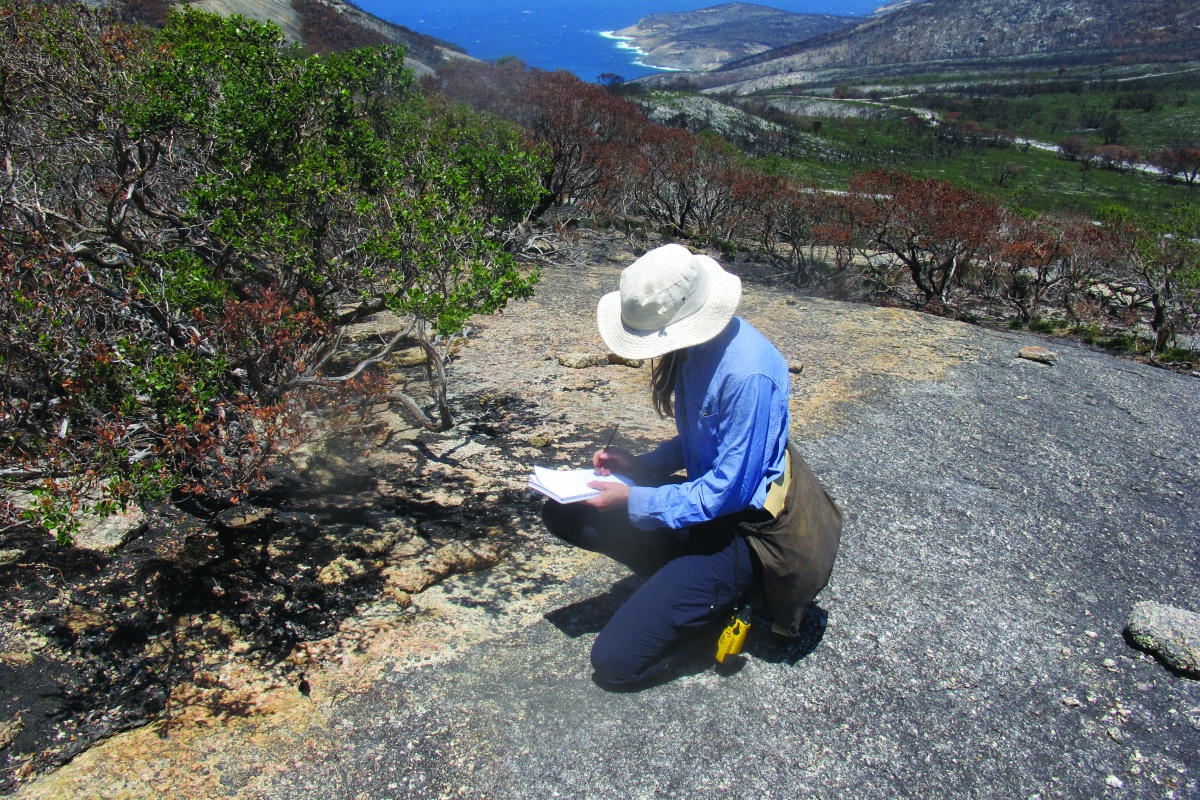
Megan Dilly conducting fieldwork at Two Peoples Bay Nature Reserve. Photo - Megan Dilly/DBCA