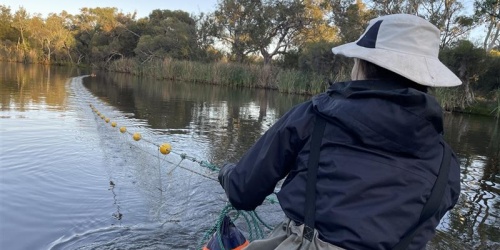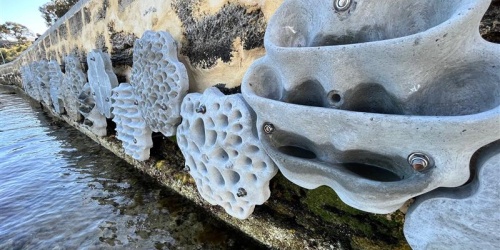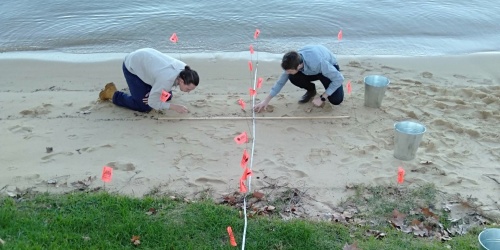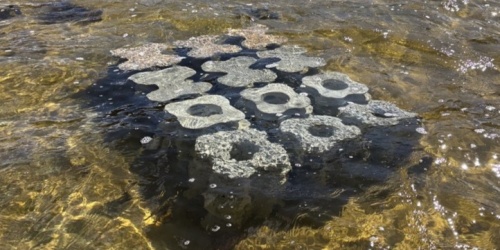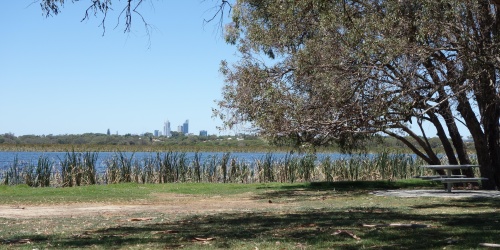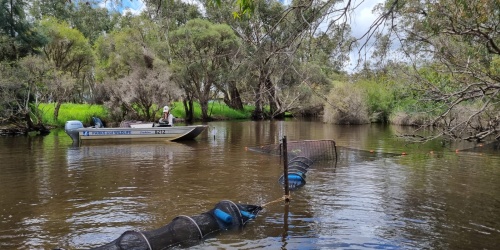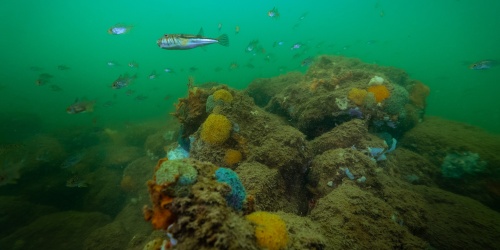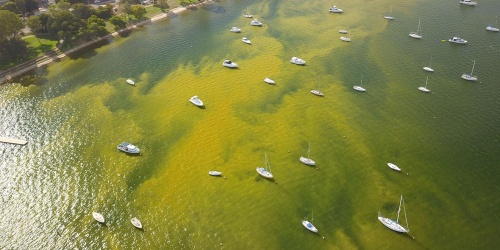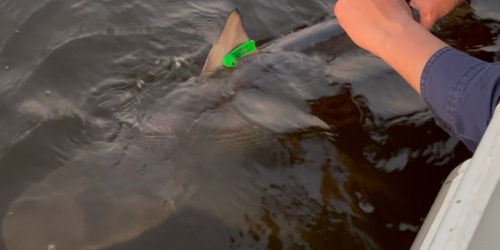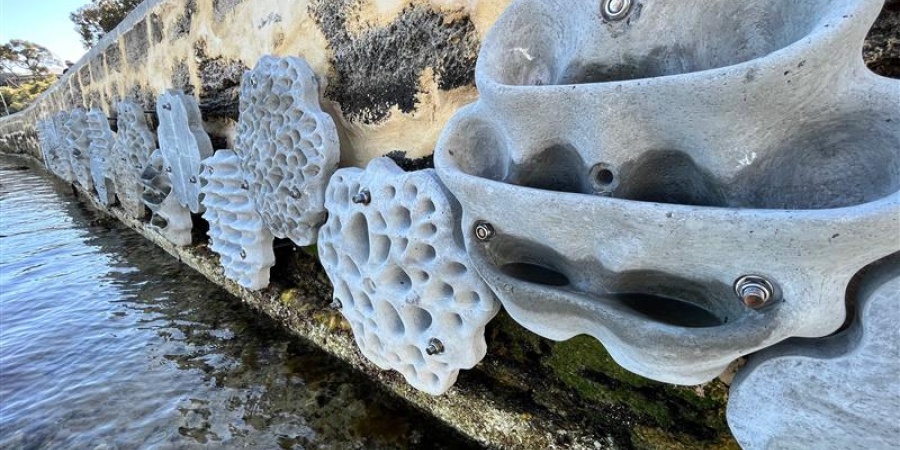
Living seawall panels in East Fremantle. Photo - DBCA
Program: Rivers and Estuaries Science
Status: Completed
About the research project
The Swan Canning Estuary has undergone significant modifications along its shorelines to reduce the risk of erosion through the installation of seawalls, revetments and other hard engineered structures. These structures are often comprised of flat, featureless, vertical surfaces that support a limited number of species.
Natural shorelines such as rock platforms contain a variety of different surface shapes, such as rockpools, holes and crevices, which provide a wide range of habitat to support a diverse group of aquatic life. This project aimed to simulate these natural shorelines on artificial structures by installing scientifically designed habitat panels containing complex habitat features based on nature on seawalls in East Fremantle.
These habitat panels are topographically complex and can be attached to existing or new infrastructures. Their textured surfaces create microhabitats that promote foundation species (macroalgae) to grow, which in turn creates surfaces that attract both mobile and invertebrate species to settle. The panels also provide shelter from predators and refuge during low tide events.
This project was funded as part of a WA State Government election promise (2021).
Management outcomes
This project provided valuable insights into how small-scale interventions can improve the ecological performance of urbanised shorelines. It aimed to inform future estuary restoration planning by testing which habitat features are most effective and feasible for broader applications within the Swan Canning Estuary.
A research trial focused on the efficacy of modified seawalls (those with panels) in supporting macroalgae growth and invertebrate settlement, compared with blank walls. It also evaluated whether different panel designs performed differently.
Project learnings were incorporated into Best Management Practice guidelines for the installation, monitoring and evaluation of artificial habitat panels in an urban estuary setting.
Progress
The Living Seawalls project along the East Fremantle seawall was the first to occur in Western Australia. This study, which is now complete, was conducted from November 2022 to January 2025.
Key findings from the project were:
- A total of 30 unique species were identified on the modified habitat panels, with encrusting macroalgae being the most dominant sessile species, and Siphonaria kurracheensis the most abundance mobile invertebrate.
- In the first year of monitoring, we found the control sites had higher species richness, diversity and abundance than the modified seawalls. However, following the 2023 and 2024 heat events, this pattern shifted, with the modified seawalls supporting higher overall species abundance and diversity, suggesting they may provide a more resilient habitat under environmental stress.
- Macroalgae abundance increased significantly on the panels for the first year of surveying, however, decreased after prolonged increases in summer temperatures, coupled with unusually low tides over the 2023-24 summer months. Similar patterns were also observed on the higher, and middle sections on the control sites.
- Rockpool panel designs had the greatest species richness, diversity and abundance compared to the other four habitat panel designs.
- Panel designs with greater habitat complexity had a greater abundance of species, with a correlation between habitat complexity and abundance of species.
- Monitoring over multiple seasons shows clear succession patterns, with the habitat panels fluctuating in species growth between Summer and Winter.
These findings highlight the potential for small-scale eco-engineering interventions to improve ecological performance on urbanised shorelines.
Project team
| Lucy Arrowsmith | Dr Kerry Trayler | Josh Baker | Chris Douglas |
|---|---|---|---|
| Environmental Officer, Rivers and Estuaries Science | Principal Scientist, Rivers and Estuaries Science | Riverbank Program Coordinator, Conservation and Ecosystem Management | Environmental Officer, Rivers and Estuaries Science |
Publications
Available upon request from project contact
- Arrowsmith et al., 2025. Artificial Habitat Panels Best Management Practice. Guidelines for the installation, monitoring and maintenance of artificial habitat panels in the Swan Canning Estuary.
- DBCA (2022). Habitat enhancement approaches in the Swan-Canning estuary – Habitat enhancement panel trial in East Fremantle. Project summary. 2 pages.
Contact
Lucy Arrowsmith
Environmental Officer
lucy.arrowsmith@dbca.wa.gov.au
Related projects
EXT-2025-19 Nature-based solutions for remediating Swan Canning Estuary foreshores
EXT-2023-21 Swan Canning Estuary Shellfish Reef Restoration