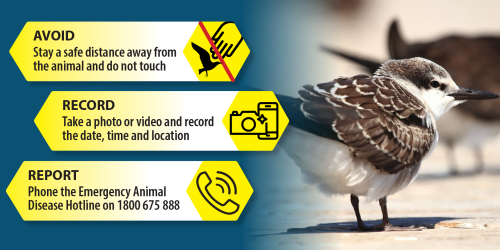
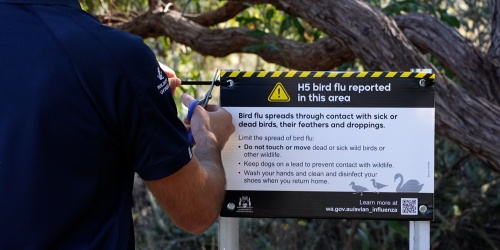
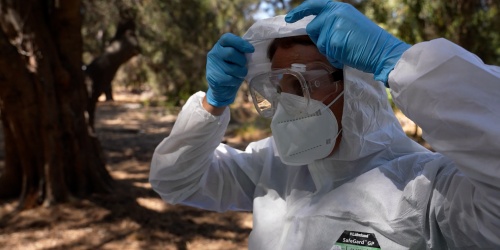
- Avoid contact and keep your distance.
- Record the date, time, location and take photos.
- Report it to the 24-hour Emergency Animal Disease Hotline on 1800 675 888.
Find out more about the signs and how to report.
For more information, visit the Australian Government website at birdflu.gov.au.
Since 2020, this new strain of bird flu has caused unprecedented disease outbreaks in a wide range of domestic and wild birds and mammals in every continent except Australia.
The signs of H5 bird flu can vary between different species of birds. In wild birds, signs can include:
- sudden death
- lack of coordination, tremors, swimming in circles
- twisted necks or other abnormal posture
- inability to stand or fly
- diarrhoea
- difficulty breathing, coughing or sneezing
- swelling around the head, neck and eyes
- cloudiness or change in colour of the eyes.
H5 bird flu can also infect mammals. Infection is usually associated with the mammal eating an infected animal or having close contact with the contaminated environment the infected birds are associated with.
Signs in mammals can include neurological (lack of coordination, circling) or respiratory signs (nasal or eye discharge, difficulty breathing) or sudden death.
It is important for people who regularly work with or have contact with wildlife to know the signs of avian influenza in wild birds and mammals and report them.
Based on experiences overseas, the impacts of H5 bird flu on some Australian native species are likely to be significant.
The virus cannot be prevented from arriving and, in many cases, mass mortality events in wildlife will be unavoidable.
Any decision whether to, and how to vaccinate captive or threatened wild animals, is complex and will depend on many factors.
The Australian Government is actively working through regulatory and policy arrangements for the potential vaccination of some priority native bird species.
Any decision to vaccinate will be made with appropriate Commonwealth and jurisdictional authorisation and will be informed by available science and evidence. Vaccination will likely target threatened species held in captive breeding facilities.
The best way to prepare our native wildlife for H5 bird flu is to ensure strong, healthy populations across their geographic range. This means continuing, and where possible increasing, efforts to support species recovery and reduce the impacts of other threats.
For more information visit the Department of Agriculture Fisheries and Forestry website