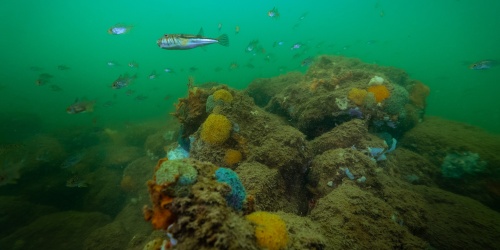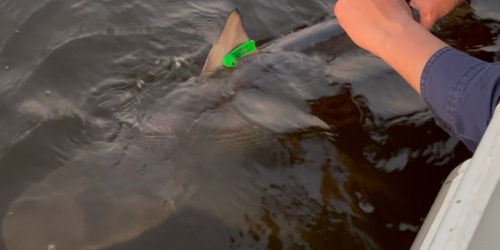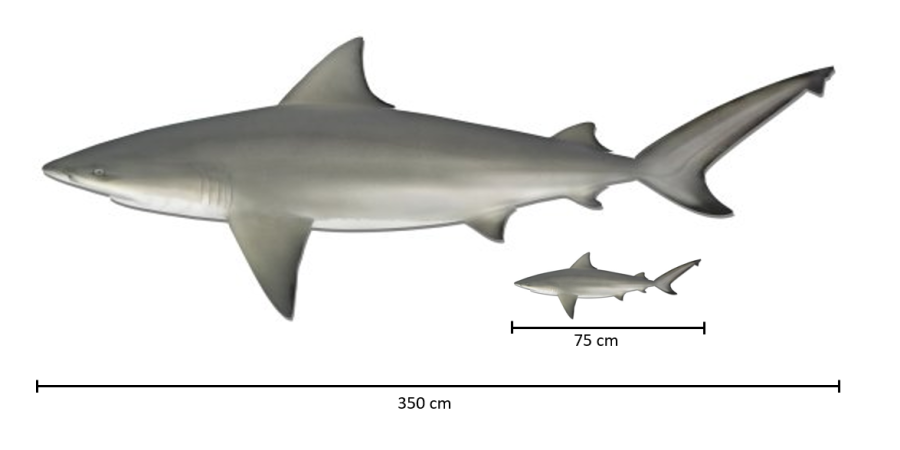
Adult and juvenile bull sharks (Carcharhinus leucas). Image - Adapted from NSW DPI (2026)
What is a Bull Shark?
Bull sharks (Carcharhinus leucas), sometimes referred to as River Whalers or Freshwater Whalers, occur throughout the Swan Canning Riverpark. Unlike most sharks, bull sharks can tolerate estuarine and freshwater conditions and can therefore travel up the river1. These sharks are considered to be aggressive and potentially dangerous, and the public should be aware of this when undertaking water activities in the Swan Canning Riverpark.
All shark sightings should be reported to the Water Police on their 24-hour hotline: (08) 9442 8600.
What do they look like?
Bull sharks can be recognised by their stout body, short blunt snout, small eyes, triangular serrated teeth and lack of fin markings as an adult. This species has a rather large second dorsal fin and no skin ridge between two dorsal fins. It is grey above and pale below, sometimes with a pale stripe on the flank. Bull sharks are born at a length of between 55-80 centimetres and grow up to 3.5 metres2.
Where do they live?
Bull sharks can be found in tropical and warm temperate waters worldwide. In Australia, the bull shark occurs from Collie River in Western Australia, around the northern coastline and down the east coast to Sydney3,4. In the Swan Canning Riverpark they have been caught as far upstream as Whiteman Bridge in Middle Swan and Shelley Bridge in Riverton (J.Watsham, pers. obs. 2025).
They can live in a wide range of habitats including marine coastal areas, estuaries and freshwater rivers. They have been recorded from the surf zone down to a depth of approximately 160 metres5.
Biology
Bull sharks are among the few shark species known to regularly use freshwater, brackish, and marine environments during their life cycle. They cannot complete their entire life cycle in freshwater and rely on rivers and estuaries that are connected to saltwater, using different habitats at different life stages6,7.
In estuarine systems such as the Swan Canning Estuary, habitat use appears to vary with age, season and environmental conditions. Juvenile bull sharks are most commonly found in the upper reaches of the estuary during warmer months, and the lower reaches in the winter (DBCA, unpublished data).
Adult bull sharks are primarily associated with coastal and lower estuary waters but can travel into freshwater areas. Females are thought to enter estuaries and river mouths to give birth to live young in late spring and early summer. How far upstream adult bull sharks travel, and whether they regularly use more brackish environments, is still not well understood and is an active area of research. Bull sharks have a gestation period of approximately 10-11 months, with litters typically ranging from 1-14 young8 that are between 55-85cm in length. Sexual maturity is reached at 9-10 years of age, with adults living between 30-35 years9.
Bull sharks are slow-swimming, robust predators that often move close to the bottom and rely on ambush tactics. Their diet is broad and varied, including fish, other sharks, sea turtles, birds, crustaceans, molluscs, and occasionally marine mammals10,11.
Potential risk to humans
The bull shark, along with the white sharks and tiger sharks, is regarded as a dangerous species because it preys on large animals and commonly lives in habitats close to human activities. Incidents involving bull sharks have occurred in the Swan Canning Estuary and the public should be aware of this when undertaking water activities.
Conservation status
Bull sharks (Carcharhinus leucas) are classified as Vulnerable by the IUCN Red List of Threatened Species9. In some parts of the world the bull shark is a popular gamefish, and is vulnerable to habitat modification, fishing pressure and pollution caused by human activities, and climate change. Bull sharks are not protected in Western Australia with a legal bag limit of 3 fish per day throughout the state, but under WA fishing regulations, whaler sharks (including bull sharks) have a maximum size limit (interdorsal fin length) of 700 mm. Restrictions also apply to gear type as recreational fishers are not permitted to use wire trace within the nearshore waters (within 800m of shore) in the Perth metropolitan area, including the Swan Canning Estuary.
Research and management
Since 2022, DBCA’s Rivers and Estuaries Science Program has been leading research on juvenile (<1.5m) bull sharks in the Swan Canning Estuary, which is recognised as an important nursery area for the species in Western Australia12. This research focuses on understanding how juvenile bull sharks use the estuary during this early and particularly vulnerable stage of their life cycle.
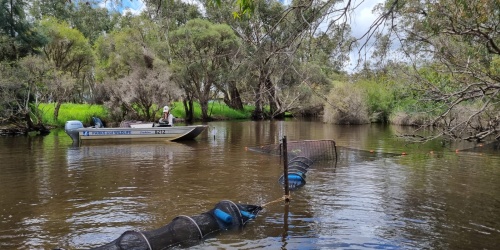
Juvenile sharks are tagged with acoustic tags, and their movements are tracked using a network of 34 data-recording acoustic receivers (“listening stations”) deployed throughout the estuary. These receivers detect tagged sharks as they move through different habitats, allowing researchers to build a detailed picture of movement patterns, habitat preferences, and seasonal changes in behaviour. The information is stored and retrieved annually and is critical for identifying important nursery habitats and understanding how environmental conditions of the estuary influence juvenile bull shark survival and growth.
In 2023, DBCA entered into a collaboration with the Department of Primary Industries and Regional Development (DPIRD) to combine efforts, resources, expertise and data to strengthen bull shark research across Western Australia. As part of this collaboration, DPIRD conducts tagging of sub-adult (<2.5m) and adult (>2.5m) bull sharks along the Western Australian coastline, including the Swan Canning Estuary.
Adult and sub-adult bull sharks tagged by DPIRD are fitted with internal acoustic tags that can trigger near real-time alerts through one of the Shark Monitoring Network receivers. When sharks swim within range of receivers equipped with near real-time technology, detections are published on the SharkSmart WA app and SharkSmart website, providing the public with up-to-date information on recent sub-adult and adult tagged shark detections.
As juvenile bull sharks tagged through DBCA’s Rivers and Estuaries Science Program grow and reach an estimated length of 1.5m, their tags will be added to the Shark Monitoring Network for public detection notifications. This ensures continuity in tracking individuals as they transition from nursery habitats to broader environments and supports public safety initiatives.
The Swan Canning Estuary has been recognised internationally as an important shark and ray area by the International Union for Conservation of Nature, highlighting its significance as a critical habitat for sharks and rays in supporting breeding and nursery functions12.
References
1. (Imaseki et al. 2019)
2. (Hoarau et al. 2021)
3. (Smoothey et al. 2023)
4. (Potter 2000)
5. (Lara-Lizardi et al. 2022)
6.(Smoothey et al. 2019)
7. (Edwards et al. 2022)
8. (Neville et al. 2013)
9. (Rigby et al . 2021)
10. (Daly et al. 2013)
11. (TinHan and Wells 2021)
12. (Jabado RW 2026)
Daly, R., P.W. Froneman, and M.J. Smale. 2013. Comparative feeding ecology of bull sharks (Carcharhinus leucas) in the coastal waters of the southwest Indian Ocean inferred from stable isotope analysis. PLoS One 8: e78229.
Edwards, M.L., M. McCallister, L.R. Brewster, C.W. Bangley, T.H. Curtis, M.B. Ogburn, and M.J. Ajemian. 2022. Multi-year assessment of immature bull shark Carcharhinus leucas residency and activity spaces in an expansive estuarine nursery. Marine Ecology Progress Series 695: 125–138.
Hoarau, F., A. Darnaude, T. Poirout, L.A. Jannel, M. Labonne, and S. Jaquemet. 2021. Age and growth of the bull shark (Carcharhinus leucas) around Reunion Island, South West Indian Ocean. Journal of Fish biology 99: 1087–1099.
Imaseki, I., M. Wakabayashi, Y. Hara, T. Watanabe, S. Takabe, K. Kakumura, Y. Honda, K. Ueda, K. Murakumo, R. Matsumoto, Y. Matsumoto, M. Nakamura, W. Takagi, S. Kuraku, and S. Hyodo. 2019. Comprehensive analysis of genes contributing to euryhalinity in the bull shark, Carcharhinus leucas; Na(+)-Cl(-) co-transporter is one of the key renal factors upregulated in acclimation to low-salinity environment. Journal of Experimental Biology 222.
Jabado RW, G.-R.E., Kyne PM, Rohner CA, Palacios MD, Armstrong AO, Gonzalez-Pestana A, Bettcher Brito V, Charles R, Batlle-Morera A. 2026. Australia and Southeast Indian Ocean: A regional compendium of Important Shark and Ray Areas. Dubai: IUCN SSC Shark Specialist Group.
Lara-Lizardi, F., E.M. Hoyos-Padilla, A.P. Klimley, M. Grau, and J.T. Ketchum. 2022. Movement patterns and residency of bull sharks, Carcharhinus leucas, in a marine protected area of the Gulf of California. Environmental Biology of Fishes 105: 1765–1779.
New South Wales Government. (n.d.). Bull shark fact sheet. SharkSmart NSW. https://www.sharksmart.nsw.gov.au/__data/assets/pdf_file/0008/1447730/Bull-Shark-fact-sheet.pdf
Potter, I.C., Chalmer, P. N., Tiivel, D. J., Steckis, R. A., Platell, M. E., & Lenanton, & R. C. J. 2000. The fish fauna and finfish fishery of the Leschenault Estuary in south-western Australia. Journal of the Royal Society of Western Australia 83.
Smoothey, A.F., K.A. Lee, and V.M. Peddemors. 2019. Long-term patterns of abundance, residency and movements of bull sharks (Carcharhinus leucas) in Sydney Harbour, Australia. Sci Rep 9: 18864.
Smoothey, A.F., Y. Niella, C. Brand, V.M. Peddemors, and P.A. Butcher. 2023. Bull Shark (Carcharhinus leucas) Occurrence along Beaches of South-Eastern Australia: Understanding Where, When and Why. Biology (Basel) 12.
TinHan, T.C., and R.J.D. Wells. 2021. Spatial and Ontogenetic Patterns in the Trophic Ecology of Juvenile Bull Sharks (Carcharhinus leucas) From the Northwest Gulf of Mexico. Frontiers in Marine Science 8