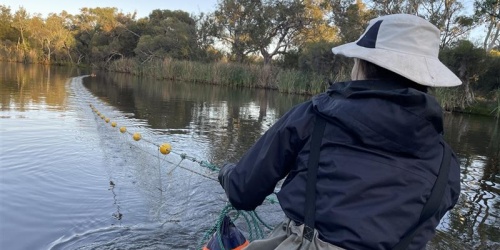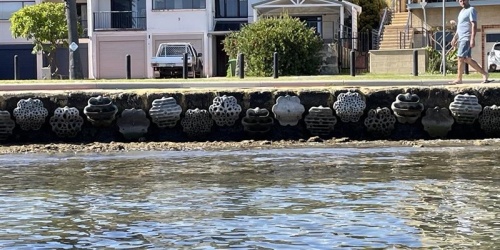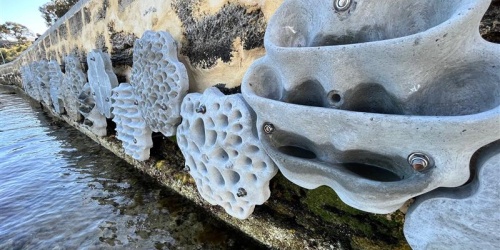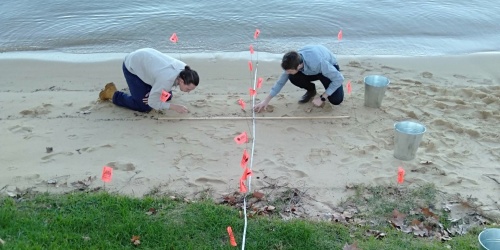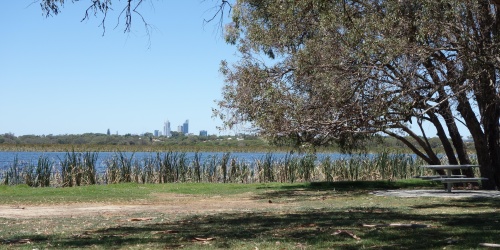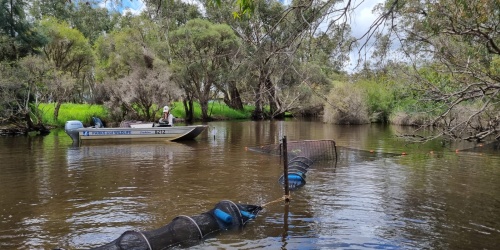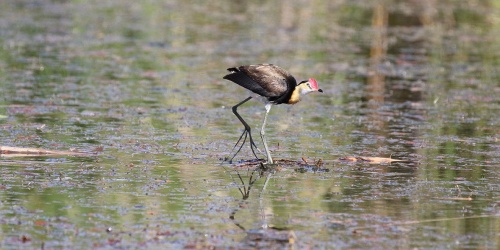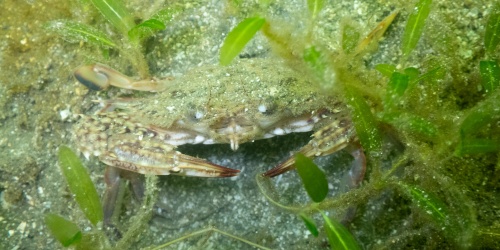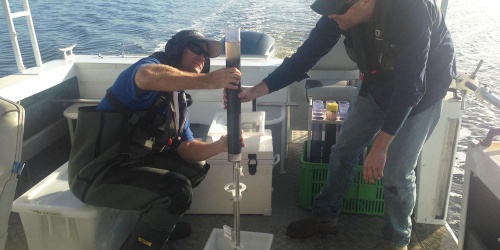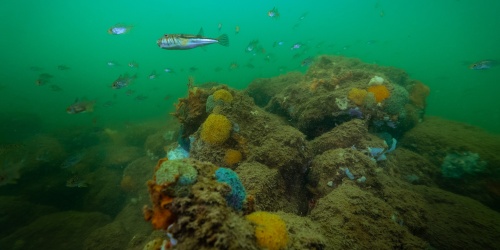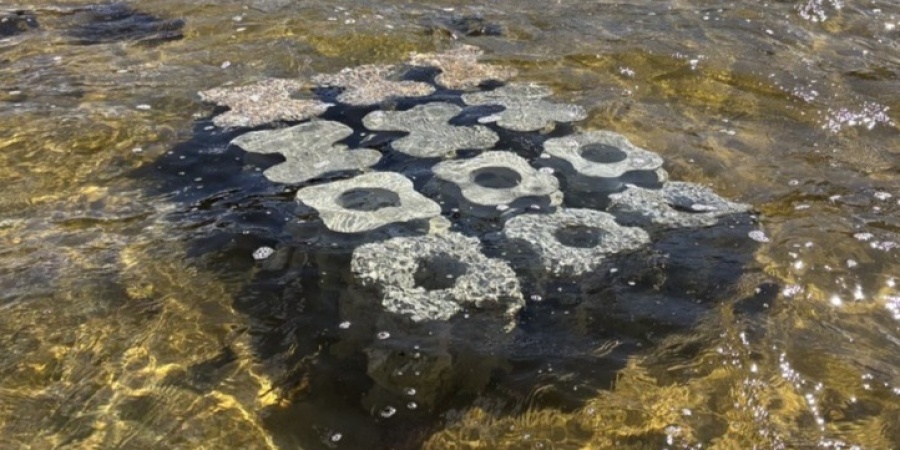
A reef array at Point Dundas, near Applecross foreshore. Photo - Lucy Arrowsmith/DBCA
Program: Rivers and Estuaries Science
Status: Active
About the research project
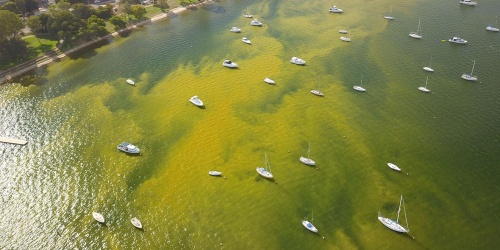
The Swan Canning Estuary supports ecologically important habitats, including seagrass meadows, mudflats and fringing vegetation, that play a critical role in maintaining water quality, stabilising sediments and providing nursery and feeding areas for aquatic species. Many of these habitats are under increasing pressure from climate change and shoreline erosion, contributing to habitat loss.
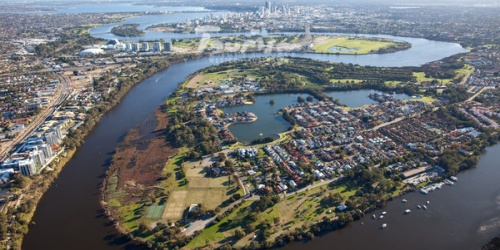
This project, led by The Nature Conservancy (TNC) in partnership with DBCA and the University of Western Australia (UWA), aims to demonstrate how nature-based solutions can remediate threatened foreshores in the lower Swan Estuary. Central to the project is the implementation of nearshore reefs to create living shorelines, reducing the impact of wind and wave energy whilst simultaneously increasing biodiversity.
The project will first trial the application of reef modules designed to mimic natural reef systems and create conditions for benthic habitat species to settle before the installation of a larger, permanent reef system. Designs can incorporate crevices, caves, ridges and overhangs to provide shelter, while materials can be fabricated to include rough substrates for colonising surface species. Additionally, when placed together, they create protection for smaller fishes to avoid predation, rest, feed and breed.
Management outcomes
This project comprises three complementary components that will provide insights into how artificial reef modules improve foreshore stability while enhancing biodiversity. The first component is a pilot study assessing: (1) the effectiveness of different materials and designs in promoting species settlement; and (2) the capacity of these modules to reduce wind and wave energy impacting shorelines. The second component involves modelling and restoration planning to identify habitats most likely to thrive under current and future conditions, establishing a decision-support framework to prioritise foreshore and nearshore habitats for restoration, and the third involves the installation of a 3ha foreshore protection reef.
Progress
The project formally commenced in January 2025 and will continue until April 2028. Thus far, TNC and DBCA have been mapping habitat and developing hydrodynamic modelling tools that will be applied to support restoration decision making.
In addition, significant effort has gone into the planning and progress of pilot reef trials. DBCA installed a 0.9 m x 1.2 m reef array at Point Dundas near the Applecross foreshore as part of the biological pilot study. This trial is comparing different materials and levels of structural complexity to determine which designs are most effective at promoting biodiversity settlement. TNC and UWA have progressed approvals for larger-scale pilot reefs installation at two locations (Attadale foreshore and Point Resolution) planned for May 2026. These will be used to assess wind and boat wave attenuation as well as inshore sediment flux.
Findings from the pilot trials and modelling components, along with community consultations, local government involvement and Whadjuk engagement will be used to inform decision-based management and guide the design and placement of a full-scale artificial reef system within Melville waters, aimed at protecting valuable habitats and stabilising shoreline infrastructure.
Assessments and installation of the full-scale nature-based solution will commence in 2027 following completion of the pilots and modelling phases of the project.
Project team
| Dr Lucy Arrowsmith | Dr Kerry Trayler | Dr Sri Adiyanti |
| Environmental Officer, Rivers and Estuaries Science | Principal Scientist, Rivers and Estuaries Science | Senior Research Scientist, Rivers and Estuaries Science |
Collaborators
The University of Western Australia
Whadjuk Aboriginal Corporation
City Melville
City of Nedlands
The project is funded by the Australian Government’s Urban Rivers and Catchments Program, with the support of The Nature Conservancy, the Department of Biodiversity, Conservation and Attractions and the University of Western Australia.
Contact
Dr Lucy Arrowsmith
Environmental Officer
lucy.arrowsmith@dbca.wa.gov.au
Related projects
SP-2022-29 Evaluation of living seawalls in East Fremantle
EXT-2023-21 Shellfish reef project